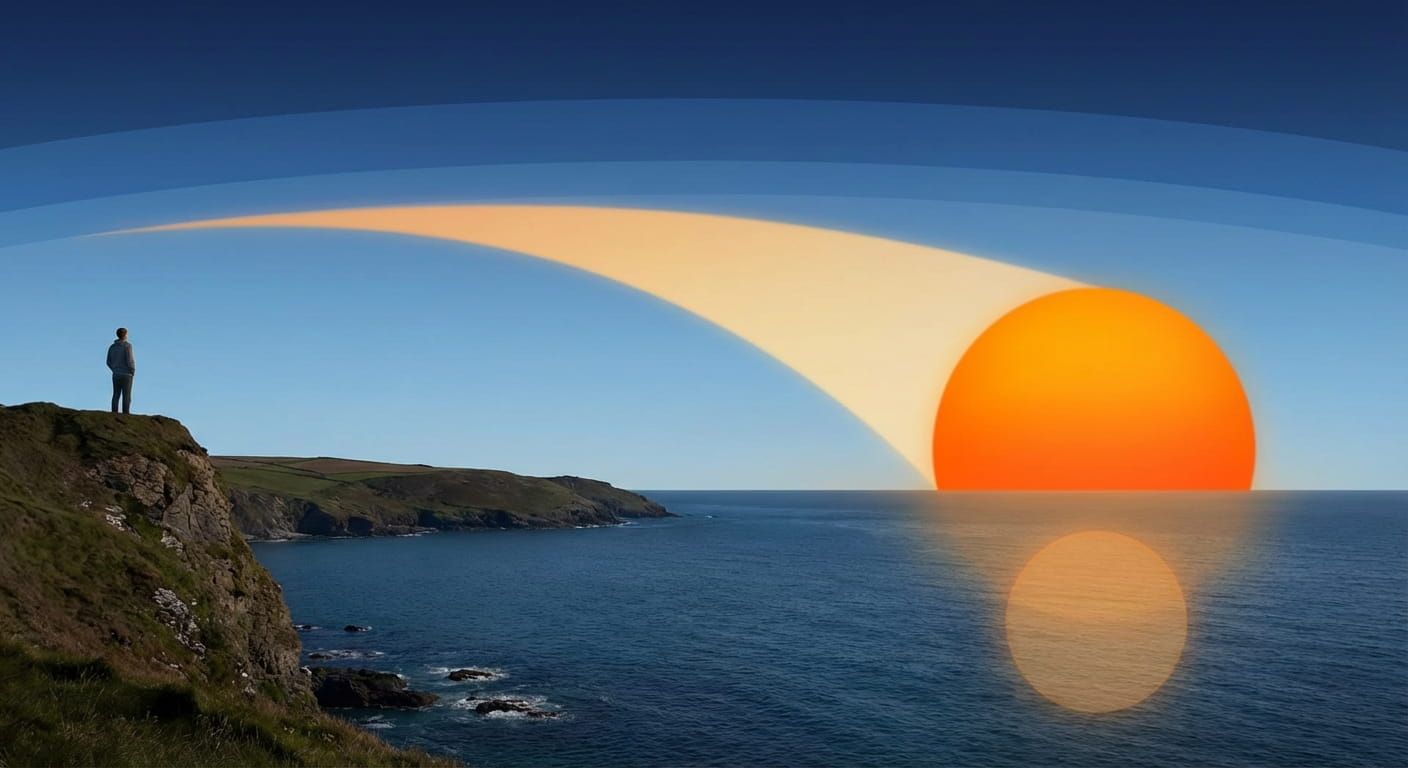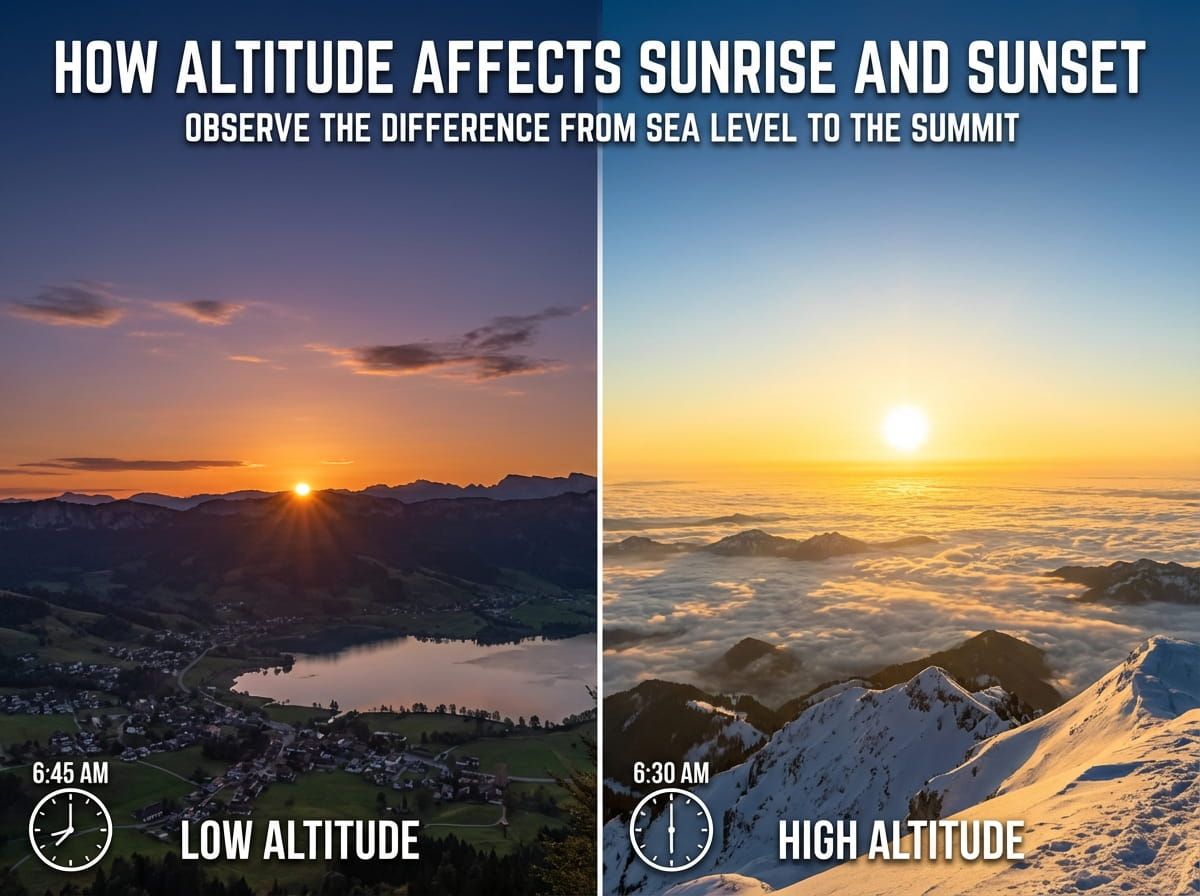
Stand on a beach at sea level and watch the Sun lift itself over the horizon. Then try the same thing from a mountain ridge. The moment feels different, and the clock often agrees. Altitude changes what you can see, when you can see it, and how sunrise and sunset are defined for everyday use.
Key takeaway
Higher altitude usually means you see sunrise earlier and sunset later because your horizon is farther away. The effect is often a few minutes for hills, and can grow to tens of minutes from very high peaks. It also stretches twilight a bit, shifts when golden hour feels strongest, and matters most in places with open horizons, clear air, and high latitudes. Calculators that include elevation and refraction give the best answers.
Mini challenge
Answer this and check your intuition. No tricks, just altitude, horizons, and time.
Which statement is usually true as you go higher?
What altitude changes, and what stays the same
Start with a simple idea. Sunrise and sunset are not just about the Sun, they are also about your horizon. At sea level on a flat shore, your horizon is close compared with what you get from a rooftop, a hill, or a summit. When you rise, the horizon drops away. That lets you see the Sun while it is still below the sea level horizon that a nearby observer would use.
One thing does not change, the Earth still rotates at the same pace. The Sun still follows the same daily path set by your latitude and the season. What changes is the line of sight that decides when the Sun appears or disappears for you.
A quick mental picture without math
Two friends stand in Singapore at the same latitude and longitude. One is on a beach, one is on a tall building. The Sun rises at the same moment in space, yet the rooftop friend can see it first because their horizon is lower.
The horizon effect in plain language
The farther you can see, the earlier you catch the first sliver of Sun and the later you lose the last sliver. This is why pilots can watch a sunrise that people on the runway have not seen yet. It is also why a sunset can linger from a lookout above a valley in Switzerland while the village below is already in dusk.
Altitude does not move the Sun. It moves your horizon, which moves your observed event times.
How big is the time shift?
Most everyday elevation changes are modest. A low hill, a mid rise building, or a coastal cliff might shift sunrise and sunset by seconds to a few minutes. Very high mountains can stretch it further, enough to notice without looking at a clock.
At extreme heights the effect can become dramatic. Think of high routes in Nepal, volcano viewpoints in Chile, or a clear ridge in Iceland with a wide ocean horizon. You can sometimes gain many extra minutes of sunlight compared with sea level.
Refraction, the quiet partner to altitude
The atmosphere bends light. This bending is called refraction. It lifts the apparent position of the Sun a little, which makes sunrise appear earlier and sunset appear later even at sea level. Refraction varies with pressure, temperature, and the vertical structure of the air.
Altitude and refraction often work in the same direction for observed times, but they are not the same thing. Altitude changes geometry, refraction changes the path of the light. On cold clear mornings, the bending can be stronger. On hot turbulent afternoons, it can be messy.
Small detail, big feeling
If your sunrise feels early on a crisp morning in Canada, refraction is part of the story. If you are also on a ridge, altitude adds another nudge.
Why calculators sometimes disagree
Look up sunrise and sunset times and you may notice small differences between sources. That happens because there are choices baked into the definition.
- Which Sun position counts as sunrise, the top edge, the center, or something else
- How much refraction is assumed
- Whether elevation is included, and if so, which elevation, ground level, rooftop, nearby peak, or an average for the area
- Whether the horizon is treated as perfectly flat, which is rarely true in cities and mountains
If you want times for a specific spot, elevation matters. A valley town in Austria can differ from the nearby ridge. A coastal road in Italy can differ from the hill above it. That is why tools that accept a location and elevation tend to match lived experience better.
You can also compare everyday baseline times using sunrise and then think about whether your viewpoint is higher than the surrounding terrain.
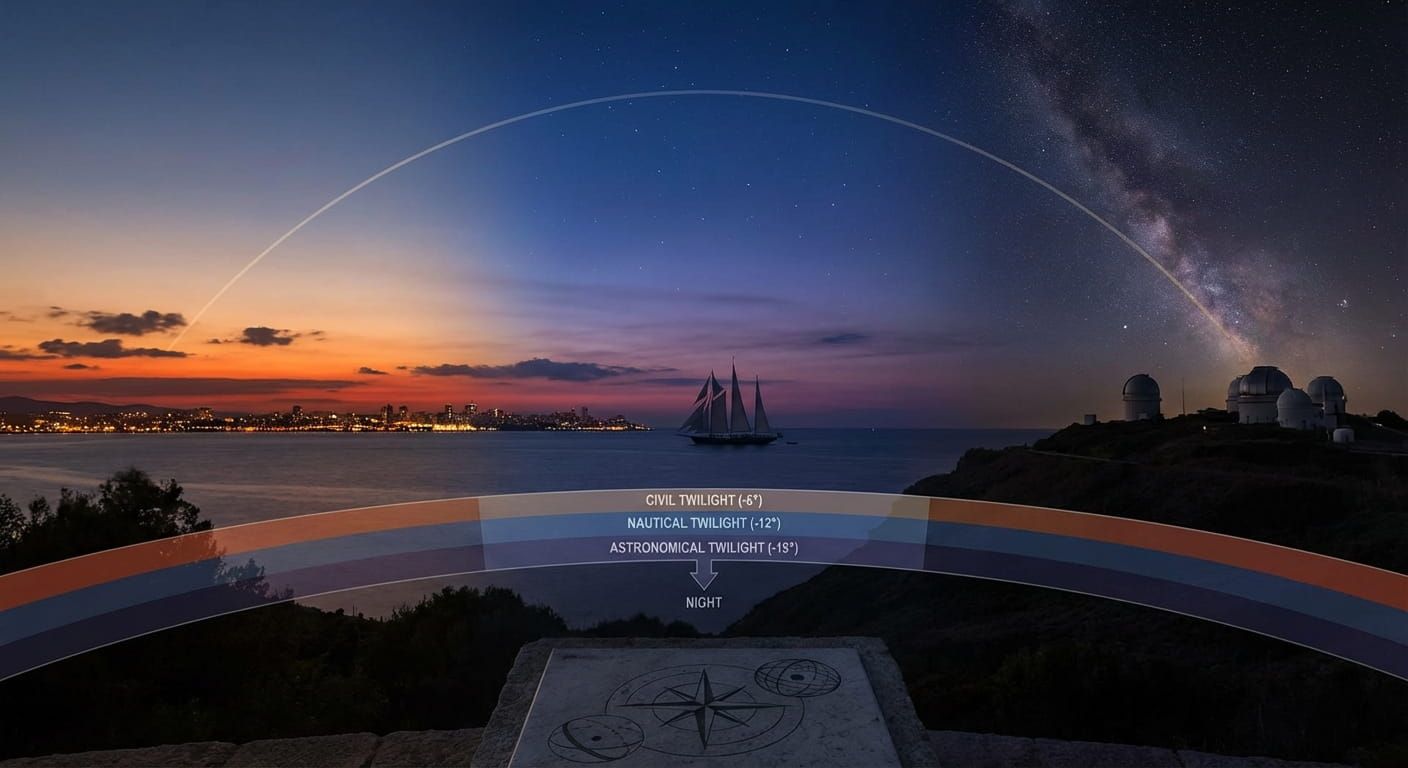
Altitude and twilight, civil, nautical, and astronomical
Twilight is where altitude sneaks in again. Twilight categories are based on how far the Sun is below the horizon, but your effective horizon changes when you are higher. This can subtly shift the start and end of twilight for what you actually see, even if formal definitions use sea level geometry.
If you like precise twilight breakdowns, it helps to know the category names and what they mean, especially if you plan hikes or photography sessions. A deeper explanation lives inside civil nautical astronomical twilight guide, which pairs well with altitude questions because it explains why sky brightness changes in stages.
How it feels in real places
In Singapore, elevation is low and the effect is subtle, yet high floors can still change the instant you spot the Sun between buildings. In Nepal, where valleys and ridges are dramatic, the time difference between a lodge in a valley and a pass above can feel like a different schedule. In Norway, where the Sun can skim the horizon in some seasons, even small changes in horizon geometry can affect whether you get a clean sunrise at all.
Golden hour and blue hour at higher viewpoints
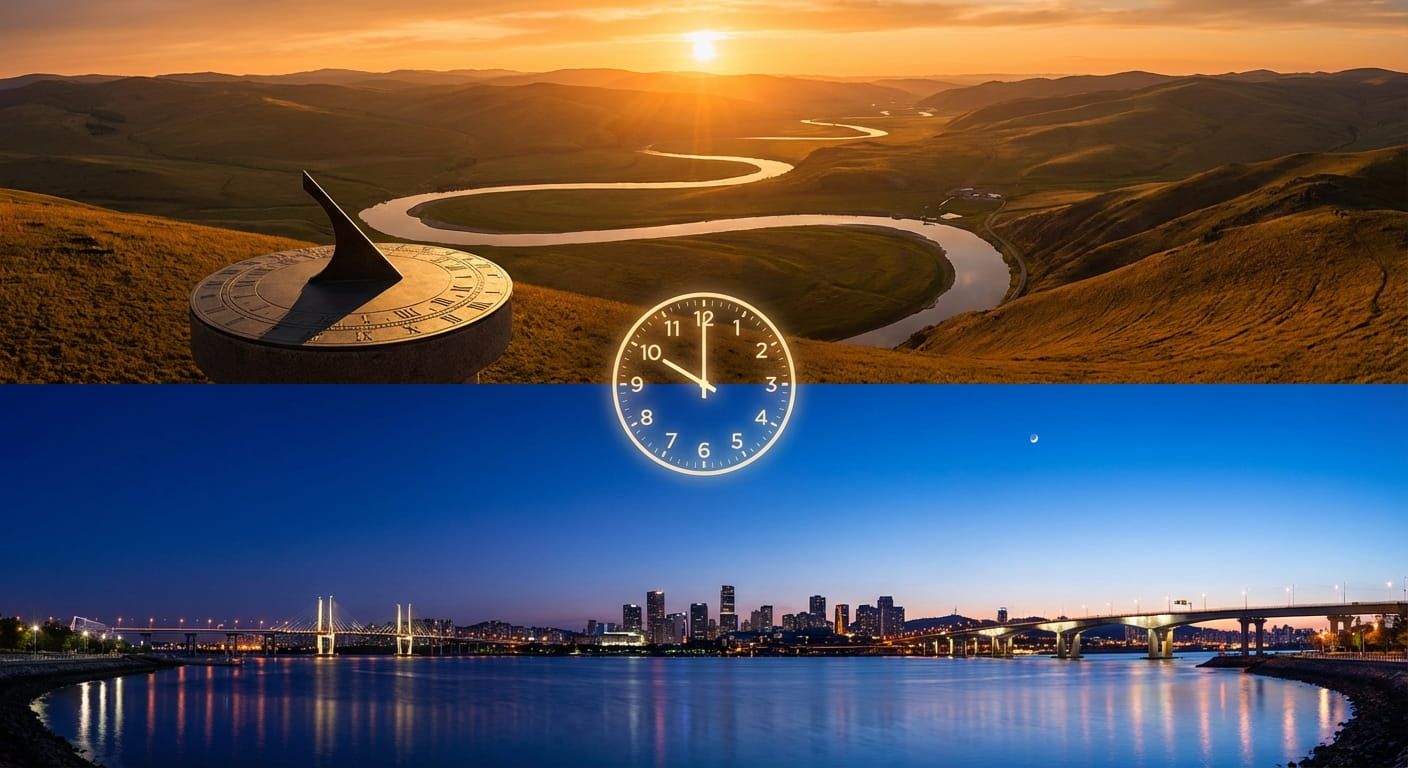
Golden hour and blue hour are more about light quality than clock time. Still, altitude influences them in three practical ways.
- Longer sightlines, a higher viewpoint often stays in direct sunlight a bit longer, while lower areas fall into shadow sooner.
- Cleaner air above haze, sometimes you rise above a pollution layer or coastal mist, making color cleaner and contrast higher.
- Different shadow geometry, mountains create early shade on one side and delayed shade on the other, which can split a city into bright and dim zones.
If you plan photography, it helps to know the typical windows for your date and location, then add the terrain factor. A timing overview with examples sits in golden hour blue hour timing.
Altitude shifts
This table gives a friendly sense of scale. Exact results depend on latitude, refraction, and terrain, but these ranges help you build intuition. Colors are muted for clarity and comfort.
Terrain can beat altitude
Here is a twist that surprises people. A higher place does not always get earlier sunrise if a mountain blocks the eastern sky. A valley can be lower yet have an open horizon, while a higher slope can face a wall of rock.
This is why two nearby points in Japan or Italy can report very different first light. It is not only height. It is the shape of the landscape around you.
Three common terrain scenarios
- Open ocean horizon, altitude helps most, because the horizon is clean and far.
- Mountain wall, altitude helps less, because the Sun must clear the ridge before you see it.
- Urban canyon, altitude helps in a different way, it lifts you above buildings, but local shadows still matter.
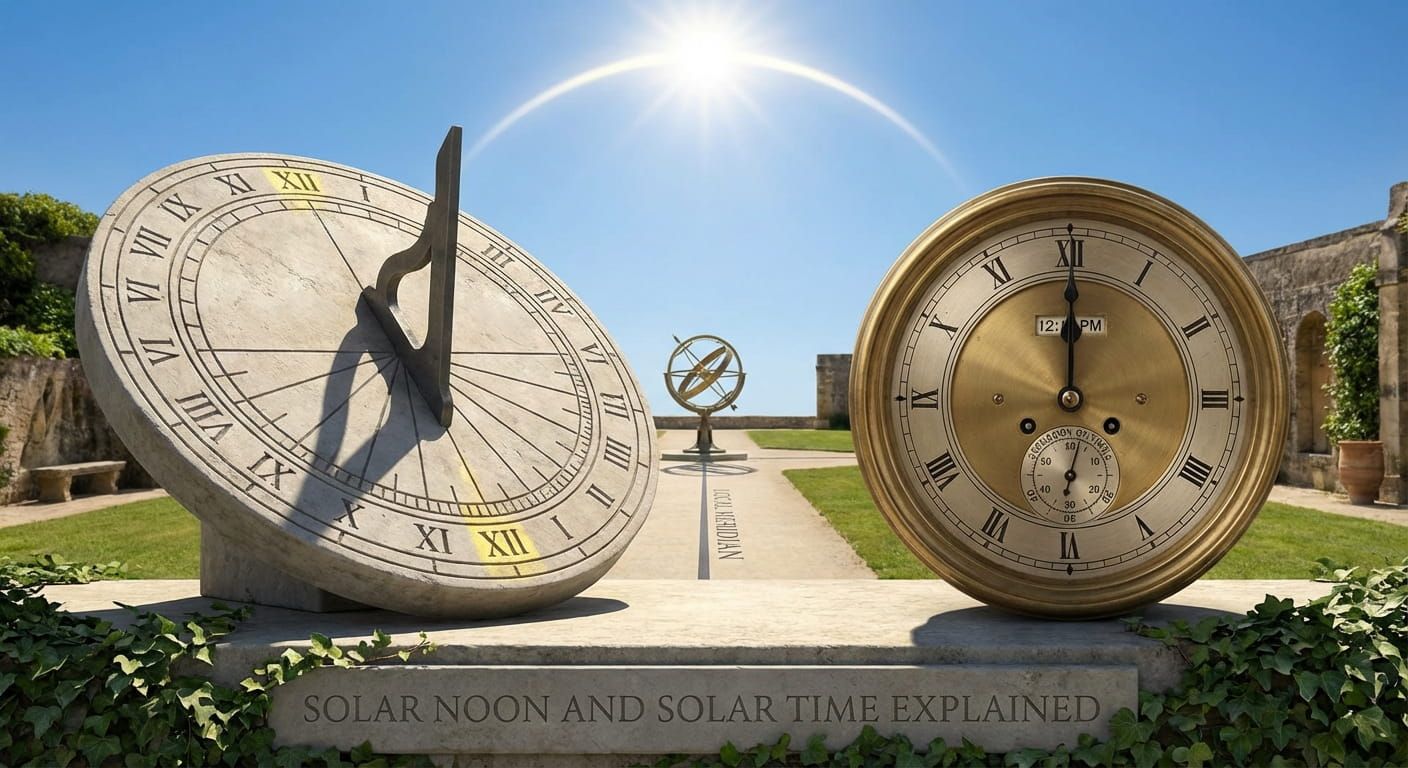
Solar time, solar noon, and why altitude can confuse the story
People often mix up solar time with clock time. Solar noon is when the Sun is highest in the sky for your location. Altitude does not move solar noon much, because solar noon is tied to the Sun position relative to your meridian. What altitude changes is visibility near the horizon, not the moment the Sun reaches its daily peak.
If you want to connect sunrise and sunset with the rest of the daily solar rhythm, reading solar noon solar time helps, especially if you are comparing places like Cairo, London, and Dubai where time zones and longitude offsets shape the clock.
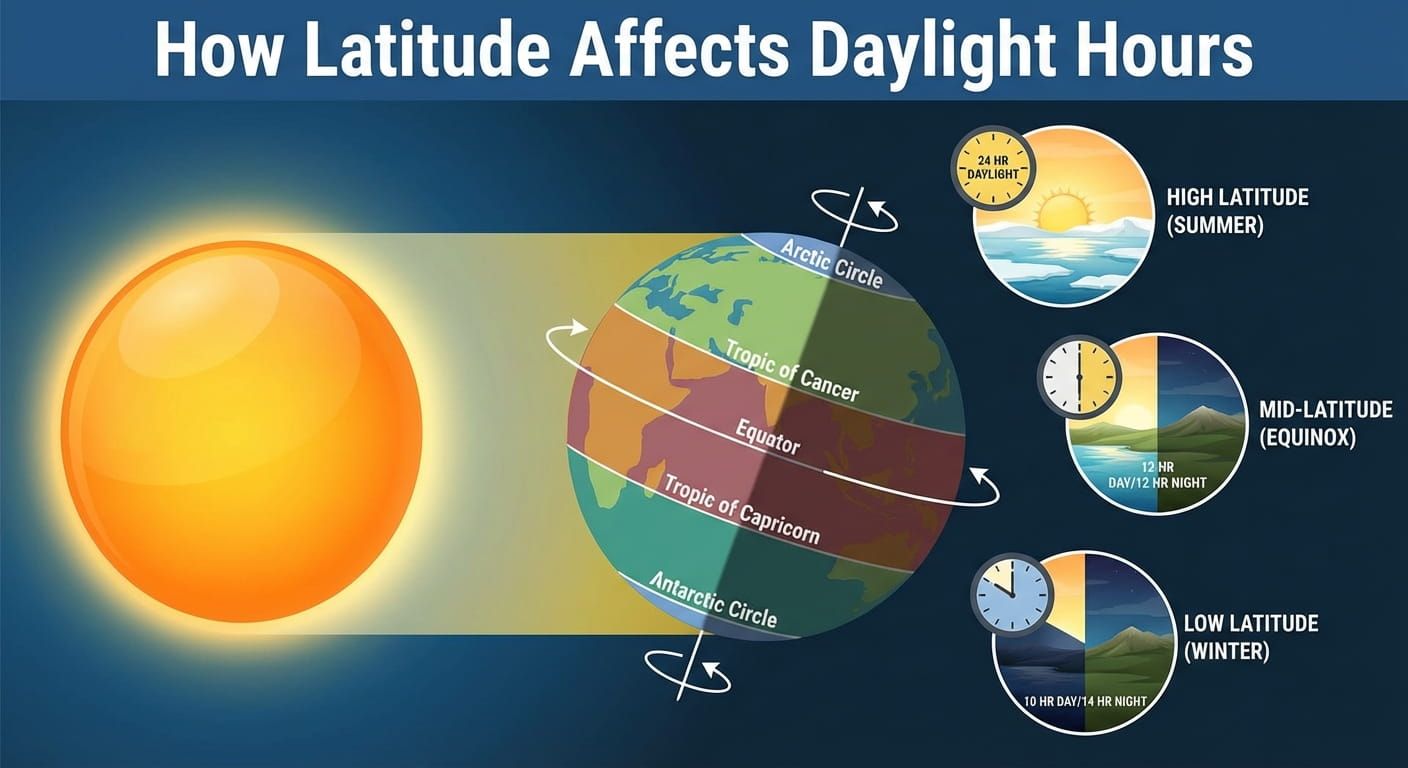
Latitude makes altitude effects feel bigger or smaller
Latitude sets how sharply the Sun rises and sets. Near the equator, the Sun crosses the horizon more steeply. That means a small horizon change can translate into a smaller time difference. Farther from the equator, the Sun can slide along the horizon at a shallow angle in some seasons. Then a horizon change can stretch the time difference.
That is why altitude can feel more dramatic in parts of Norway, Sweden, Finland, and Iceland during certain months than it does in Singapore or Indonesia.
If you are comparing day length across the map, this companion piece fits naturally into the same train of thought, latitude daylight hours.
Where altitude plays a role in extreme daylight patterns
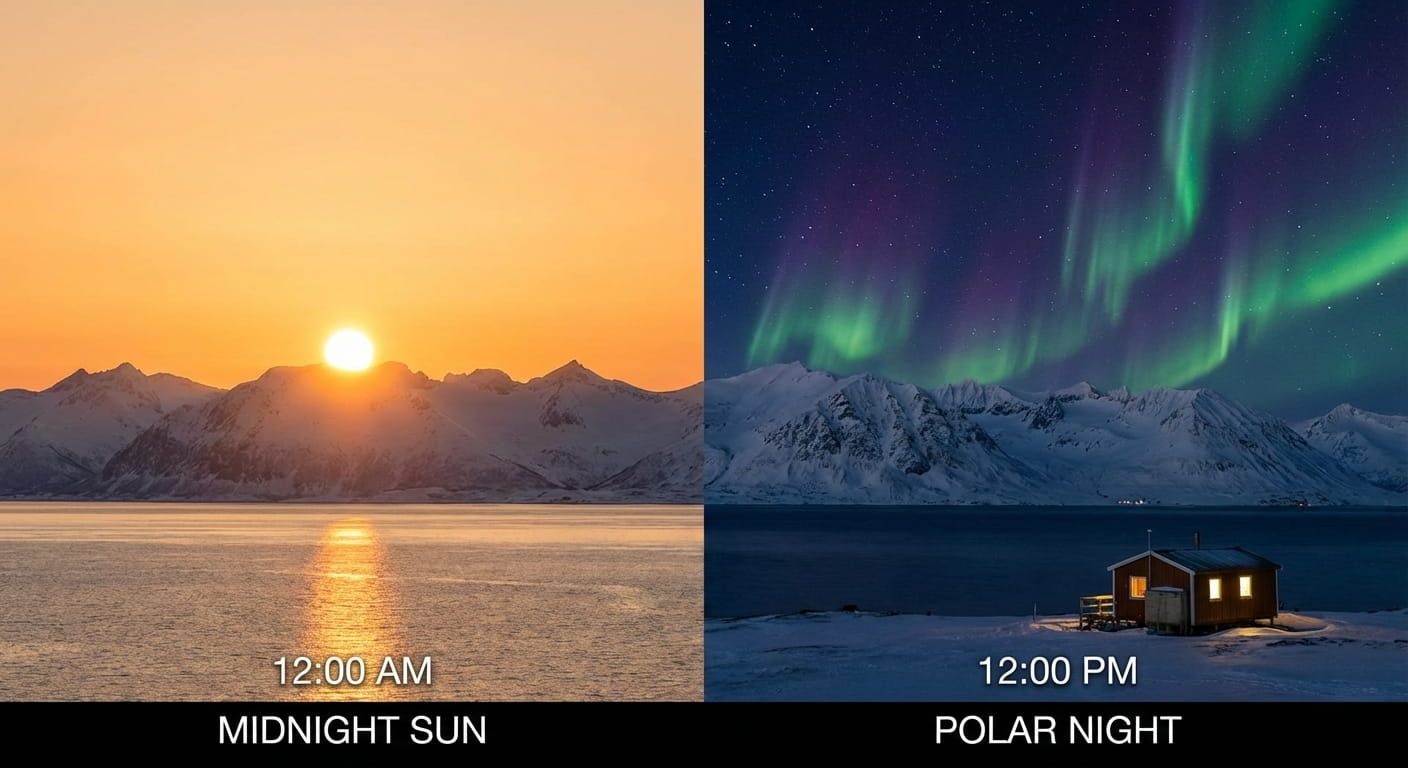
In high latitude regions, sunrise and sunset can become strange, not because the Sun behaves oddly, but because your local horizon and the season push the Sun into edge cases. In summer, the Sun may not set. In winter, it may not rise.
Altitude can shift whether you get a brief appearance of the Sun near the horizon in shoulder seasons. It can also change how long the Sun stays just above or just below your local horizon.
If you are reading about places like northern Norway or far northern Russia, the story connects well with midnight sun polar night.
Practical tips for travelers, hikers, and photographers
Altitude is only one variable, but it is a useful one when planning a day.
- Check sunrise and sunset for your area, then consider whether your viewpoint is far above the listed elevation.
- If you camp in a valley in Nepal, expect the ridge line to delay your first direct sunlight, even if the sky brightens earlier.
- If you watch the horizon from a high coastal road in Portugal, expect a slightly earlier sunrise than friends at the beach.
- In cities like Hong Kong or New York City, building shadows can dominate. A higher floor can restore the horizon, yet nearby towers still matter.
- In cold climates like Canada or Sweden, refraction can change day to day. Treat minute level precision as weather dependent.
A simple checklist to get accurate times
- Use the exact coordinates of your viewpoint if you can.
- Include elevation if the tool supports it.
- Note whether your horizon is blocked by terrain or buildings.
- For twilight planning, consider both the formal category and what your local horizon allows you to see.
- When you compare cities, keep latitude and season in mind, a July evening in Stockholm behaves very differently from a July evening in Singapore.
Quote to keep in mind
Altitude changes when you see the Sun, terrain changes whether you see it at all.
Light, elevation, and the final minutes you can actually feel
Altitude can gift you extra minutes of Sun, yet the real payoff is often emotional rather than numerical. A longer sunset from a high point in Switzerland feels calmer. A sudden sunrise after a ridge line in Nepal feels earned. A clear first light over the sea near Greece feels clean and sharp.
If you remember one thing, let it be this, sunrise and sunset times are a meeting between astronomy and your local horizon. Raise the horizon with terrain, and you wait. Lower it with altitude, and the day opens a little earlier and lingers a little longer.