You line up the perfect sunset shot, the clock hits the listed time, and the Sun is still hanging on the horizon. Or it slips away a little earlier than you expected. That tiny gap between the schedule and what your eyes see is often atmospheric refraction at work, bending sunlight and stretching the day by a few extra minutes.
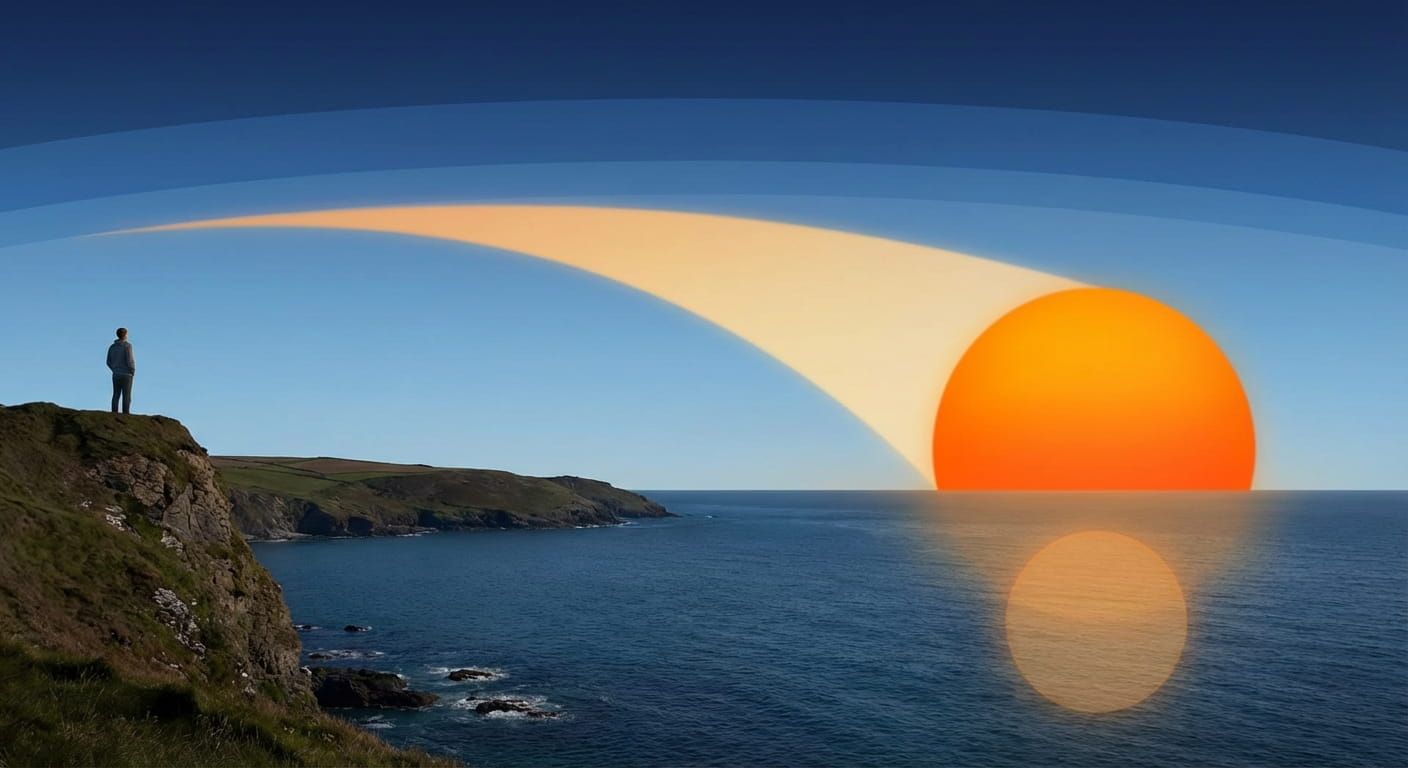
Atmospheric refraction bends light downward as it passes through denser air near the surface. Near the horizon, this effect is strongest, making the Sun appear higher than it really is. That is why sunrise looks earlier and sunset looks later than pure geometry predicts. The size of the shift changes with air pressure, temperature, your elevation, and the exact definition of sunset used by calculators.
Quiz to test your sunset intuition
Question: Which statement is most accurate for most locations near sea level?
What atmospheric refraction really is
Refraction is the bending of light as it moves through air layers with different density. Air density changes with temperature, pressure, and humidity. Near the ground, the air is often denser than the air above it. That density gradient acts like a gentle optical curve, nudging incoming sunlight downward as it travels toward you.
Your brain traces that bent light backward in a straight line. The result, the Sun looks slightly higher in the sky than its true geometric position. At midday the effect is small. At the horizon it becomes the main character. That is the key reason sunset times and what you see can disagree by a minute or two, sometimes more in unusual weather.
Quick picture in your head: the Sun can be physically below the horizon while you still see its upper edge. Refraction is one reason. The other big reason is the way “sunset” is defined in calculations.
Why sunset is not a single simple moment
Many people assume sunset means “the instant the Sun touches the horizon.” Most published times do not use that. A common definition is the moment the Sun’s upper edge disappears below a flat horizon, while also accounting for refraction and the Sun’s apparent radius. That detail matters because your eye sees the Sun as a disk, not a dot.
On Time.you, the easiest way to compare is to look up your location’s official values and then watch what happens from your actual viewpoint. You can check your local values on the sunset page, then compare what you see from a beach, a balcony, or a hilltop.
How much refraction shifts the Sun near the horizon
Near the horizon, standard refraction is often around 34 arcminutes, a bit more than half a degree. The Sun’s apparent radius is about 16 arcminutes. Put those together and you get a practical result: when you see the last sliver of the Sun vanish, the Sun’s center is already well below the horizon. That is why “geometric sunset” and “observed sunset” are not identical.
The time difference depends on your latitude and the angle the Sun takes as it cuts the horizon. In Singapore, the Sun drops fairly steeply, so the extra time is usually modest. In London, the Sun’s path can be shallower at certain times of year, so a similar vertical shift can translate into a bigger time shift. In Reykjavik, season can stretch the geometry even more.
Refraction is weather sensitive, and that is where surprises come from
Refraction is not a constant. It responds to the atmosphere you actually have, not the average one. Higher pressure generally increases refraction. Colder air near the surface can also increase it. Temperature inversions, common near coasts and sometimes after a clear day, can bend light more than expected.
That is when you get the strange feeling that sunset is “late” even though the clock says it should be gone. It can also produce mirage like distortions, flattened Suns, or a brief green flash at the top edge in the right conditions. Those visual effects are fun to spot, but the clock shift is what most people notice first.
Elevation changes the game more than people expect
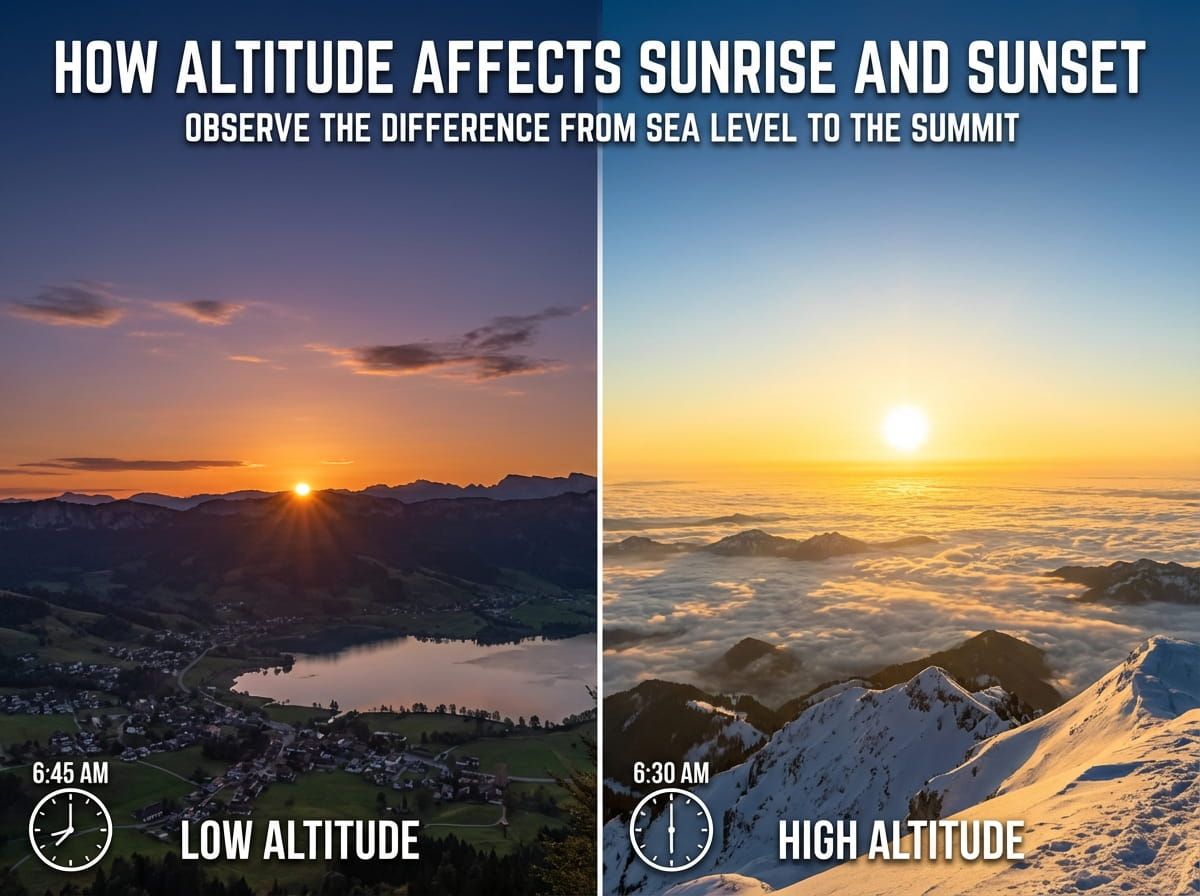
Stand higher and your horizon drops. That alone delays sunset because you can see farther around Earth’s curve. Refraction still matters, but now geometry adds extra minutes.
A rooftop in Dubai, a hill outside Cape Town, or a viewpoint above Los Angeles can all add time compared with the sea level schedule. The effect gets larger the higher you go, then slows down. It is very noticeable between street level and a tall building, and still noticeable from a mountain.
If you want the practical details on how altitude affects sunrise and sunset schedules, the write up on altitude and sunrise and sunset fits perfectly with this topic.
What shifts sunset
The numbers below are typical ranges. Real conditions vary by weather, season, and how clean your horizon is. The goal is to show what pushes sunset later or earlier relative to a standard schedule.
| Factor | What changes | Typical direction | Common size |
|---|---|---|---|
| Refraction near horizon | Sun appears higher than geometric position | Later sunset | About 1 to 3 minutes in many mid latitudes |
| Air pressure higher than average | Denser air bends light more | Usually later sunset | Seconds to about a minute, sometimes more |
| Cold surface layer or inversion | Steeper density gradient near ground | Can delay sunset and distort the disk | Often subtle, can be noticeable on some evenings |
| Observer elevation | Horizon drops below 0 degrees | Later sunset | Roughly minutes for hills and towers, more for mountains |
| Local horizon not flat | Buildings, mountains, haze, ocean swell | Earlier if blocked, later if you can see farther | From seconds to many minutes |
What you should check before blaming the calculator
If your sunset does not match the listed time, you do not need a physics lab to narrow it down. A few simple checks get you most of the way.
- Confirm the location and time zone. A nearby city can shift the answer by minutes. A wrong time zone can shift it by hours. Time.you is built around precise timekeeping across time zones, so make sure the location match is exact.
- Think about your horizon. Are you facing a flat ocean horizon, or a skyline, or hills? In Tokyo a dense skyline can hide the last edge early. In Sydney a clear sea horizon can let you see the full effect.
- Note your elevation. A balcony in Hong Kong and a street corner in the same district can disagree. A hill in San Francisco can add noticeable time compared with the waterfront.
- Look at the weather pattern. Clear calm evenings can create strong near surface layers. Stormy mixed air often reduces the weirdness.
- Know what “sunset” means in the listing. Many schedules are based on the Sun’s upper edge, with standard refraction built in. That is different from the Sun’s center crossing the horizon.
Simple ways to spot refraction with your own eyes
Refraction is invisible, but its fingerprints are easy to notice when you know where to look. Here are a few signs that your atmosphere is bending light more than usual.
- A flattened Sun near the horizon. The disk looks squashed vertically.
- A shimmering lower edge. The base of the Sun flickers as air layers shift.
- A delayed disappearance. The last rim hangs on longer than you expect.
- A stretched afterglow. Twilight colors linger, especially with thin haze.
- A clean sea horizon gives cleaner clues. A beach in Singapore or a coast near Barcelona is a great place to compare day to day.
Twilight, and why refraction still matters after the Sun sets
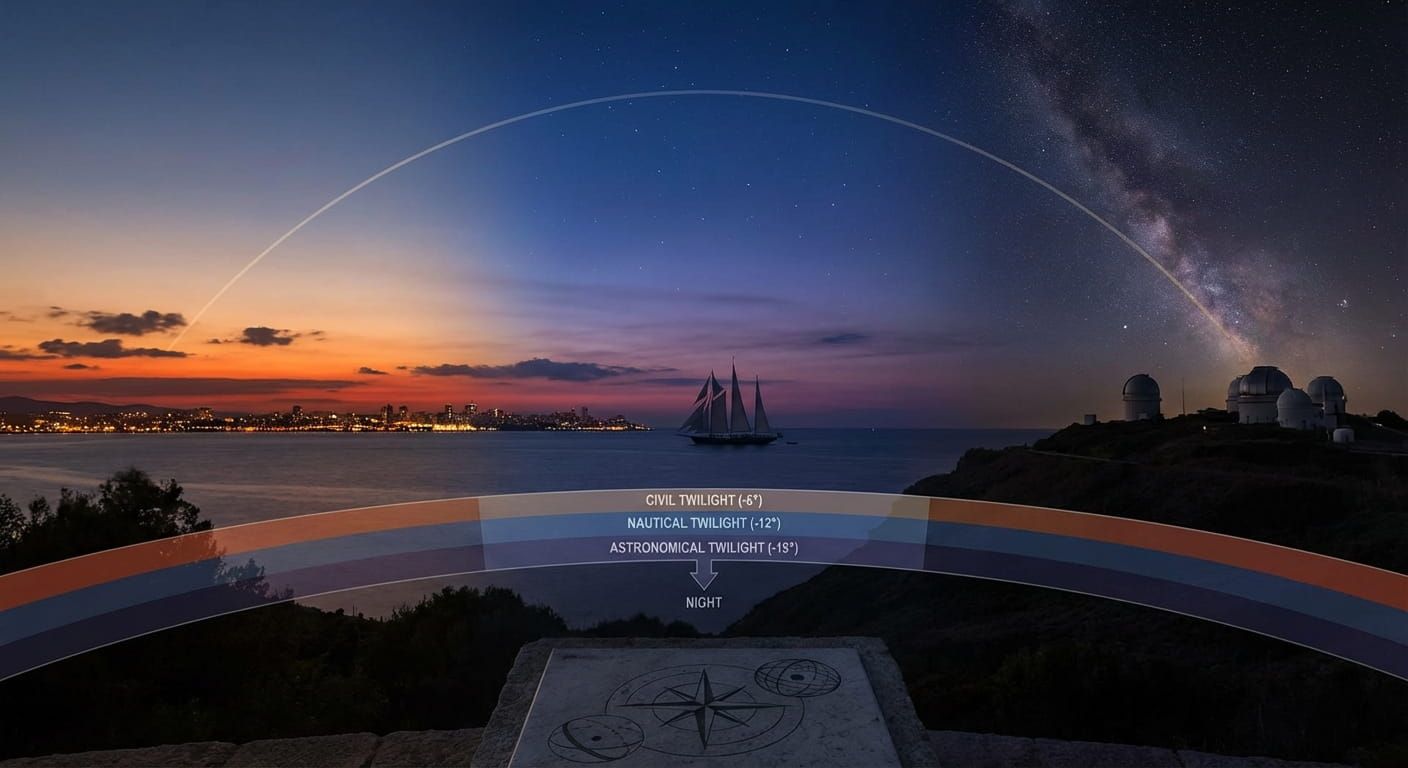
Even after the Sun is below the horizon, its light still passes through the atmosphere above you. Refraction shapes where that light goes, while scattering paints the sky. That is why twilight is not just a timer, it is geometry plus air plus dust plus moisture.
If you track civil, nautical, and astronomical phases, you will notice the boundary between them feels smoother on some evenings and sharper on others. Refraction is one piece of that. If you want a deeper breakdown of the twilight phases, the overview of civil, nautical, and astronomical twilight gives useful context for what happens around sunset.
Latitude and season, why London differs from Singapore
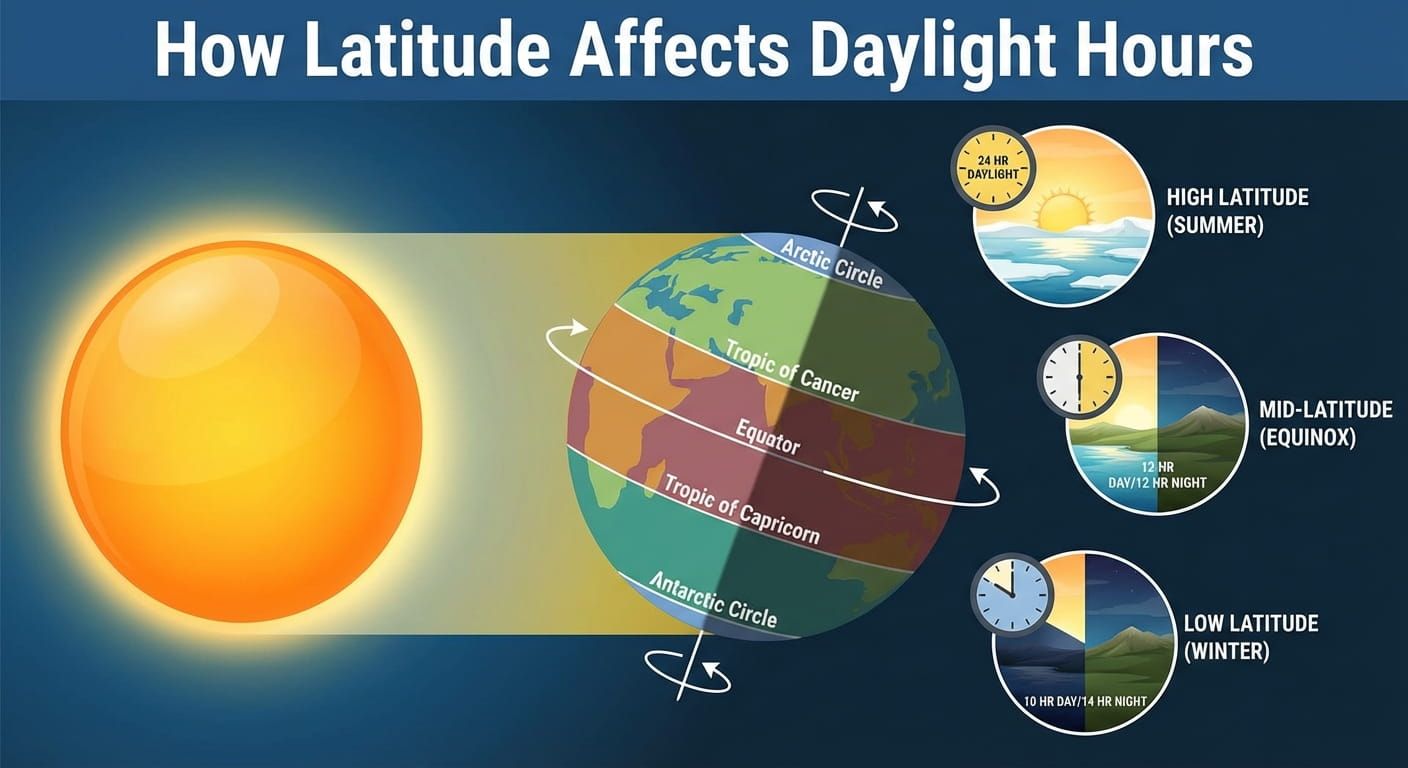
Latitude controls how the Sun meets the horizon. Near the equator, places like Singapore see the Sun rise and set at a steeper angle most of the year. That makes the transition feel brisk. A small vertical shift from refraction becomes a smaller time shift.
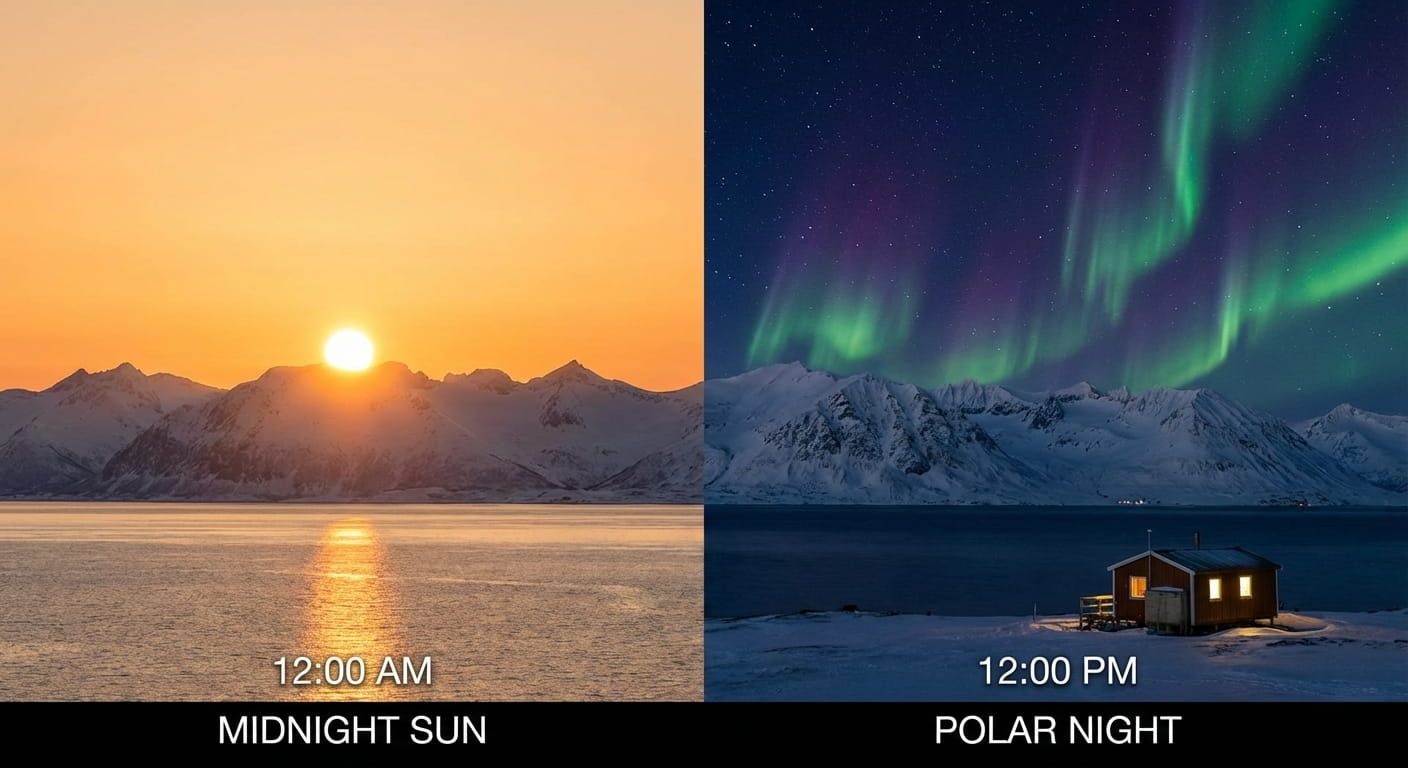
In London, Paris, Berlin, and Amsterdam, the Sun’s path can be more slanted across the horizon in parts of the year. The same vertical bending can stretch the clock difference. In Stockholm and Helsinki, the seasonal effect is stronger. In Reykjavik, it can feel dramatic, especially near summer.
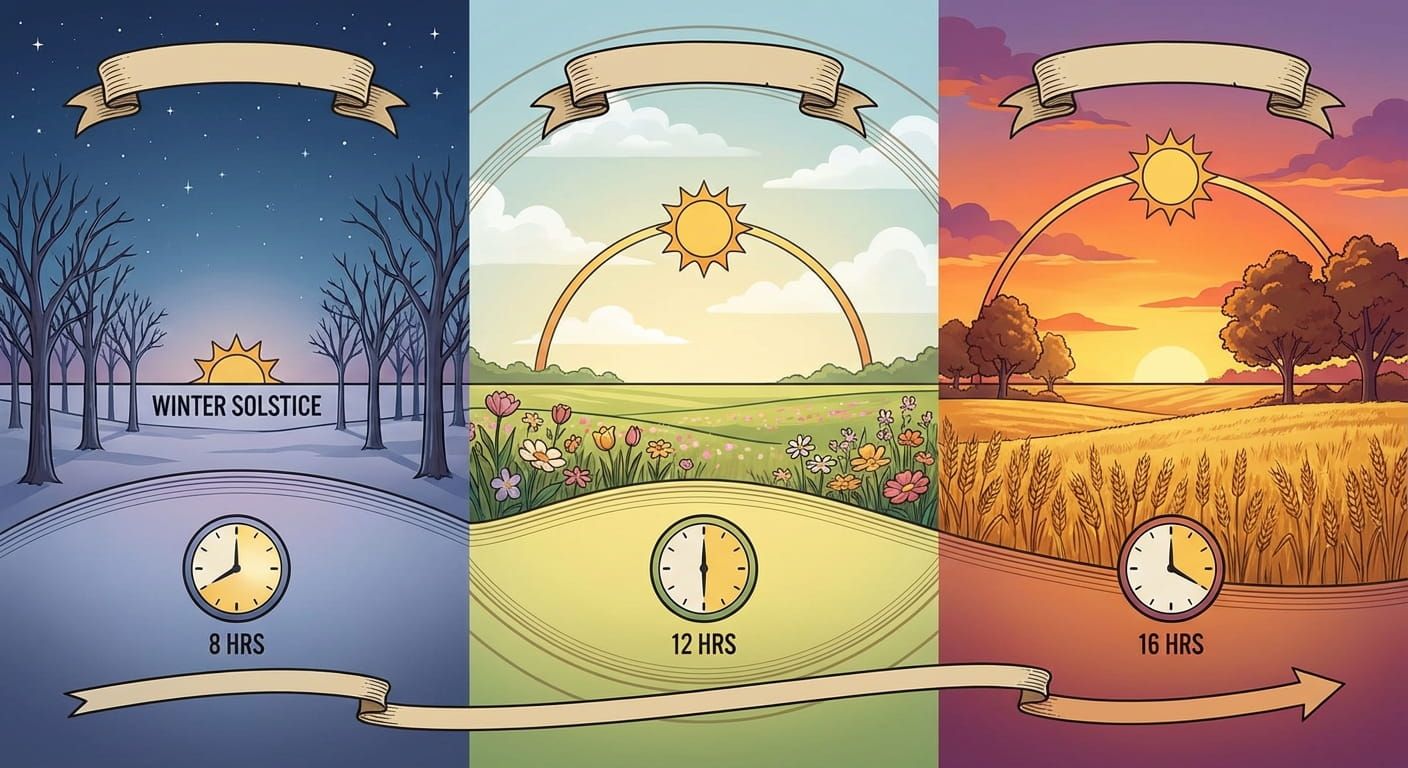
Seasonal daylight patterns also shape the emotional experience of sunset. If you like comparing how day length stretches and shrinks across the year, you can fold that into your sunset tracking using seasonal day length.
Golden hour timing and why the last minutes feel special
Many photographers care less about the exact second of sunset and more about the light just before it. Refraction nudges the Sun’s apparent position, which can shift when the warm low angle light hits your street, your balcony, or your favorite park.
Air clarity matters, too. In Cairo, Dubai, and Delhi, dust and haze can tint the light. In Vancouver or Zurich, clear air can make the edge look crisp. If you plan shoots around those soft minutes, pairing sunset timing with the lighting window on golden hour and blue hour timing makes planning easier.
Common misconceptions that keep popping up
A few myths show up in group chats every time someone posts a horizon photo. Clearing them up makes sunset timing much less confusing.
- Myth: Refraction is the same every day. Reality: It responds to real air conditions.
- Myth: Your phone camera proves the listed time is wrong. Reality: Your viewpoint and horizon shape the moment you call sunset.
- Myth: Only humidity drives it. Reality: Pressure and temperature structure are often bigger drivers.
- Myth: High altitude always means clearer and simpler. Reality: Your horizon changes, and refraction still plays a part.
A tiny experiment you can do in one week
Choose one spot with a clean horizon, a beach, a flat field, or a waterfront. Then observe at sunset for seven evenings. Note the listed time, the moment the last edge disappears, and the weather feel.
Try this in two very different places if you can. Singapore versus London is a classic contrast. Bangkok versus Tokyo is another. Or compare a low viewpoint and a high viewpoint within the same city, a street level park and a rooftop. You will feel the difference, even if you never calculate a single arcminute.
Note: If you log pressure and temperature from a local weather app, you will often see that the “odd” sunsets cluster around stable, high pressure evenings. That is a hint that refraction conditions were stronger than average.
Solar time connects the dots between clocks and the Sun
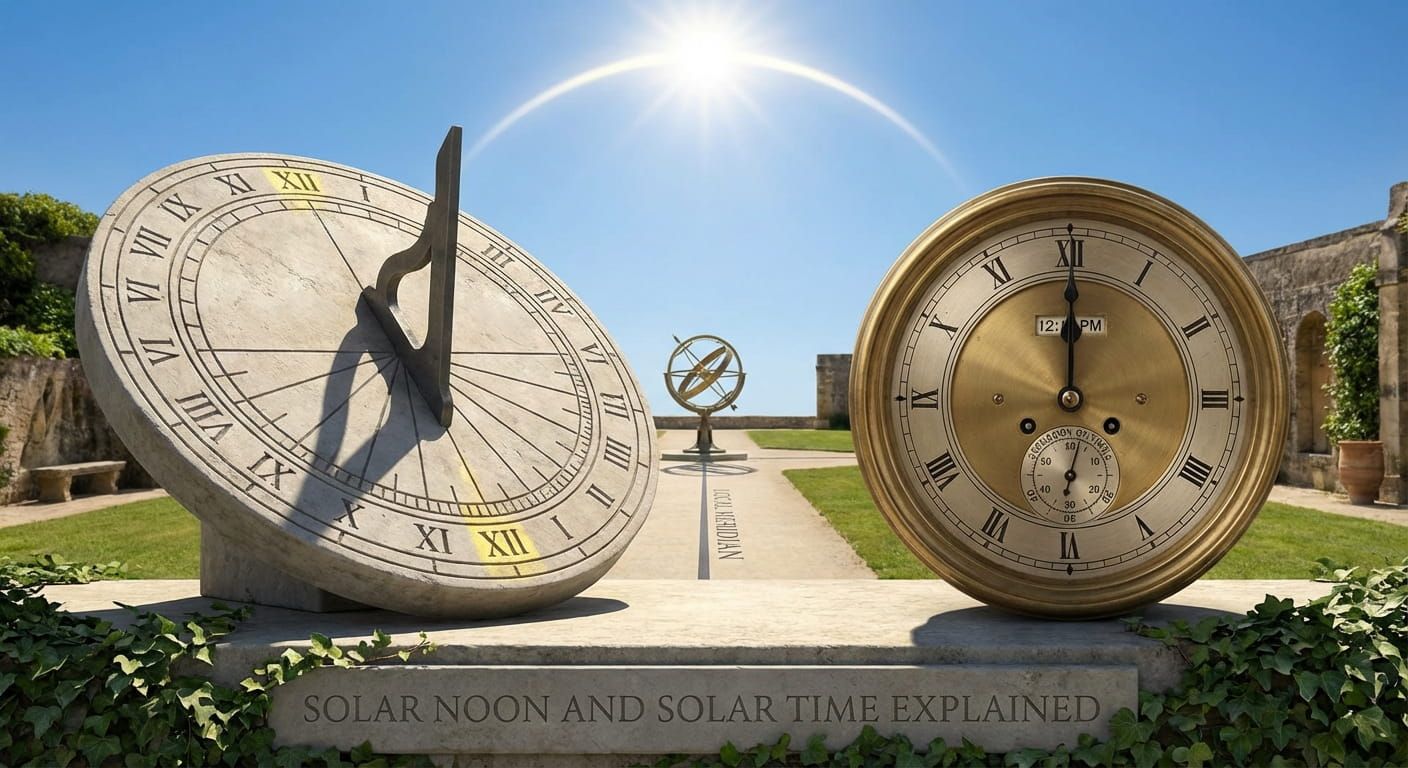
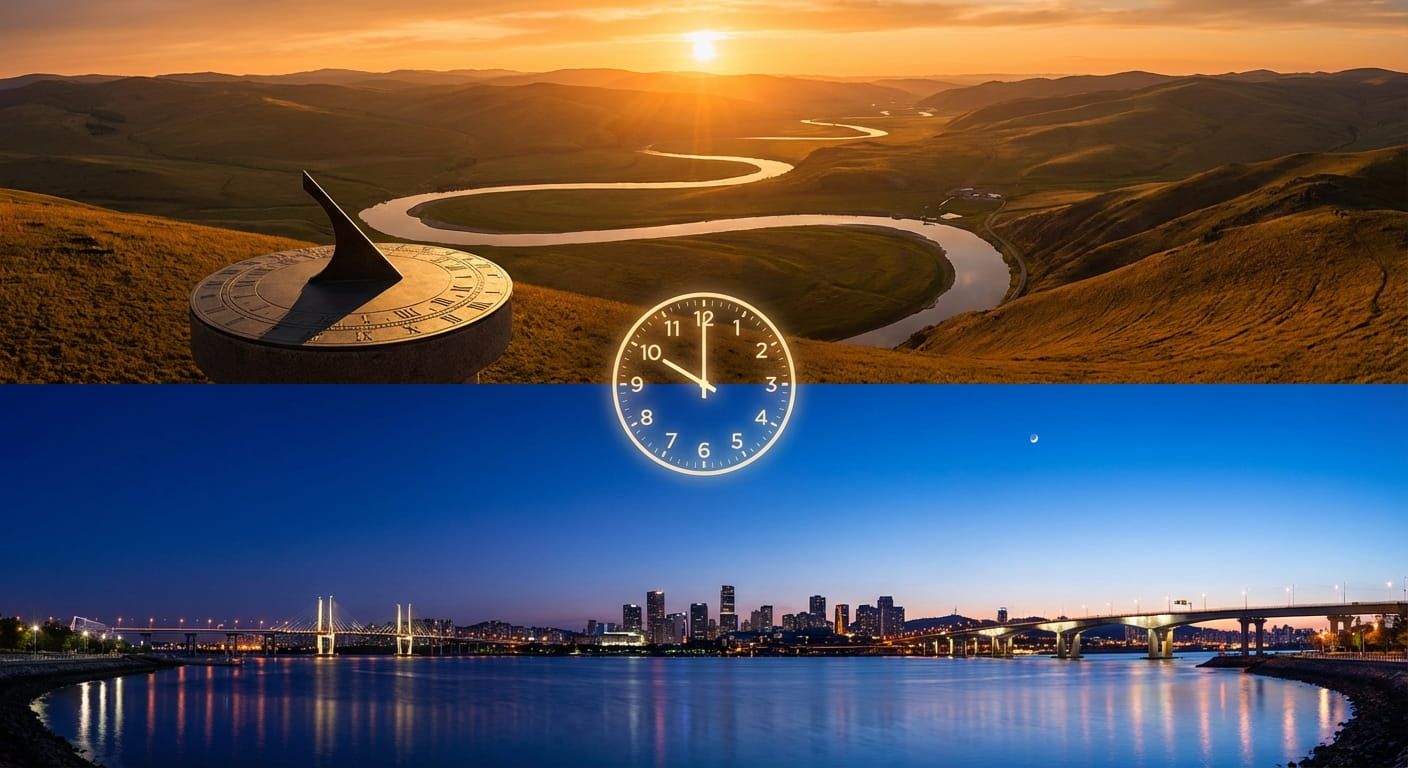
Sunset times live in clock time, but the Sun follows solar time. Your civil clock includes time zones and sometimes daylight saving rules, while the Sun’s daily peak is solar noon. The relationship between those two explains why the Sun can feel “late” in one city and “early” in another, even at similar longitude. Refraction sits on top as a near horizon adjustment.
If you enjoy connecting the schedule to the Sun’s daily high point, reading about solar noon and solar time helps frame sunset as part of a full daily cycle, not a single event.
When the horizon keeps its secrets
Some evenings refuse to match any neat expectation. Heavy haze can hide the disk early. A mountain ridge can steal the Sun minutes before a flat horizon would. Sea swell can momentarily lift and drop the visible line. And in a city, the “horizon” is a jagged line of buildings that changes by the block.
That is not a failure of the schedule. It is the schedule doing exactly what it claims, a standard horizon and standard atmosphere, while your view is real and local. Once you accept that, refraction becomes a helpful explanation rather than a frustrating one.
Keeping sunset plans calm and accurate
For most people, the best approach is simple. Use the listed sunset time as your anchor, then arrive a little early if the view matters. In Singapore, showing up 15 minutes before listed sunset usually covers you. In London or Stockholm during seasons with shallow angles, 20 to 30 minutes gives more breathing room. If you are in a high viewpoint or a mountain area, add extra time for the extended horizon.
And if you are coordinating across places, Tokyo, Dubai, New York City, and Sydney, the atomic clock precision behind Time.you keeps the timekeeping consistent. Refraction explains the last mile, the human moment at the horizon.
When the bending air meets the ticking clock
Atmospheric refraction is a quiet trick of physics that turns a clean geometric sunset into a living, weather shaped experience. It lifts the Sun’s appearance near the horizon, stretching daylight by small but real amounts. Add the definition of sunset, add your elevation, add your local horizon, and you get the familiar surprise: the schedule is close, but the sky has the final say.