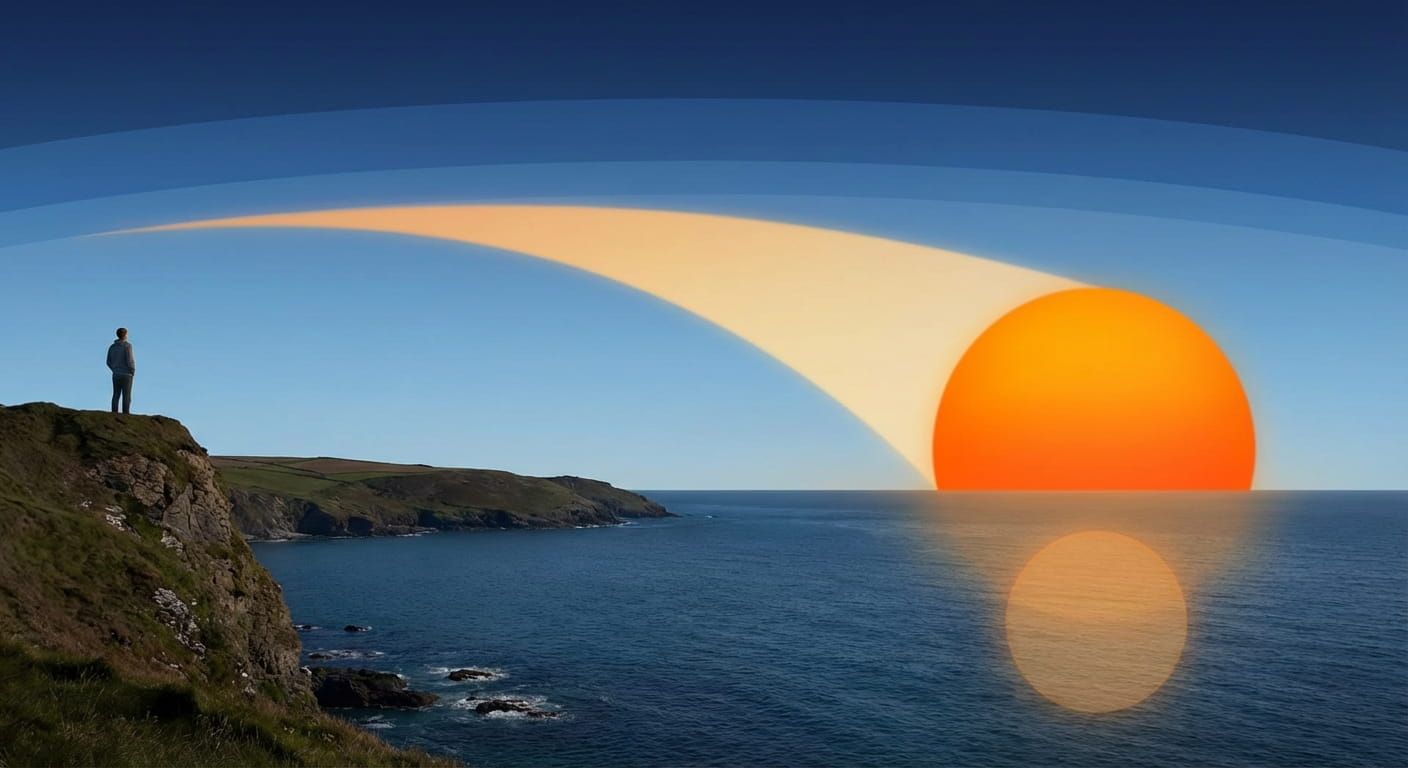
The Sun does not need to be above the horizon to shape the whole mood of the sky. Those minutes before sunrise and after sunset can feel soft, dramatic, or deeply dark, and the difference comes down to twilight. Once you learn the three twilight bands, you can plan a calm commute, a photo session, a safe boat departure, or a stargazing window with a lot more confidence.
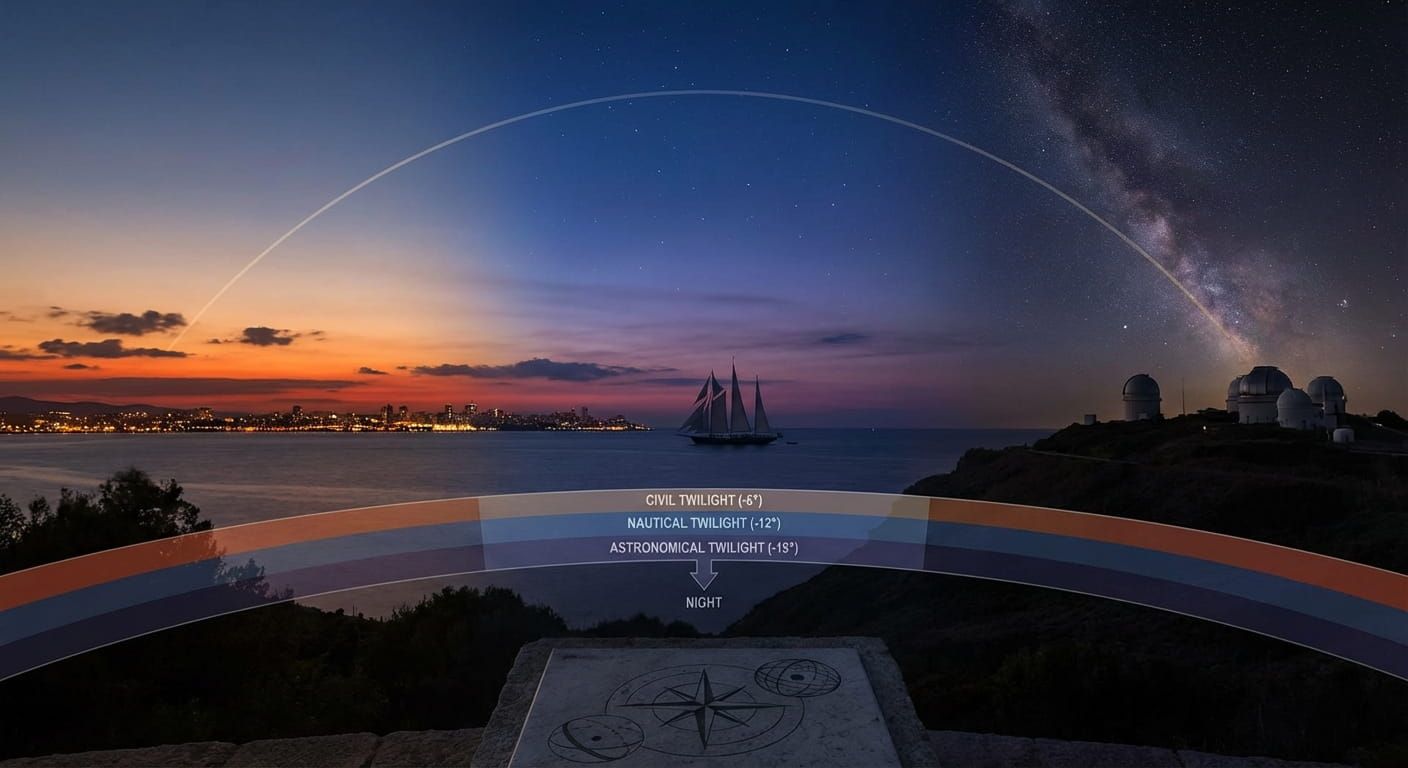
Twilight is the time when the Sun sits below the horizon but still lights the sky. Civil twilight is bright enough for most outdoor activity. Nautical twilight is dim, the horizon is faint, and navigation lights matter more. Astronomical twilight is the final fade, the sky becomes truly dark after it ends. Use sunrise and sunset times, plus twilight start and end times, to plan daylight length, photo light, and night sky conditions for your location.
Twilight quiz to test your timing
Question: You want a sky that is dark enough to see faint stars, with minimal glow left in the west. Which moment should you target?
What civil nautical and astronomical twilight really mean
Twilight is defined by the Sun’s position below the horizon, measured as an angle. The deeper the Sun drops, the less scattered sunlight remains in the atmosphere. That is why twilight changes from a bright, usable glow into full night.
Plain way to remember it: civil feels like day is still hanging around, nautical feels like the sea and land are turning into silhouettes, astronomical feels like the sky is finally ready for deep night.
These are the standard bands used around the world:
- Civil twilight starts when the Sun is about 6 degrees below the horizon and ends when it reaches the horizon. This is the phase where many outdoor tasks are still comfortable without extra lighting.
- Nautical twilight sits between about 6 and 12 degrees below the horizon. The horizon line becomes hard to pick out, which is why navigation by the horizon gets tricky.
- Astronomical twilight runs from about 12 down to 18 degrees below the horizon. After it ends, the sky reaches its darkest state for that evening.
How twilight connects to sunrise sunset and daylight length
Sunrise and sunset are single moments, the instant the top edge of the Sun appears or disappears relative to the horizon. Twilight is a span of time around those moments. If you only track sunrise and sunset, you miss a big part of the usable light in the morning and evening.
That matters for everyday planning. Civil twilight can feel like an extended morning buffer, especially in summer. It also helps explain why daylight length can feel longer than the time between sunrise and sunset in places with wide open horizons.
If you are already checking your location’s sunrise time, add twilight to your routine. It is the best way to set expectations for what the sky will look like when you step outside.
Why the same twilight can feel totally different by location
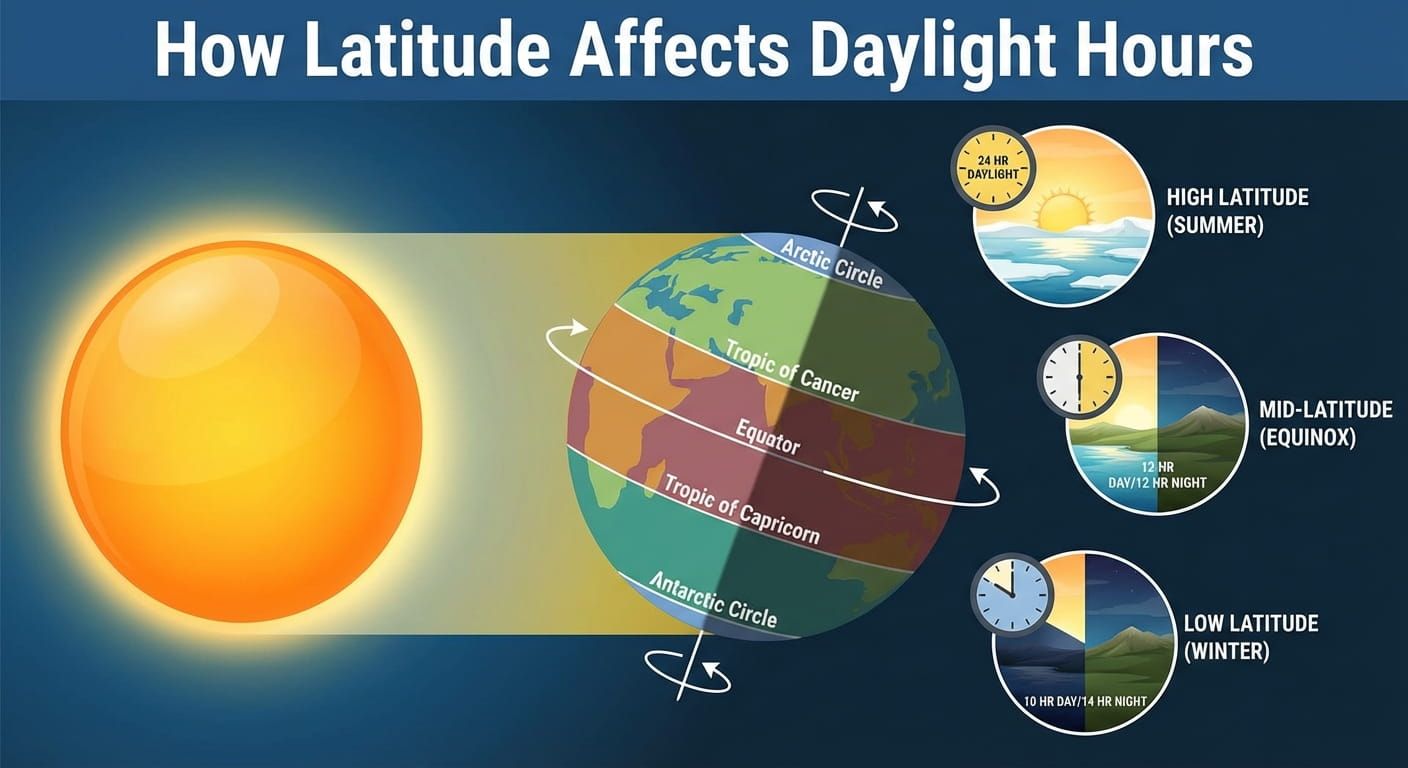
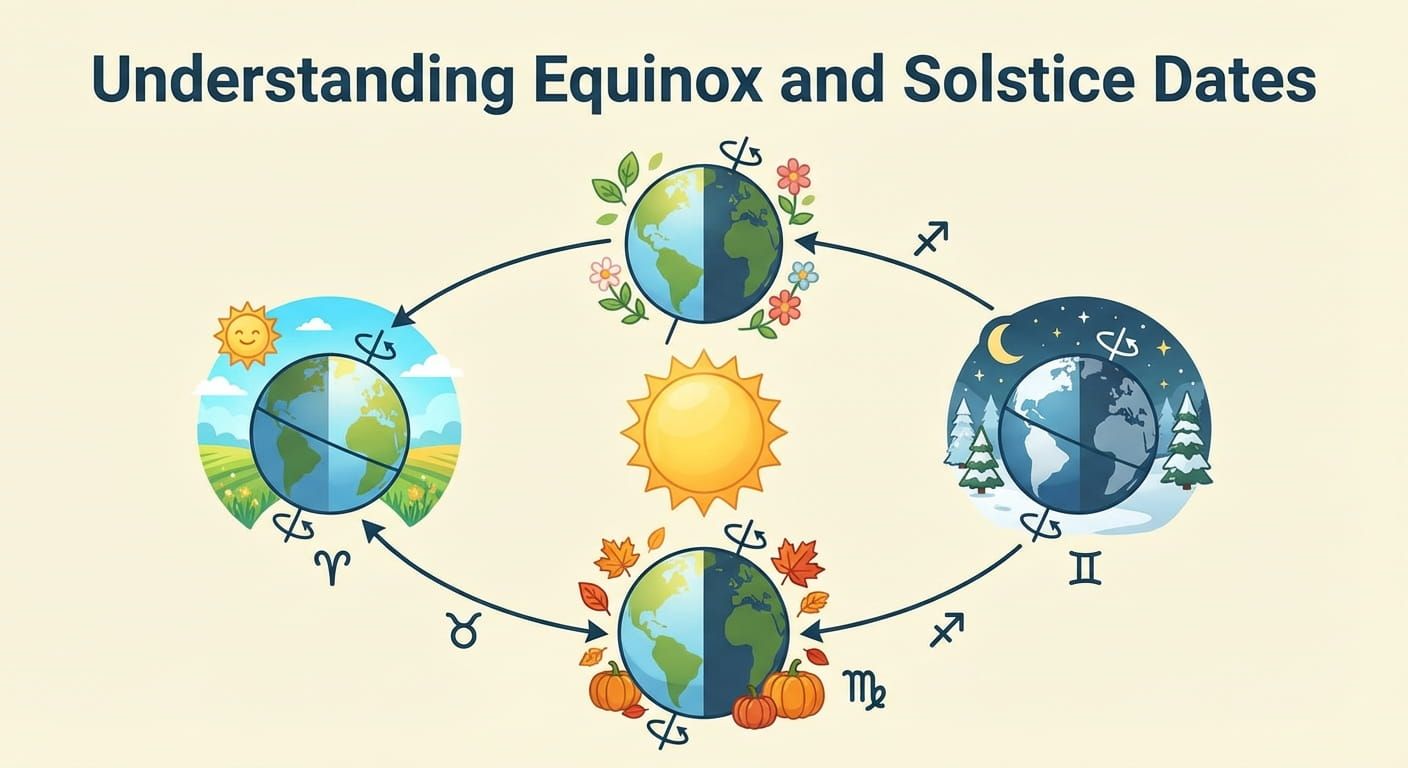
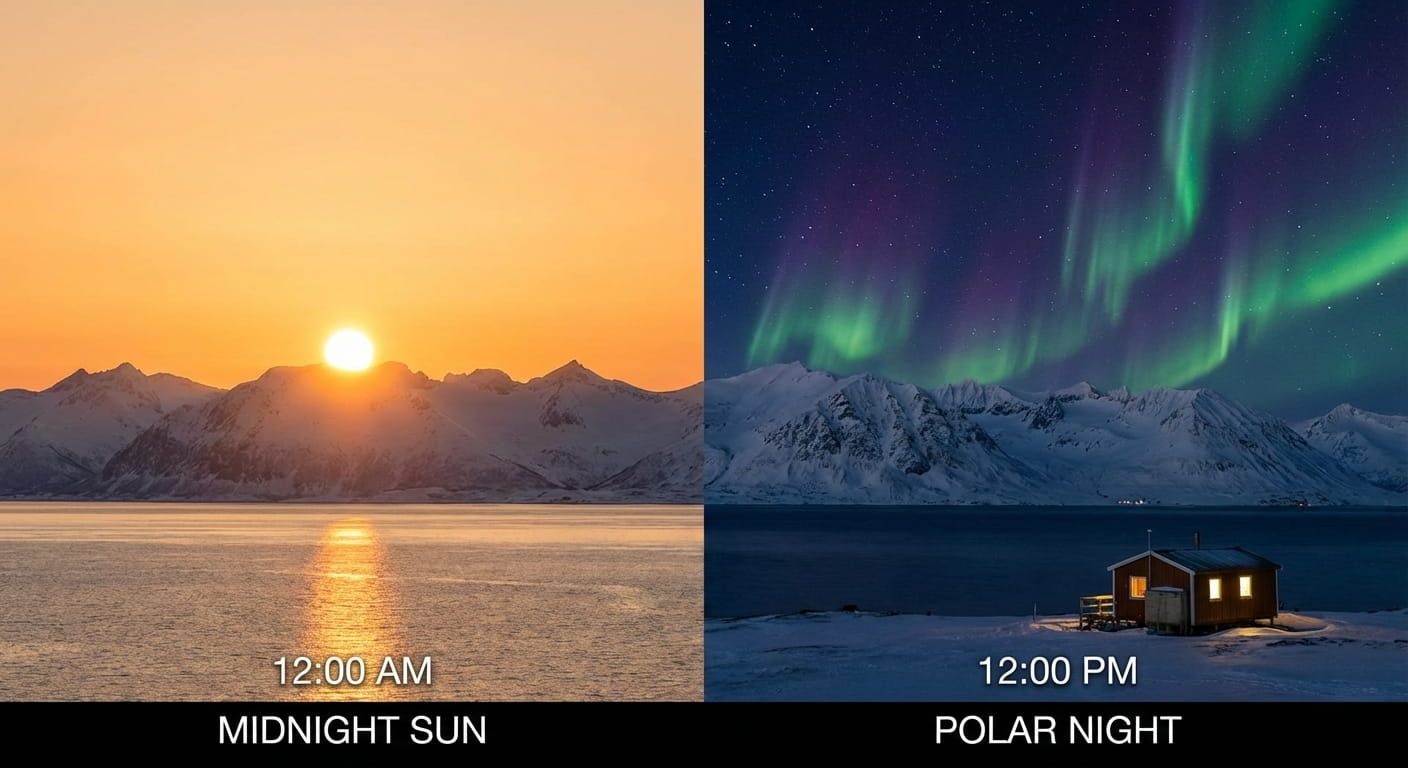
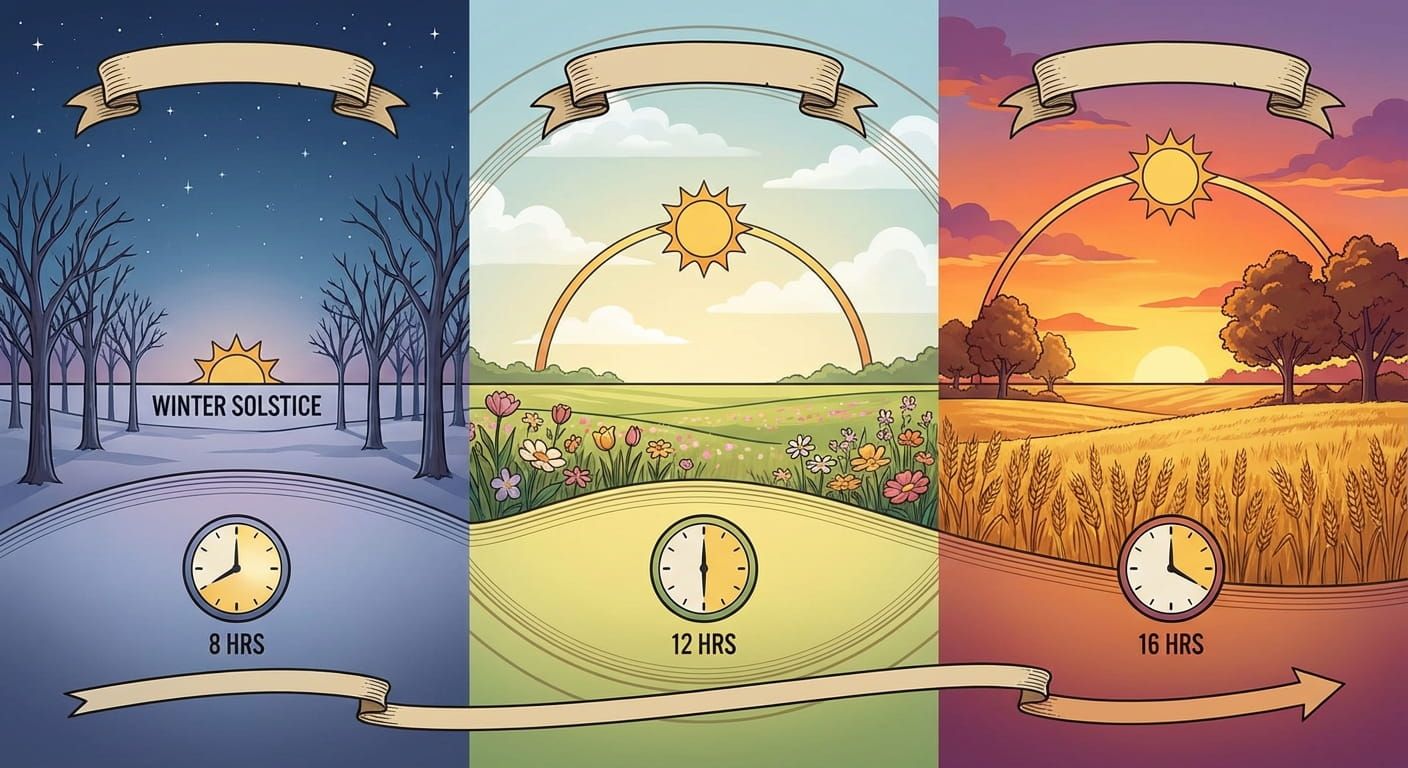
Twilight is not one size fits all. Two big forces change it: latitude and season. Near the equator, the Sun drops more steeply, so twilight tends to be shorter. Farther from the equator, the Sun slides at a shallower angle, and twilight can stretch out for a long time.
In Bangkok, twilight moves along at a steady pace through most of the year. In cities like London or Stockholm, summer evenings can hold onto twilight for ages. In winter, those places can flip to darkness much faster.
Here are a few reasons your twilight times might surprise you:
- Latitude changes how sharply the Sun rises and sets.
- Time of year shifts the Sun’s path, stretching or shrinking twilight.
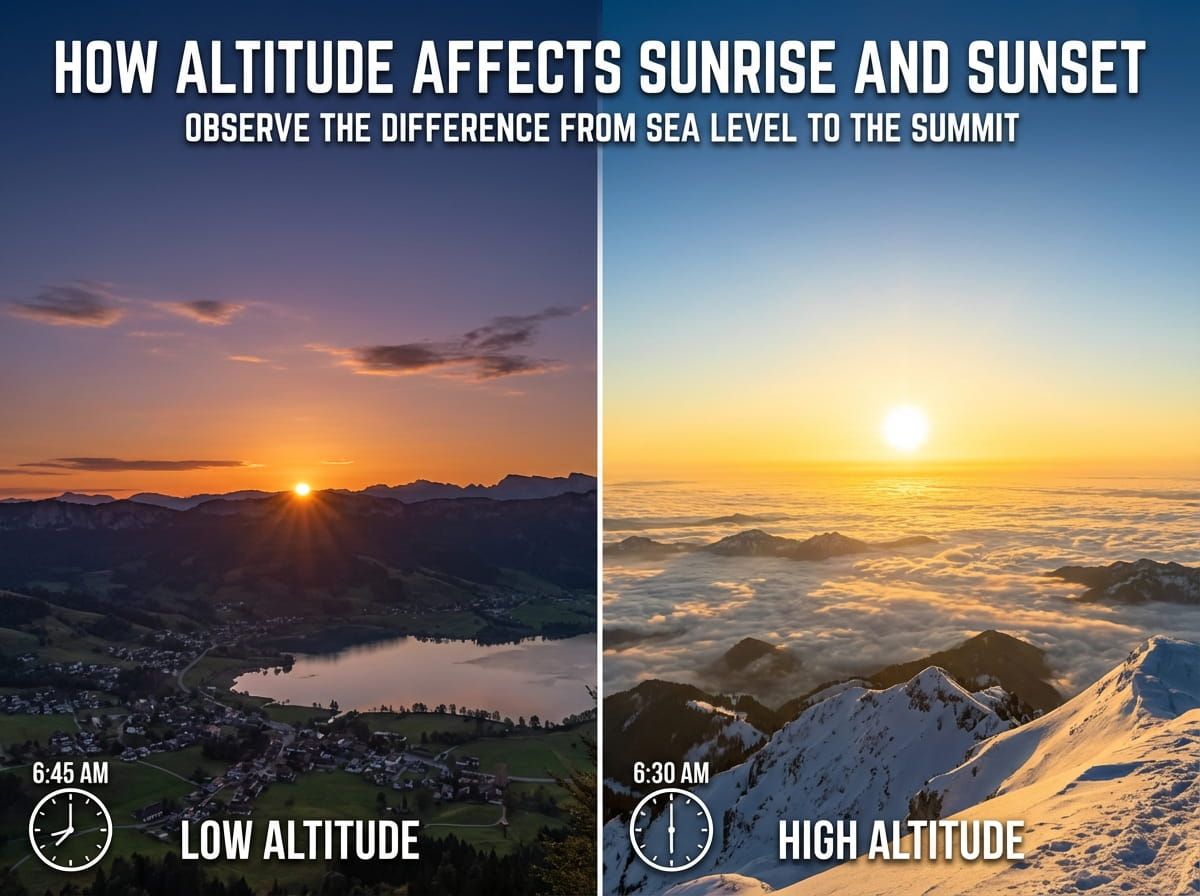
- Elevation gives you a wider view, which can slightly change perceived timing, especially around local terrain.
- Atmosphere adds refraction and scattering, making the glow linger even when the Sun is lower.
- Local obstacles like mountains or buildings can block the horizon, changing what sunrise or sunset feels like in real life.
A clear chart of the twilight bands
| Band | Sun angle below horizon | What you notice | Good for |
|---|---|---|---|
| Civil twilight | About 0 to 6 degrees | Outdoor detail is visible, street lights begin to matter | Walking, commuting, casual photos, early flights, calm port prep |
| Nautical twilight | About 6 to 12 degrees | Horizon becomes faint, brighter stars appear | Harbor departures, shoreline visibility checks, city skyline silhouettes |
| Astronomical twilight | About 12 to 18 degrees | Most sky glow fades, Milky Way becomes possible in dark areas | Astrophotography, meteor watching, deep sky observing |
How to use twilight for travel and daily plans
Twilight is practical. It tells you when the sky will look bright enough to walk the dog, when headlights start feeling necessary, and when a scenic overlook might be worth the drive.
Try this simple rhythm in any city:
- If you want comfortable light for walking or a run, aim for civil twilight.
- If you want dramatic silhouettes or the first stars, aim for nautical twilight.
- If you want real darkness, wait until astronomical twilight ends.
And if you are building a trip schedule, combine twilight with your local sunset time. The transition after sunset can be the best part of the day, and it changes a lot between seasons.
Using twilight for sailing and coastal safety
Civil and nautical twilight are especially important on the water. Even when the sea looks calm, your ability to read distance depends on light. During civil twilight, nearby markers and shoreline features are still fairly readable. During nautical twilight, the horizon becomes harder to separate from the sea, and navigation lights carry more weight.
When planning a departure or arrival, a helpful habit is to check the nautical twilight start and end, then build your timing around it. It keeps expectations realistic, especially in unfamiliar harbors.
Small habit, big payoff: check twilight times before you commit to a dock arrival. It is easier to handle unfamiliar buoys and shorelines when you know what the light will be doing.
Photography timing that actually matches the sky
People talk about golden hour and blue hour, but those names can feel vague until you connect them to twilight. Golden hour usually sits around sunrise and sunset when the Sun is low and the light turns warm. Blue hour often lines up with deeper twilight when the sky takes on a cooler tone and city lights balance well.
If you want portraits with soft light and open shadows, civil twilight is often the sweet spot. If you want skyline shots where the sky holds detail while street lights glow, nautical twilight is usually your friend. If you want stars, you need the end of astronomical twilight and a darker location away from city glare.
For planning in Japan, checking sunrise times in Japan can help you pick the right morning window, especially if you are moving between Tokyo and more rural areas where the horizon view changes.
Stargazing and astronomy planning without guesswork
Night sky conditions are not just about clouds. They are also about the remaining glow in the atmosphere. A common frustration is arriving at a dark site too early, setting up, and finding the sky still bright. Twilight solves that.
Here is a clean approach:
- Check the end of astronomical twilight for your location.
- Add extra time if the western horizon is hazy or you are near a bright city.
- Use a moon phase calendar if you are chasing faint objects.
- Plan your best observing window between the end of astronomical twilight and the first brightening before dawn.
If eclipses are your thing, city pages can be a fun add on. Bangkok viewers can keep an eye on Bangkok eclipses to pair twilight timing with upcoming sky events.
Examples across countries and cities
Twilight can be a gentle routine marker. It changes how a morning feels in Delhi, how an evening stroll feels in Paris, and how fast darkness arrives in Nairobi. Here are a few location based notes you can use as mental anchors:
- Bangkok and Singapore: twilight stays fairly consistent through the year, and the shift from sunset to night is often smooth and predictable.
- Paris and Rome: summer gives long evenings with a generous twilight feel, winter shortens that window and pushes darkness earlier.
- Cairo and Dubai: clear air can make twilight feel crisp, and desert horizons can make the transition very easy to notice.
- Nairobi and Lagos: near equatorial latitudes often mean shorter twilight, which makes timing more important for evening plans.
If you are checking timing for Thailand travel, you can fold local daylight planning into sunrise times in Thailand without bouncing between different tools.
Why accurate time sources matter for twilight
Twilight times are calculated, and small errors can show up as real world frustration. A few minutes can be the difference between a bright harbor entrance and a dim one, or between a sky full of stars and a sky that still looks washed out.
Time.you focuses on exact time by time zone around the world, with atomic clock synchronized time that supports precise timing in major cities, countries, and time zones. That matters because sunrise, sunset, and twilight calculations are only useful when the displayed time is trustworthy for your location.
Common questions people ask about twilight
Is civil twilight the same as sunrise
No. Sunrise is a moment. Civil twilight is a span of time that leads up to sunrise, and a span that follows sunset.
Why can I still read outside after sunset
Because civil twilight can remain bright enough for outdoor activity, especially on clear days with a wide open horizon view.
Why does twilight last so long in some places
High latitude locations can have a shallow Sun angle near the horizon, which stretches the time it takes for the Sun to move deeper below it.
Does weather change twilight times
The calculated times stay the same, but cloud cover and haze change how bright it feels. Thin clouds can keep the sky glowing longer. Heavy clouds can make it feel darker earlier.
Make the sky work for you tonight
Once you start thinking in twilight bands, the day feels easier to read. Civil twilight is your soft on ramp into the morning and your gentle off ramp at night. Nautical twilight is the cinematic zone where silhouettes take over. Astronomical twilight is the doorway to a truly dark sky. Check the times, match them to what you want to do, and you will spend less time guessing and more time enjoying the light you actually have.
If you are planning an evening in Paris, pairing twilight with Paris eclipses can also spark ideas for nights when the sky has something extra to offer.