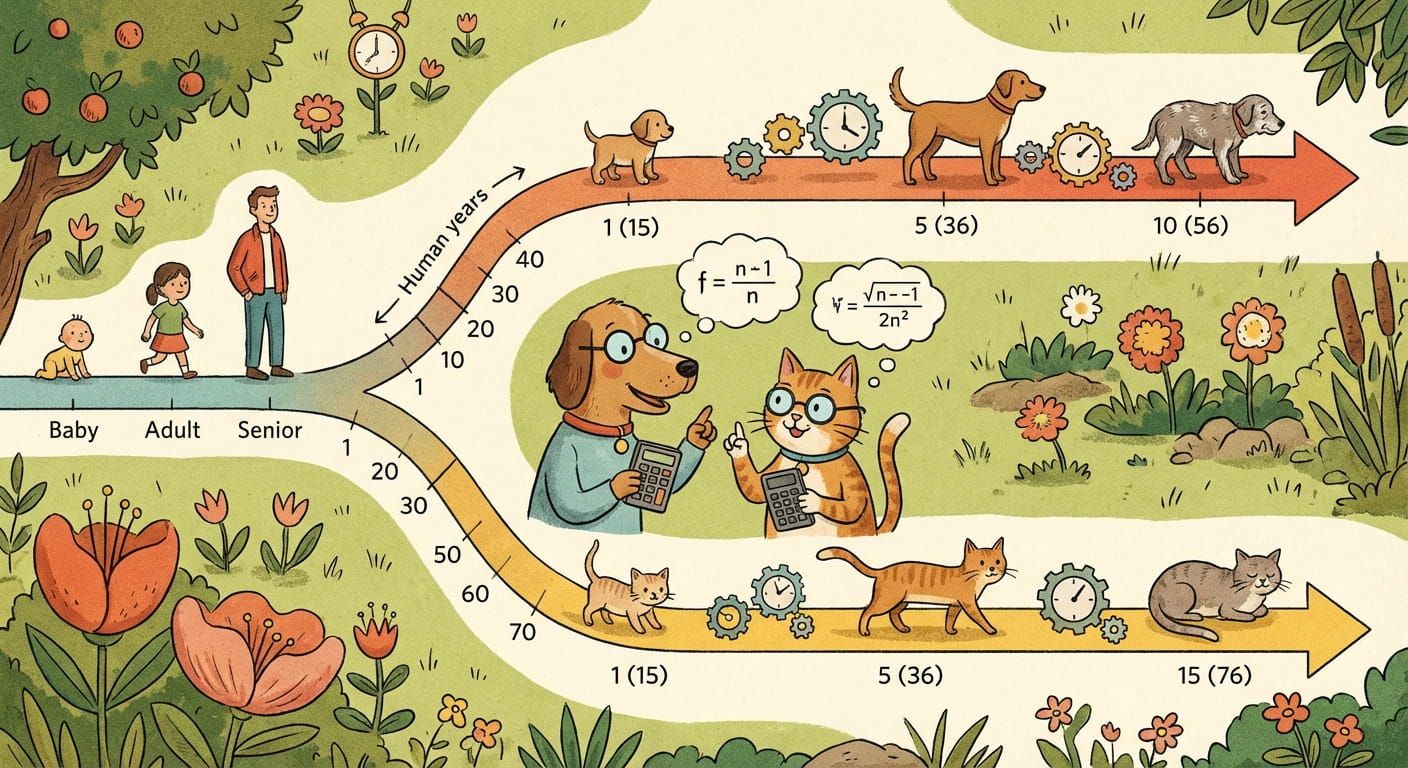
Dog and cat ages do not translate to human years in a straight line. The first months of life are a fast sprint, then the pace steadies. That is why the old multiply by seven idea misses the mark. With a few inputs, you can estimate a pet’s human equivalent age in a way that matches real life stages, like baby, teen, adult, and senior. This guide shows the most reliable methods, how to calculate them, and how to use the result wisely.
To calculate dog and cat age in human years, use life stage based formulas, not a single multiplier. For dogs, size matters because larger breeds age faster after early adulthood. For cats, the first two years map to big jumps, then each year adds a steady amount. Use your pet’s exact birthdate for best results, and pair the number with body condition, dental wear, and energy level to judge true life stage.
Mini quiz to test your pet age instincts
What people mean by dog age and cat age
When someone says, my dog is ten, they usually mean ten calendar years since birth. That is chronological age. A human age equivalent is different. It is an estimate of life stage, shaped by growth speed, puberty timing, peak adulthood, and the start of age related decline.
These estimates help you talk with a vet, plan training goals, and adjust routines. They also help you spot when changes are not normal for a given life stage.
The number is a helpful label, not a diagnosis. A fit, lean senior dog may behave younger than the math. A cat with dental disease may act older. Use the estimate to guide choices, then watch the pet in front of you.
Why the old multiply by seven idea misses
The multiply by seven rule is simple, but biology is not. Dogs and cats mature far faster than humans during the first year. Many dogs can reproduce before their second birthday. That is closer to human adolescence than early childhood. After that early rush, the pace becomes more steady, and it also varies by breed and body size.
That is why you will see different charts for small dogs versus large dogs. And that is why cat age charts make big jumps in the first two years.
Start with real time, then convert it
Before you convert, get the pet’s exact age in years and months. If you know the birthdate, you can compute the precise age down to the day. That matters for puppies and kittens, because a few months changes the life stage a lot. If you want a clean way to compute the exact age span from a birthdate to today, the age calculator helps you do that with a clear breakdown.
If you do not know the birthdate, your vet may estimate from teeth, body development, and coat changes. Shelter intake notes can help too.
Dog age calculation methods that people actually use
There are three common approaches. Each has a place. The best choice depends on how precise you need to be.
Method 1, life stage mapping chart
This is the most practical way for everyday decisions. It maps dog years into human equivalents by stage. It captures the fast early maturity, then adjusts based on dog size.
Most charts follow a pattern:
- Year 1 is roughly the leap from baby to teen.
- Year 2 reaches young adulthood.
- After that, each dog year adds a smaller amount, but larger dogs add more per year than small dogs.
Method 2, size based formula
This method turns dog age into human years using a piecewise approach. It uses one rate for the first two years, then a different rate after that. A common version looks like this:
- If your dog is under 1 year, treat it as a rapid ramp that depends on months. You can approximate with a chart.
- At 1 year, many charts place the dog around the mid teens in human years.
- At 2 years, many charts place the dog around the mid twenties.
- After 2 years, add a per year value that depends on size.
This gives a better estimate than a single multiplier, and it is easy to do on paper.
Method 3, the logarithmic research based estimate
Some research suggests a curve based on DNA methylation, often shared as a logarithmic equation that maps dog age to human age. It reflects the fast early change and the slower later change. The curve is interesting, but for most daily use, a good chart plus your dog’s size is enough. If you do use a curve, treat the output as a range rather than one exact number.
A dog age table you can actually use
This table is meant for quick reference while staying realistic. It is a guide, not a promise. Body size matters most after age two.
If your dog is between table rows, estimate with months. A 6 month old puppy is not half of year one in human years. It is often closer to a human pre teen to early teen stage, depending on breed.
How to calculate dog age step by step at home
Here is a simple method you can use with a calculator or mental math. It matches the way most vets talk about life stage.
- Find your dog’s age in years and months. If you have a birthdate, compute today minus birthdate for precision.
- Identify size group. Use adult weight, not puppy weight. If your dog is still growing, estimate expected adult size from breed mix and vet guidance.
- Convert the first two years. Use the rule of thumb, year one is about mid teens, year two is about mid twenties.
- Add the post two year rate. Small dogs add fewer human years per dog year, giant dogs add more.
- Sanity check using life stage signs. Compare the result with energy, mobility, and dental wear.
If you want a hands on tool for dog conversions, the dog age page can help you run the numbers with fewer steps while you focus on what to do with the result.
Cat age calculations that fit how cats mature
Cats have a well known pattern in most charts:
- Year 1 is about 15 human years.
- Year 2 brings them to about 24 human years.
- Each year after adds about 4 human years.
That captures what cat owners notice. Kittens grow up fast. A two year old cat is not a toddler in behavior. It is more like a young adult, curious, athletic, and fully capable.
A cat age table for simple conversions
Use this as your baseline. Then adjust with your cat’s health status and indoor or outdoor lifestyle.
If you want a cat focused tool for the conversion, the cat age page gives a clean result you can share with family members who help care for your cat.
How to calculate cat age step by step
- Get exact age in years and months. Birthdate helps a lot for kittens.
- Map year one and year two. Many charts place them around 15 and 24 human years.
- Add about 4 per year after that. This is the common steady rate used by many cat charts.
- Adjust for health and lifestyle. Outdoor risks and chronic disease can change how old a cat seems functionally.
Dog and cat ages in months, not just years
Year based charts hide the most dramatic part. Months. A puppy at 3 months is not the same stage as at 9 months. A kitten at 4 months is often already showing strong hunting play and social confidence.
Here is a simple month focused way to think about it without turning your life into spreadsheets:
- Under 6 months, changes happen fast. Training windows feel short because they are.
- 6 to 12 months, adolescence shows up. Energy peaks and impulse control dips.
- 12 to 24 months, you see adult body and more stable habits.
Using time tools to track birthdays, vet schedules, and habits
Once you know the equivalent age, the next step is planning. A younger animal may benefit from consistent short sessions, while an older one may need more recovery time.
If you want to time short training intervals, a simple timer keeps sessions structured without dragging them out. For recall practice or calm settle work, a stopwatch helps you measure duration without guessing. If you are counting down to a new puppy arriving home or a senior checkup, a countdown can keep the whole household on the same page.
For medication reminders or routine check ins, an alarm is a low effort way to build consistency without relying on memory.
Life stages for dogs and what to do in each stage
Dog age calculations matter most when they change what you do. Here is a practical life stage view.
Puppy stage, learning and growth
Puppies learn fast, and they tire fast. Short practice blocks work best. Use gentle social exposure, predictable routines, and lots of sleep.
Helpful focus points:
- House training rhythm
- Handling practice for paws, ears, mouth
- Simple cues, name response, sit, come
- Safe social experiences with people and dogs
Teen stage, energy and impulse control
Adolescence can feel messy. Your dog is not being stubborn for sport. Their brain is still wiring. Keep sessions short. Reward the behavior you want. Manage the environment so they can win.
A dog can look like a full grown adult at one year and still behave like a teen. That is normal. Treat the calendar as a guide and the behavior as the truth.
Adult stage, maintenance and enrichment
This is where routines shine. Healthy weight, daily movement, dental care, and mental enrichment keep adulthood long and comfortable.
Senior stage, comfort and prevention
Older dogs benefit from lower impact movement, more warm up time, and checkups that look for pain early. Small changes, like adding traction rugs, can make a big difference.
Life stages for cats and what to watch for
Cat age conversion is useful because cat aging can be quiet. A cat can hide discomfort well. The life stage idea helps you stay alert.
Kitten stage, skill building
Kittens learn what is safe, and they practice hunting movements through play. Provide scratching surfaces, climbing, and predictable meal times.
Young adult stage, peak athletic years
Many cats are at their strongest jumps and fastest sprints around this time. Boredom can lead to nighttime chaos. More play earlier in the day helps.
Mature stage, subtle shifts
Some cats start gaining weight in midlife. Portions and movement matter more. Teeth and gums can change too, even if appetite stays the same.
Senior stage, comfort first
Senior cats may jump less, groom less, and sleep more. It can be normal, but a sudden change should be checked. Pain in cats can look like irritability or hiding, not limping.
Ways to use the human equivalent age
- Plan vet visits around life stage. Puppies and kittens need more frequent care, seniors benefit from regular monitoring.
- Choose exercise that fits the body. Younger pets handle bursts, older pets do better with steady movement and recovery.
- Set training expectations. Teens are inconsistent, adults are steady, seniors may need slower pacing.
- Adjust food and portions. Growth, maintenance, and senior needs are different.
- Watch for age linked risks. Dental disease, arthritis, and kidney issues tend to rise with age.
- Communicate clearly with caregivers. Saying your dog is like a sixty year old in life stage can help people understand why routines changed.
- Celebrate milestones. The human equivalent can make birthdays feel more meaningful, especially for rescued pets with unknown history.
Common pitfalls that throw off the calculation
Even a good chart can be misused. These mistakes happen a lot.
- Using puppy weight to pick a size group. Use adult weight, or expected adult size.
- Ignoring months. Early life changes rapidly.
- Assuming all cats age the same. Indoor cats often face fewer risks, but diet and activity still matter.
- Taking the number too literally. Behavior and health signs matter more than the exact figure.
How to estimate age if you do not know the birthdate
Many pets are adopted without a reliable birthdate. You can still get close.
Vets often use:
- Teeth eruption and tartar patterns
- Eye clarity and lens change
- Muscle tone and mobility
- Coat texture and graying patterns in some dogs
Once you get an estimated age range, you can still convert it into a human equivalent range. That range is often more honest than a single number.
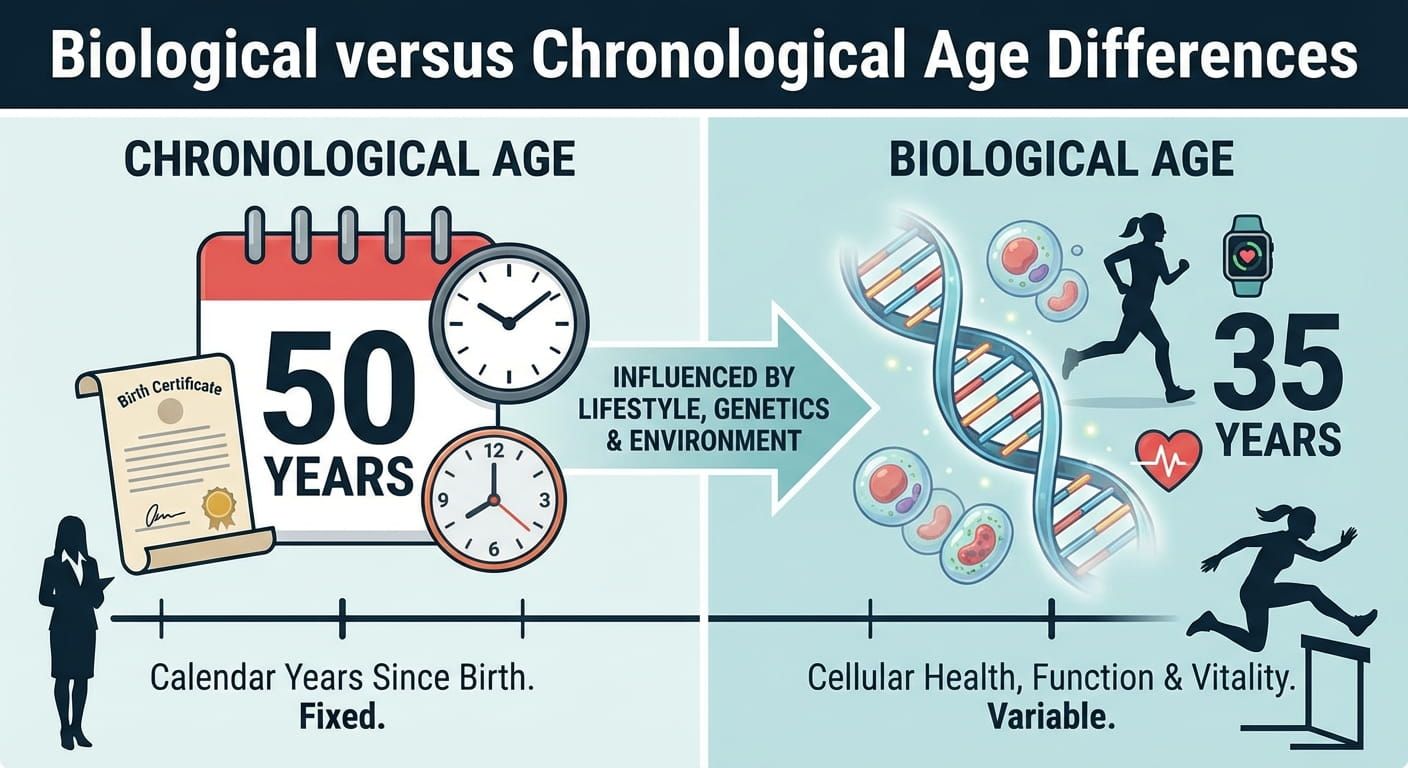
Age equivalents versus biological age
A pet’s calendar age and their functional age can differ. Some animals are spry long into their later years. Others slow down early due to genetics, injury, or weight gain.
If you want a deeper explanation of the difference between calendar age and how old a body seems, the article on biological vs chronological age gives a clear framework you can apply to pets and people.
Turning your pet age result into a routine that sticks
Once you calculate the age, the next question is what routine fits. The key is consistency, not intensity.
Here is a simple approach you can follow:
- Daily movement. Tailor it to the body. Avoid sharp spikes in activity.
- Mental work. Sniffing games for dogs, hunting play for cats.
- Sleep protection. Young animals and seniors both need more rest than people expect.
- Weight management. Extra weight can make a pet seem older fast.
If your pet’s routine keeps slipping, timing tools help. Short sessions done often beat long sessions done rarely.
Pet age calculations for mixed breeds
Mixed breed dogs can be tricky because adult size is not always obvious early. Use the best estimate you have and update it as the dog fills out.
For example, if your dog ends up medium size, use the medium rate after age two. If it ends up large, adjust. The early years are similar enough that the biggest differences show up later.
Using a time calculator to compare multiple dates
If you manage multiple pets, you might compare ages or plan checkups around school or travel schedules. A time math tool helps. If you need to add or subtract time spans, a time calculator is handy for figuring out dates and durations without counting on a calendar by hand.
Short answers to common dog and cat age questions
Is a one year old dog seven human years old? Usually no. Many charts place year one closer to the mid teens.
Do small dogs live longer than large dogs? Often, yes, and they tend to age more slowly after early adulthood. That is why size matters in conversion.
Do cats age more slowly than dogs? It depends. Cats often have a steady adult phase, but they also hide illness well. Watch health signs.
Should I change food based on human equivalent age? Use life stage as your guide, then follow vet advice. Growth, adult maintenance, and senior needs differ.
A simple template you can save for your next calculation
Use this mini checklist each time you want the number and the meaning behind it.
- Compute exact age in years and months.
- Pick dog size group, or use the cat chart.
- Convert year one and year two with the life stage jump.
- Add the later year rate.
- Match the result to what you see in energy, mobility, and habits.
A closing note that keeps the math in its place
Calculating dog and cat age is useful because it gives you a shared language for life stage. It helps you make choices that fit the body you live with every day. Keep the math simple. Track time with real dates. Then pay attention to comfort, appetite, movement, and joy. Those are the signals that matter most.