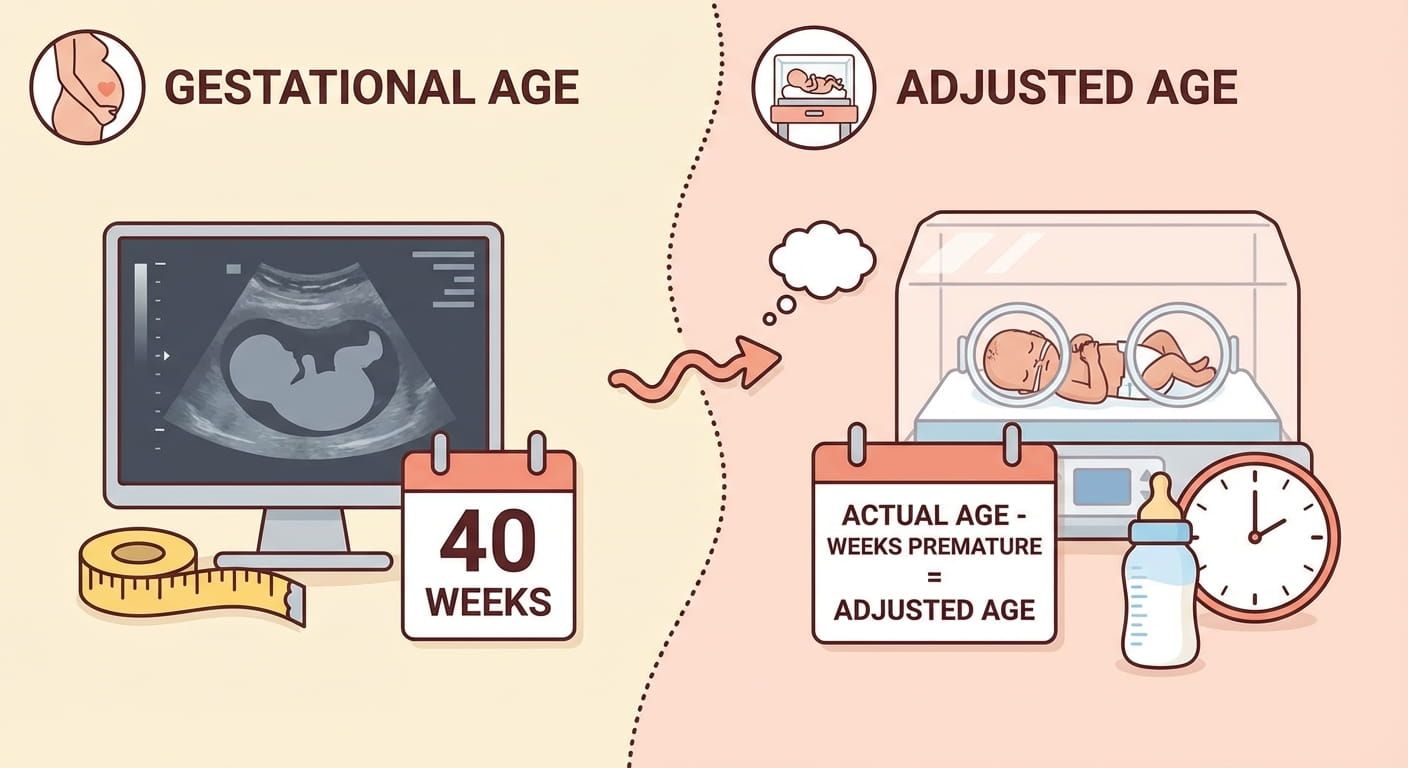
In pregnancy and early infancy, a few days can change a decision, a milestone, or even a parent’s peace of mind. That is why age words matter. Gestational age tells you how far along a pregnancy is, based on weeks since the last menstrual period. Adjusted age helps you judge growth and development for babies born early, by subtracting the weeks they missed before full term. Once you know which age fits the moment, the numbers stop feeling slippery and start feeling useful.
Gestational age is counted in pregnancy weeks and helps guide prenatal care, screening timing, and due date planning. Chronological age starts at birth and is how old a baby is on the calendar. Adjusted age is mainly for babies born early, it subtracts the number of weeks before 40 weeks that the baby missed in the womb. Use gestational age during pregnancy, chronological age for everyday life, and adjusted age when tracking early development and milestones after a preterm birth.
Try a short quiz before you read further
How the two ages fit into real life
Most people only meet “gestational age” during pregnancy, then it fades away after birth. “Adjusted age” tends to show up later, usually for babies born early. Both exist because the clock can start in more than one place. Pregnancy is measured from a medical starting point. Infant development is measured from the day a baby arrives, yet preterm babies also have a different starting line for brain and body development. The goal is fairness. A number should help you compare the right things, not create panic.
Here is the simple mental model that works in daily life:
- Gestational age answers: how many weeks into pregnancy is this?
- Chronological age answers: how long has it been since birth?
- Adjusted age answers: how old would this baby be if birth happened closer to full term?
If you want a fast way to translate dates into ages without getting tangled, you can lean on a tool built for basic date math. A tab with time calculator open during appointments can be surprisingly calming, because you can count days and weeks cleanly, then focus on the actual questions you want to ask.
Gestational age explained without the fog
Gestational age is the age of a pregnancy, measured in weeks and days. In many clinics it is written as weeks plus days, like 28 weeks 4 days. The count usually starts on the first day of the last menstrual period. That might feel odd, because conception often happens about two weeks later. Yet that starting point is used because it is usually easier to identify than the exact day of conception. It also matches how many screening windows and prenatal milestones were researched and scheduled.
Gestational age is used for things like:
- timing ultrasounds and screening tests
- choosing when to talk about fetal growth and anatomy
- planning around due dates, induction discussions, and birth expectations
- making sense of symptoms and body changes week by week
A provider might say a pregnancy is “dated” by ultrasound. That means they are choosing the most reliable estimate for gestational age and due date based on measurements, especially if last menstrual period dates are uncertain.
Due date math and why it can shift
A due date is an estimate, not a promise. Many due dates are first predicted by last menstrual period counting. Some are adjusted after an early ultrasound. The reason is simple, early measurements can reduce guesswork. If ovulation happened earlier or later than average, last menstrual period counting can drift from reality. When the pregnancy is dated by ultrasound, gestational age can change by a few days. That small change can move a screening window, a measurement chart line, or an interpretation of growth.
If you ever get two different due dates, ask which method is being used going forward. One consistent reference point matters more than the exact day. Keeping the same “official” date helps avoid confusion across visits.
Adjusted age explained for parents who want straight answers
Adjusted age is mainly used for babies born early. It is sometimes called corrected age. The idea is to remove the weeks a baby did not get to spend developing in the womb before a full term pregnancy point. Many professionals use 40 weeks as the full term reference. Some use 40 weeks 0 days as the clean anchor. Others may talk about 37 to 42 weeks as the full term range. In daily milestone conversations, adjusted age is often calculated from a 40 week point because it makes the math clear.
Adjusted age helps with questions like:
- Is my baby tracking expected milestones for their developmental starting line?
- How should we think about head control, rolling, sitting, babbling, and first words?
- What growth chart or developmental screen timing makes sense right now?
- How can we set expectations without comparing apples to oranges?
For a direct calculation without guessing, many people like using an adjusted age calculator because it keeps the subtraction step consistent, even when dates fall across different months with different day counts.
Chronological age still matters, just not for every comparison
Chronological age is how long it has been since birth. It is the age used for legal records, most everyday conversations, and lots of routine scheduling. Vaccines, for example, are often guided by chronological age, though specific medical plans can differ. Some feeding guidance also uses chronological age while developmental guidance may use adjusted age in parallel. This is why parents of preterm babies often live with two ages at the same time. One age is for the calendar, the other is for development expectations.
It can feel strange at first. Then it becomes routine. You might say “She is four months old, adjusted two months.” That single sentence saves a lot of confusion.
The step by step method to calculate both ages
Here is a clear way to do the math with a pencil, a calendar, or a trusted date tool. I will keep the steps simple and repeatable. You will notice the steps are the same every time, which is what makes this manageable.
- Start with the baby’s birth date. This anchors chronological age.
- Pick the date you are measuring on. This might be today, an appointment date, or a milestone date.
- Compute chronological age. Count the weeks and days from birth to the measuring date.
- Find how many weeks early the baby was. Take 40 weeks minus gestational age at birth.
- Subtract that early amount from chronological age. The result is adjusted age.
If you want a general tool that covers a lot of age math beyond preterm adjustments, a simple age calculator can also help you verify the chronological part fast, then you only handle the preterm subtraction step.
A reference table you can glance at
Tables are helpful because they reduce mental load. This one focuses on what each age is used for, what it is based on, and what it answers. The colors are meant to guide the eye, not distract it.
| Age type | What it is based on | Best for | Common wording you will hear |
|---|---|---|---|
| Gestational age | Weeks and days since first day of last menstrual period, sometimes updated by early ultrasound dating | Pregnancy timing, prenatal tests, growth tracking before birth, due date planning | “You are 22 weeks 3 days” |
| Chronological age | Time since birth | Everyday age, records, many routine schedules, birthday counting | “He is 3 months old” |
| Adjusted age | Chronological age minus weeks early, using 40 weeks as the reference point in many settings | Development expectations, milestone conversations, early intervention screening timing for preterm babies | “Corrected age” or “adjusted age” |
Gestational age at birth, what those weeks can suggest
Gestational age at birth is often grouped into categories, because risks and typical care patterns change as weeks increase. People often hear terms like late preterm, very preterm, or full term. These are not labels for a child’s future. They are shorthand for what kind of support might be needed right after birth and how to interpret early growth patterns.
Here is a gentle way to think about it: the earlier a baby is born, the more likely they will need time for catch up growth and development. Adjusted age helps you judge progress without punishing a baby for being early. It also helps parents celebrate real gains in a fair way.
Milestones are ranges, not deadlines. A baby can be ahead in one area and slower in another. Adjusted age is a tool for context, not a score.
Where gestational age shows up during pregnancy
During pregnancy, gestational age is everywhere, even when it is not named. Many pregnancy charts are week based. Many appointment schedules are week based. People talk about trimester changes, and those are also week ranges. When you see phrases like “anatomy scan” or “glucose screening window,” those are tied to gestational age.
If you want to estimate pregnancy weeks for planning, a gestational age calculator can help you translate key dates into weeks and days, then you can bring that number into a conversation with your clinician. It is not a substitute for medical care. It is just a clean counting tool.
Where adjusted age shows up after a preterm birth
Adjusted age is used most during the first one to two years. Many clinicians and early intervention programs use it during that window because it helps compare development to a realistic timeline. Over time, many preterm children narrow the gap. At some point, adjusted age becomes less central in everyday talks. The exact timing depends on the child, their birth gestational age, and their health history. Parents often notice that once a toddler is running around, the calendar becomes less stressful.
Even after adjusted age fades from conversation, the habit you build now is valuable. You learn to measure the right thing with the right yardstick. That skill helps with school readiness talks, sleep pattern changes, and growth chart discussions later.
Moments people mix up age terms
These mix ups happen to almost everyone at least once. A little awareness can save you from confusion during appointments, forms, or anxious late night searches.
- Reading a hospital note. Gestational age may be written in weeks and days, while adjusted age is discussed verbally.
- Hearing two due dates. One may come from last menstrual period counting and the other from an early ultrasound dating scan.
- Comparing milestones with friends. Chronological age feels natural, yet adjusted age gives a fairer comparison for preterm babies.
- Filling out daycare forms. Many forms only ask chronological age. You can share adjusted age in a note if it helps staff.
- Searching growth chart percentiles. Some charts and checklists assume term birth unless adjusted age is stated.
- Talking about birthdays. Celebrations are chronological age, even if developmental tracking uses adjusted age.
- Scheduling check ins. Some follow up programs schedule by adjusted age windows for screenings and progress reviews.
Examples that make the math feel real
Examples help because they reduce abstract thinking. I will give a few scenarios, written the way people actually talk about them.
Example 1, pregnancy timing. A person says their last menstrual period started on a certain date. Their clinic says they are 12 weeks 2 days today. That number is gestational age. It helps the clinic decide which screenings are next. It also helps plan what to expect week to week.
Example 2, preterm baby timeline. A baby is born at 32 weeks gestational age. That means the baby arrived 8 weeks before a 40 week reference point. Twelve weeks after birth, the baby’s chronological age is 12 weeks. Subtract 8 weeks early, and the adjusted age is 4 weeks. That adjusted age helps set expectations for early milestones, because the baby has had roughly 4 weeks of post due date developmental time.
Example 3, the confusing middle. Parents hear “your baby is 6 months old” from family, yet a therapist says “your baby is closer to 4 months adjusted.” Both can be true at once. The baby has lived 6 months on the calendar, and has had about 4 months of development time since the due date point.
How clinicians use these ages, and why it can sound inconsistent
People often notice that different professionals emphasize different ages. That can feel messy. There is a reason. Each setting has its own purpose.
Neonatal and early follow up care tends to focus on adjusted age for development. Pediatric scheduling often uses chronological age for routine items. Lactation and feeding support can refer to both, because feeding endurance and growth can relate to gestational maturity, while intake schedules relate to life outside the womb. Therapy services may use adjusted age for milestone comparisons, yet also track chronological age for service eligibility and documentation.
The fix is simple. Ask one clarifying question: “Are you speaking in chronological age or adjusted age?” That one sentence is powerful.
Early milestones, how adjusted age changes expectations
Milestones are often presented as a month number, yet babies do not follow calendars. They follow readiness. Still, milestone lists can be useful if you interpret them correctly. For preterm babies, adjusted age helps you interpret them with less stress.
Here is a practical way to use milestone lists:
- Use adjusted age for developmental checklists and screening tools.
- Use chronological age for social moments and memory keeping, like monthly photos.
- If you are unsure, write both ages in your notes, then patterns become obvious.
In a phone note, keep one line that looks like this: “Age today, 5 months chronological, 3 months adjusted.” It saves you from redoing the math each time.
Growth charts, percentiles, and the age you should bring to the chart
Growth charts are often tied to age. That is why age choice matters. A baby’s weight, length, and head size are compared with reference data. For preterm babies, some providers use specialized preterm growth charts early, then shift toward standard charts later. The choice can depend on the baby’s gestational age at birth and current health.
Parents can support clear conversations by stating both ages and then asking which one the chart uses. The key is consistency across visits. If one appointment uses chronological age and another uses adjusted age without saying so, percentiles may appear to swing. That can create unnecessary worry.
To keep a calm record, many parents track measurements against dates and compute the difference. If you want to see how far away an appointment is in weeks, a simple countdown can help you visualize the time until the next check in without adding mental clutter.
Age terms you might see, and what they usually mean
Medical language has a lot of close sounding terms. Here are the common ones, explained in plain words.
- Gestational age. Weeks into pregnancy based on a medical start point, often last menstrual period and sometimes refined by early ultrasound dating.
- Postmenstrual age. Often used in neonatal units. It can refer to gestational age plus the time since birth. It keeps everything on a pregnancy weeks scale.
- Chronological age. Time since birth. This is the everyday age.
- Adjusted age. Chronological age minus the weeks early. Used for development and milestones for preterm babies.
- Corrected age. Another phrase for adjusted age.
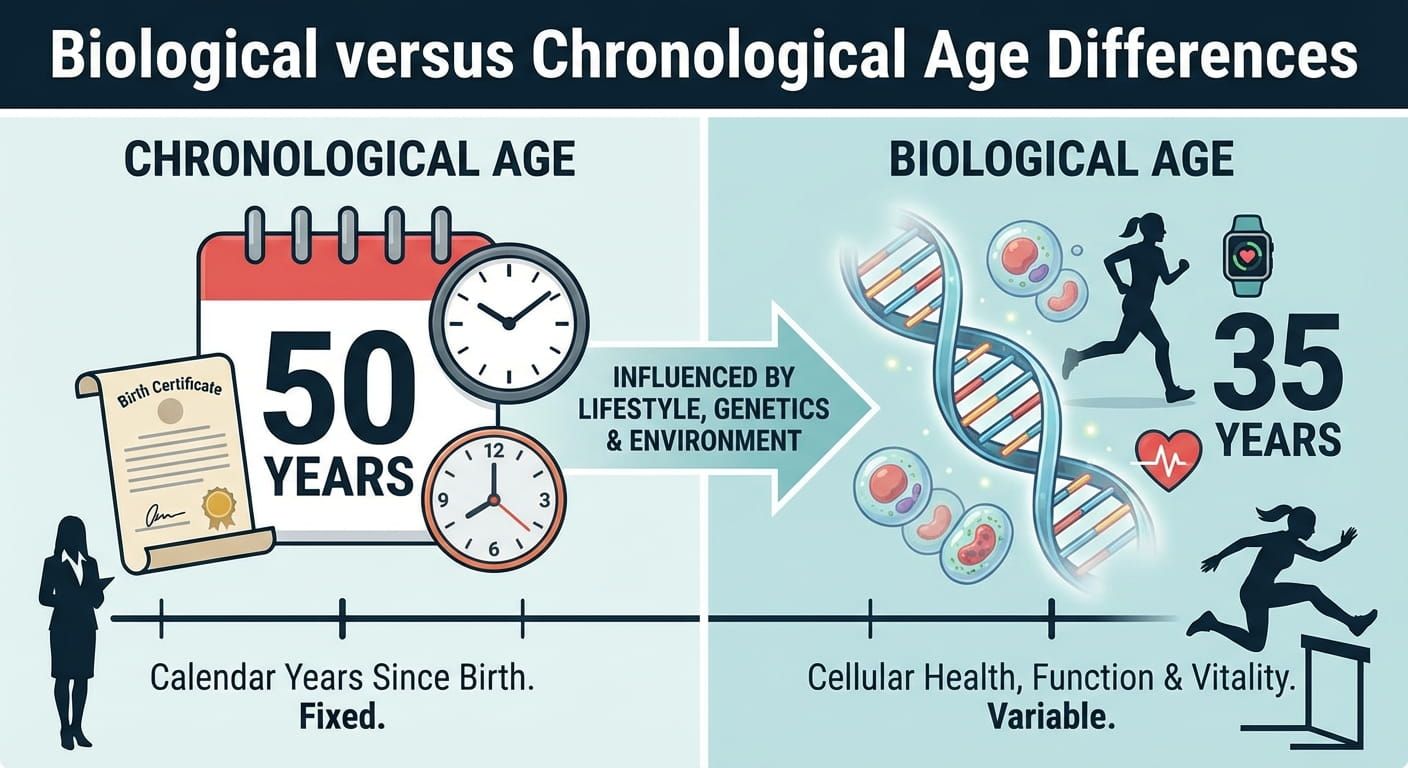
Many parents also run into general age concepts outside pregnancy. If you have ever wondered why “age” can mean different things in different contexts, the perspective in biological vs chronological age can make the bigger idea feel familiar, because it shows how “age” shifts based on what you are measuring.
How long should you use adjusted age?
This is one of the most common questions, because people want a finish line. There is not one universal rule, yet there are common patterns.
Many professionals use adjusted age for developmental expectations until around 24 months. Some stop earlier, especially for babies born only a few weeks early who catch up quickly. Some continue a bit longer if a child was born very early or had medical complications. What matters is whether adjusted age still helps you interpret progress fairly. If it does, it remains useful. If it no longer changes the interpretation, it can fade from daily talk.
In practical terms, you can think of adjusted age as a bridge. It helps you cross the early months with clearer expectations. Once the gap feels small, the bridge matters less.
Common questions parents ask, answered with care
Birthdays are chronological age. Celebrate the day your baby arrived. Adjusted age is mainly a development tracking tool, not a social calendar.
The form may ask chronological age. You can share adjusted age in a note if it helps staff understand expectations for feeding, sleep, or milestones. Keep it simple and factual.
Start by checking which age you are using. Many worries fade once adjusted age is applied. If concerns remain, bring them up early. Early support is about helping skills grow, not labeling a child.
Bullet points in one paragraph you can save
• Gestational age is pregnancy weeks counted from last menstrual period and often refined by early ultrasound dating.
• Chronological age is time since birth and fits everyday schedules and celebrations.
• Adjusted age is chronological age minus weeks early, and it helps interpret milestones more fairly in the first years.
• Saying both ages out loud reduces confusion in appointments and family conversations.
• Consistency matters more than perfection, pick a method and stick with it across notes and charts.
How time tools can reduce mental load for families
Time stress is real for new parents. You have appointments. You have feeding logs. You have sleep questions. Then you add a second age system, and it is easy to feel lost. A time focused site can help by taking the counting work off your brain. Time.you exists to provide exact time for any time zone across the world, showing current time in major cities, countries, and time zones. It is an atomic clock synchronized time service, built for precise time display across time zones. That same love of accuracy can be useful for age math too.
Even outside baby tracking, time math is everywhere. People schedule reminders, track durations, and compare dates. If you ever need to anchor a moment, like the exact time a contraction pattern changed, or the exact duration between feeds, it helps to think in reliable time units rather than fuzzy memory.
Time zones and medical notes, why exact time can matter
Most age counting is date based, yet sometimes the hour matters. Families who travel, families with cross border care, and families who deliver away from home can run into time zone confusion. A birth time recorded in one time zone may be viewed in another. That can shift the date when you cross midnight. It rarely changes adjusted age in a meaningful way, yet it can change official paperwork or how a hospital portal displays dates.
If you are tracking events across locations, keep a note of the local time zone for each key moment. It helps keep your records clean. It can also prevent disputes about which day something happened, especially around midnight.
Prematurity, milestones, and patience as a strategy
Parents often want one neat sentence that predicts the future. That is human. Yet development is more like a series of small changes than a straight line. A preterm baby may catch up in one area fast and take longer in another area. Adjusted age helps you set kinder expectations, yet it does not remove all uncertainty. That is normal.
Here are a few gentle ways to use adjusted age without turning it into a scoreboard:
- Use it to choose the right milestone ranges, not a single deadline day.
- Use it to frame progress, not to compare your baby with a friend’s baby.
- Use it as a conversation starter with professionals, not as a final verdict.
If you find yourself spiraling into comparisons, it can help to return to one calm truth. Your baby is learning, even when it is not obvious. A few weeks can change coordination, attention, muscle tone, and stamina.
How adjusted age is calculated in more detail
Adjusted age is built from two pieces. The first is chronological age, the time since birth. The second is “weeks early,” which is the difference between a reference pregnancy length and the gestational age at birth.
Most of the time the reference is 40 weeks. Here is the core equation written in everyday words:
Adjusted age equals time since birth minus time born early.
That means if a baby is born at 36 weeks gestational age, they are about 4 weeks early. If the baby is 10 weeks old on the calendar, the adjusted age is about 6 weeks. If a baby is born at 28 weeks gestational age, they are about 12 weeks early. If the baby is 20 weeks old on the calendar, the adjusted age is about 8 weeks.
Parents sometimes ask if they should subtract days, not just weeks. You can. Many clinicians talk in weeks because it is easier and often accurate enough for milestone talk. If you want to be very precise, count in weeks and days. The concept stays the same.
Gestational age methods, last menstrual period and ultrasound dating
Two common methods show up in real care:
- Last menstrual period counting. This uses the first day of the last menstrual period as the start and counts forward in weeks and days.
- Ultrasound dating. This uses measurements from an early scan to estimate gestational age and due date.
Last menstrual period counting is simple and widely used. Ultrasound dating can improve accuracy when cycles are irregular, when the date is uncertain, or when ovulation timing was different than average. Once a clinic picks a dating method, they typically keep it consistent across the rest of the pregnancy.
This is also why two people with the same conception date can have different reported gestational ages, depending on how their cycles and dating methods line up. It can feel confusing. It is not a sign something is wrong. It is just the reality of using an estimate for a biological process with natural variation.
When a few days matter, screenings and care windows
Some prenatal tests and scans are time sensitive. Growth assessments also rely on gestational age. If a pregnancy is dated a bit differently, the timing of these windows can shift. That is why clinics care about accurate dating early. It helps them avoid doing something too early or too late.
Parents can support this by keeping a simple record. Write down the clinic’s official due date. Write down the gestational age stated at key visits. Bring the same notes to each appointment. It reduces the chance of a mismatched record.
Adjusted age and early intervention, what to watch for
Adjusted age is useful for spotting when support could help. Early support can be about motor skills, feeding skills, communication, sensory processing, or social interaction. The goal is not to wait for a crisis. The goal is to respond early if a pattern suggests a baby could benefit from extra help.
Here are signs parents often notice, which can be worth discussing with a professional. These are general observations, not a diagnosis list:
- persistent difficulty with feeding coordination beyond what your care team expects for adjusted age
- limited head control or very stiff or very floppy tone compared with typical ranges for adjusted age
- lack of interest in sounds, faces, or interaction in a way that worries you
- skills that appear then disappear repeatedly
If something feels off, bring it up. You do not need to have the perfect vocabulary. A simple “this worries me” is enough.
Tracking milestones without turning your home into a clinic
It is easy to fall into constant measurement. Many parents do it because they care. Still, too much tracking can steal joy. A better balance is a simple check in rhythm. Note a few milestones monthly, or at visits, and spend the rest of your time being present.
Try this approach:
- Keep one short note with both ages, updated weekly or every other week.
- Pick three skills to notice, like head control, reaching, and vocal sounds.
- Bring questions to appointments, instead of searching for reassurance every day.
This keeps you informed without living inside a spreadsheet.
What about babies born a little early?
Not every early birth leads to long adjusted age use. Babies born just a few weeks early often catch up quickly. Adjusted age can still help for a while, especially if you are comparing milestones with families who had full term babies. In many cases, the difference becomes small enough that it stops being worth calculating. Parents often find they naturally stop mentioning it once the baby’s skills line up closely with peers.
The key is flexibility. Use the tool while it helps. Drop it when it does not add value.
How to talk about these ages with family and friends
Family members often mean well. They also might not know how prematurity affects early timelines. A short script can help you keep the conversation kind.
- “On the calendar he is five months, adjusted he is three months.”
- “We track milestones by adjusted age, it keeps expectations fair.”
- “She is making progress, it just follows her own timeline.”
This keeps it factual and avoids turning the conversation into a debate.
Why time measurement feels extra intense in the newborn stage
Newborn life is built from cycles. Feeding cycles. Sleep cycles. Growth cycles. When you are tired, time feels both slow and fast. That is why people grasp for numbers. A clear number can feel like control.
The healthier goal is clarity, not control. Gestational and adjusted age create clarity. They make sure everyone talks about the same starting line. They help parents plan, clinicians interpret, and caregivers coordinate.
Time.you focuses on precision and time awareness. That mindset fits this topic. You do not need to obsess. You just need a clear way to count when counting is useful.
From pregnancy weeks to baby months, a smooth handoff
There is a transition point where gestational age stops being the star of the show. Birth happens, and chronological age becomes the everyday number. If a baby is born early, adjusted age joins the conversation. The handoff can feel abrupt, especially after months of hearing pregnancy weeks at every appointment.
A practical way to make the handoff smooth is to keep a small “timeline card” in your notes:
- Official due date
- Gestational age at birth
- Weeks early compared with a 40 week reference
- Adjusted age today
Once you have those four items, you can answer most questions you will get in the first year without redoing math each time.
A note for parents who carry guilt about “being early”
Some parents feel guilt. They wonder if they did something wrong. Most of the time, prematurity is not anyone’s fault. Bodies are complex. Pregnancy is complex. Care teams focus on what is needed now, not on blame.
If you feel guilt, name it to someone safe. A partner. A friend. A clinician. It helps. Your baby benefits most from a parent who has support, rest when possible, and a little more kindness toward themselves.
Keeping age calculations calm and consistent
Gestational age, chronological age, and adjusted age are not competing truths. They are different rulers for different jobs. Gestational age helps guide pregnancy care and timing. Chronological age anchors life after birth. Adjusted age supports fair development tracking for babies born early. Once you know which ruler to use, the numbers stop feeling like a trap. They become a simple language you can use to ask better questions, celebrate progress, and move through early parenthood with steadier footing.
If you ever want to translate a timestamp into a clean number for logs and records, the unix time tool can turn moments into a consistent format that travels well across systems, then you can focus on what the moment meant, not how to format it.