Calendar confusion shows up at the worst moments, project deadlines, flight bookings, payroll cutoffs, school terms, and global launches. One team says week 1, another says week 0, a third says week 53. Dates look different across borders, and a single day can shift depending on where the week starts. This guide pulls the major international calendar standards into one clear picture, with practical examples you can use right away.
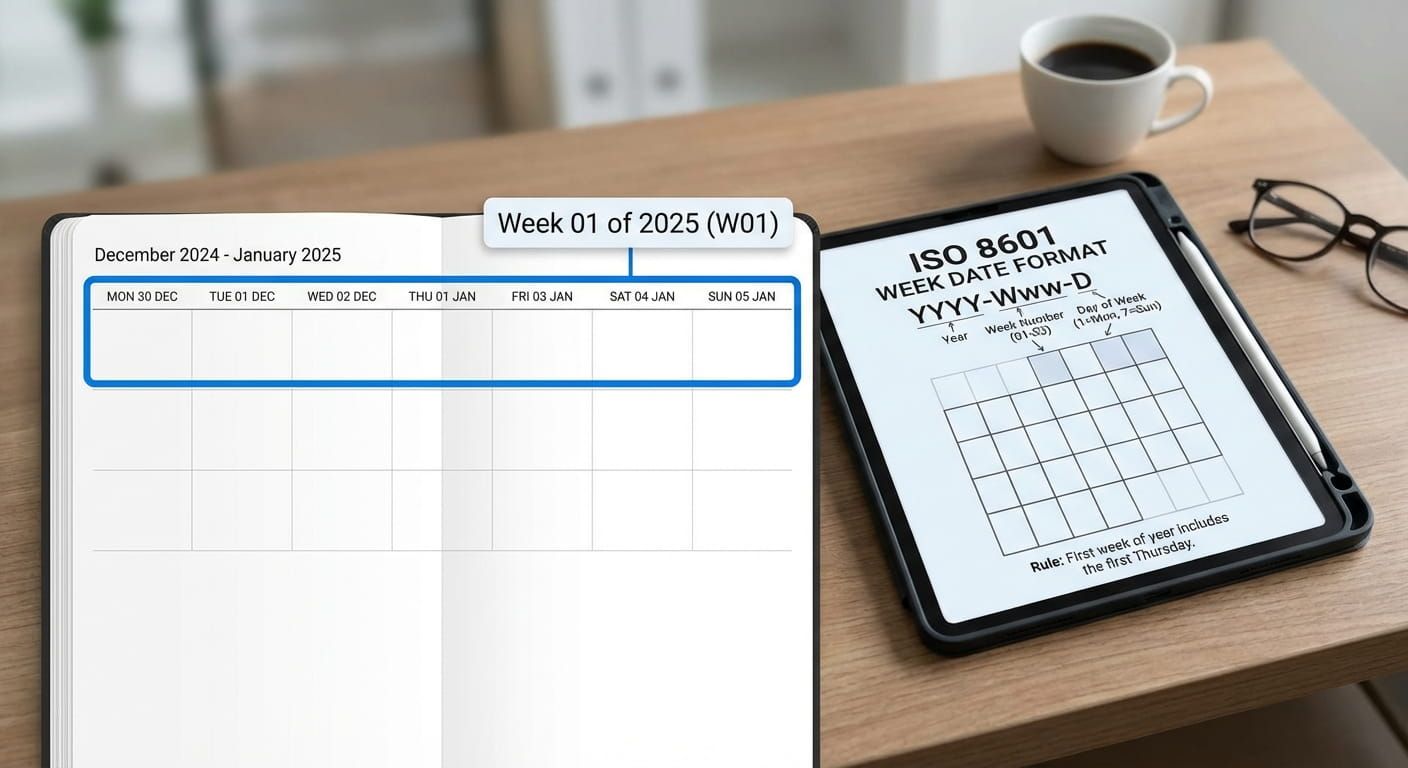
International calendar standards help people agree on dates, weeks, and time across borders. The most common backbone is ISO 8601, which defines a consistent date format and a week date system where weeks start on Monday and week 1 is the week with the year’s first Thursday. Leap years follow a predictable rule, and date math becomes reliable once you choose a standard, a time zone, and a clear week numbering system.
What counts as an international calendar standard
Some standards are official, written by international bodies. Others are widely adopted conventions that act like standards because tools and systems depend on them.
In daily life, you will usually meet three layers:
- Calendar rules that define months, leap years, and day ordering, usually the Gregorian calendar.
- Date and time formatting rules used in documents and systems, most commonly ISO 8601.
- Week numbering rules used in planning, reporting, and scheduling, often ISO week numbers.
If your team spans London, Madrid, Berlin, Paris, Rome, Toronto, New York, São Paulo, Mumbai, Sydney, Tokyo, and Seoul, standards stop being “nice to have”. They become the only way to keep everyone talking about the same day.
Test your date skills before we go deeper
This interactive check helps you spot the most common week and format pitfalls. Your answers stay on the page.
1) In ISO week numbering, what day does the week start on?
2) Which format is least ambiguous for a global audience?
3) A year has 53 ISO weeks when
ISO 8601 in plain language
ISO 8601 is the backbone for international date and time notation. It does two big jobs. It defines a clear date format, and it defines a week date system that many countries and businesses use for planning.
The date format you can trust
The safest format for global communication is year, month, day. It sorts well, reads well in software, and avoids the US versus Europe swap. For example, 2026-03-05 is March 5, 2026 everywhere.
ISO 8601 also defines times and time zones. A full timestamp can include hours, minutes, seconds, and an offset from UTC. That matters when a meeting time is set in Singapore, but attended from New York or London.
If you need to convert between formats without guessing, the ISO 8601 converter helps you check that your inputs and outputs match the standard.
The ISO week date idea
ISO week dates look like a year plus a week number plus a weekday number. That sounds unusual, yet it is perfect for planning cycles, sprints, and reporting periods. A week date avoids month boundaries, which can split a work week in half.
The official rules are easy to carry in your head:
- Weeks start on Monday.
- Week 1 is the week that contains the year’s first Thursday.
- Every ISO week year has 52 weeks, and sometimes 53.
If you want the formal background and examples, the explanation inside ISO 8601 week date standard lays out how the week year can differ from the calendar year around New Year.
Week numbers across countries and why arguments happen
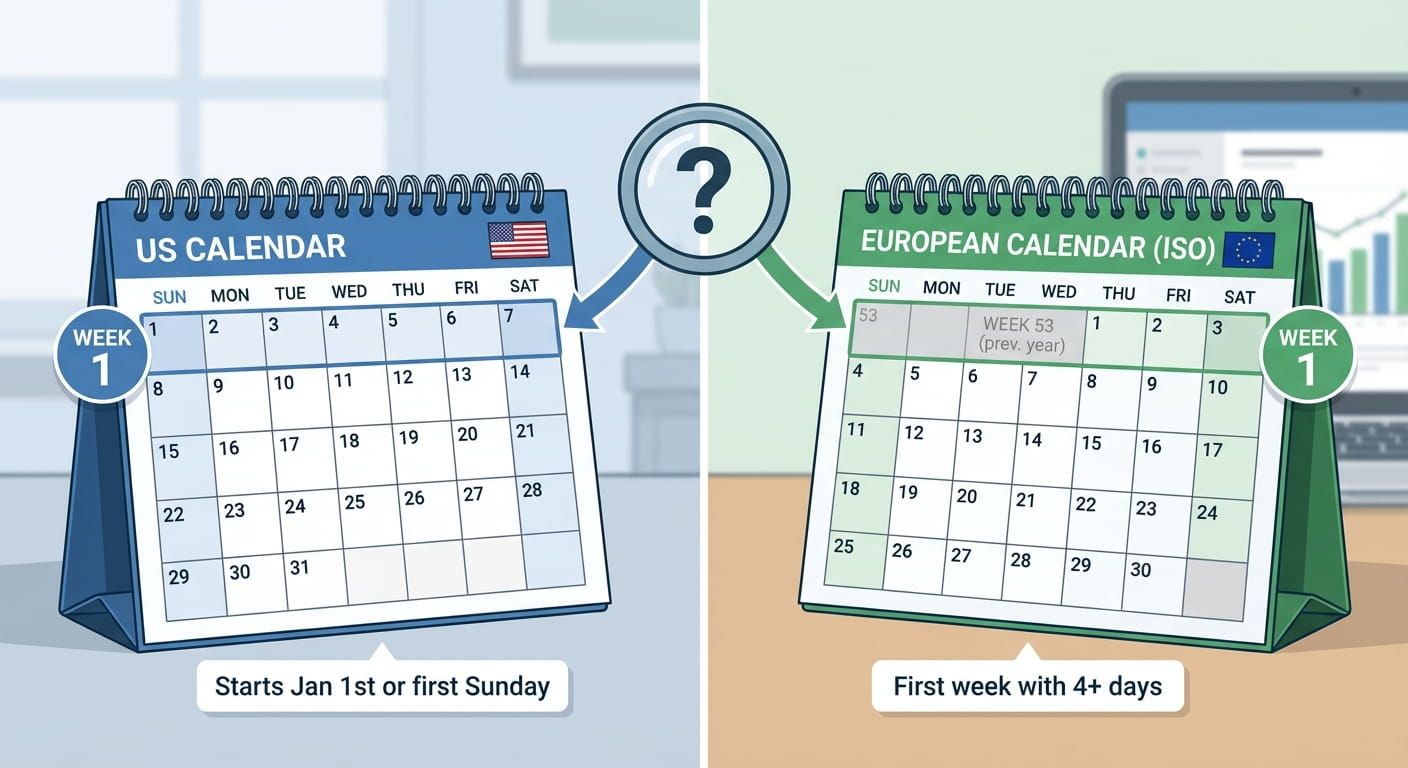
Week numbers seem simple until you compare countries. In much of Europe, week 1 usually follows ISO rules. In the United States, many calendars show weeks starting Sunday, and week numbering can be less consistent between products.
The result is predictable. A report deadline is tagged as week 10, then someone in another region opens a different calendar and sees a different week number for the same Monday. If that sounds familiar, the practical comparison in US vs Europe week numbers shows why the same date can land in different week counts depending on the rule set.
Even within one country, the week start day can vary by industry. Retail, education, and manufacturing may follow different conventions. If your team keeps tripping over Sunday versus Monday, the guidance in week start Sunday or Monday can help you pick one rule and document it.
Why some years have 53 weeks
A 53 week year sounds like a mistake. It is not. It is a calendar alignment effect. ISO weeks are full Monday to Sunday blocks. Most years fit into 52 blocks plus a little extra. Some years have enough extra days at the start or end that a full extra week appears.
This is the part that surprises people in finance and reporting. A fiscal plan built on week blocks may end up with an extra week in certain years. The details and examples in why some years have 53 weeks make it easier to spot those years early, before budgets and staffing models get awkward.
A helpful habit: store both the calendar date and the ISO week date for records that drive weekly reporting. It turns “Which week is this?” into a simple lookup.
Leap years and month lengths, the steady rules underneath
Most international systems use the Gregorian calendar for civil time. That brings stable month lengths and a leap year rule that is predictable across centuries.
The leap year rule
- A year divisible by 4 is a leap year.
- Except years divisible by 100 are not leap years.
- Except years divisible by 400 are leap years.
This explains why 2000 was a leap year, while 1900 was not. For modern planning, the main takeaway is that February can be 28 or 29 days. That single day affects due dates, anniversaries, interest calculations, and any “add one year” logic.
Months, quarters, and business reporting
Months are uneven, which is why weekly planning often works better than monthly planning. Quarters are used heavily in finance and reporting because they provide a consistent rhythm even when months vary.
Quarters are typically grouped as:
- Q1: January to March
- Q2: April to June
- Q3: July to September
- Q4: October to December
Internationally, the quarter labels are consistent, but the fiscal year start month can differ by company or country. That is not a standards issue, it is a policy issue. The trick is to label clearly, for example “FY2026 Q1” and define your fiscal year start month once.
Date math that does not surprise you
Date math sounds easy until time zones enter the room. The gap between two calendar dates depends on what you mean by “day”, and where your clock lives.
Days between two dates
If you are counting whole days between two dates, decide whether the start date counts, whether the end date counts, and whether you are counting midnight boundaries or 24 hour spans. For project timelines, midnight boundaries are usually what people expect. For durations, 24 hour spans may be the right choice.
The time zone trap
A day boundary in Tokyo is not the same instant as a day boundary in New York. If you store timestamps, store them with a time zone offset or store them as UTC plus a separate time zone field. That keeps conversions honest.
Time.you’s mission is aligned with this reality. It provides precise, atomic clock synchronized time across time zones, which supports consistent conversions when people check “right now” in different regions.
Use a week number tool when weeks drive the plan
If your schedule is built around week blocks, use a direct week lookup. The week number view is handy when you need to agree on the current week instantly across regions.
For a specific date, the week number calculator helps you translate a date into its week position under the chosen rules, which is useful for sprint planning and reporting.
Common date formats around the world
People often assume their own date format is universal. It is not. A format like 03/05/2026 is ambiguous. In the United States it is usually March 5, 2026. In many other places it is May 3, 2026. That is a real risk for travel bookings and legal documents.
A safer practice is to use ISO 8601 date format in international settings, and reserve local formats for local audiences where confusion is unlikely.
Country calendars you can use as reference points
Sometimes the easiest way to settle a disagreement is to look at a trusted calendar view for the region in question. These pages can help you align expectations without arguing about settings.
- Planning a launch for Madrid and Barcelona, check Spain's calendar for week layout and local holidays.
- Coordinating Tokyo and Osaka, Japan's calendar is a solid reference for month structure and local observances.
- Working across New York and Los Angeles, United States' calendar helps teams align on visible weeks and dates.
- Scheduling around London and Manchester, United Kingdom's calendar can be useful for planning windows and public holidays.
- Handling Sydney, Melbourne, and Perth timelines, Australia's calendar supports planning across AEST aligned work weeks.
A reading friendly checklist for teams that work globally
Use this checklist as a shared agreement. It prevents recurring confusion in documents, spreadsheets, and project tools.
- Choose one display format for global work. ISO 8601 date format is a safe default for shared docs.
- Pick a week rule and write it down. If you use ISO week numbers, state Monday week start and the week 1 rule.
- Store timestamps with time zone context. Use UTC with an offset or keep a separate time zone field.
- Decide how you count days. Clarify inclusive versus exclusive counting for deadlines.
- Label quarters with the year type. Use “FY” labels if your fiscal year differs from the calendar year.
- Validate edge dates. Check late December and early January dates, that is where week year shifts happen.
Working with week numbers in spreadsheets and reports
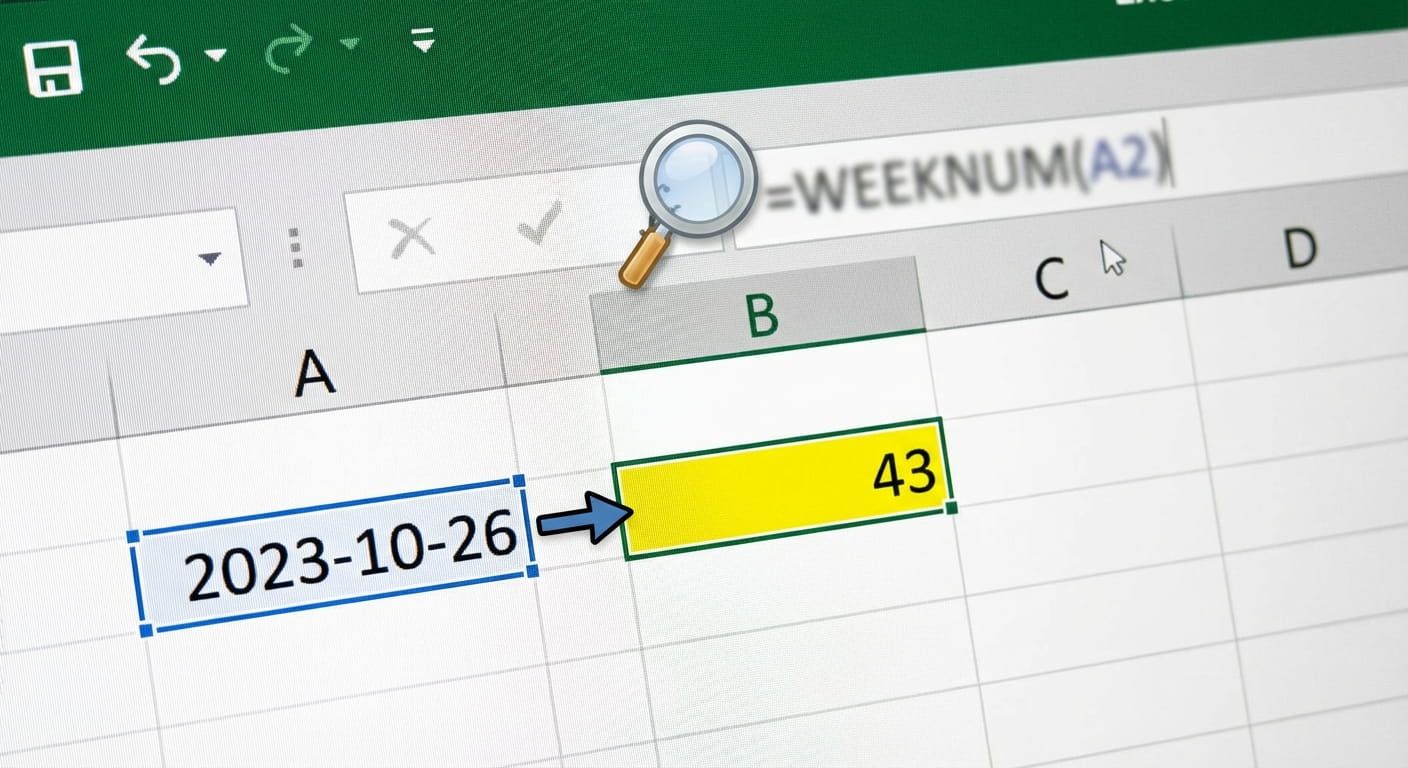
Many teams meet week numbers in Excel or similar tools, then wonder why results differ across functions or settings. Week calculations can change based on whether the week starts Sunday or Monday, and how week 1 is defined.
If your reporting lives in spreadsheets, the practical tips in find week numbers excel can help you align formulas with the week system you actually use.
A final note for stress free dates and weeks
Calendars feel personal because everyone grew up with a default. International work asks for a shared default instead. Pick a standard, apply it everywhere, and document it once. Use ISO 8601 for dates and ISO week numbers if weekly planning drives your workflow. Then keep a trusted calendar reference per region, from Paris to Berlin, from Rome to Mumbai, from Toronto to São Paulo, from Sydney to Tokyo. Your future self will thank you the next time a deadline lands near New Year.