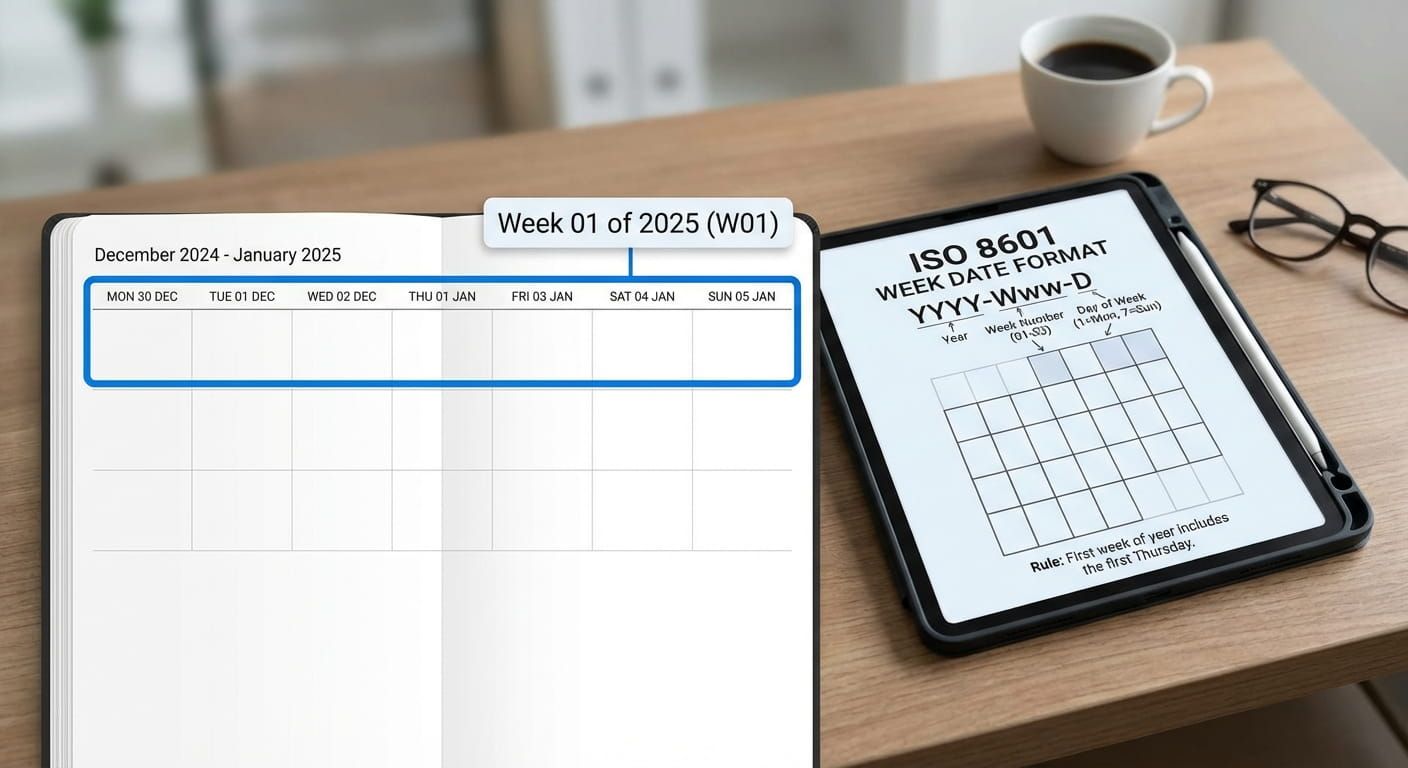
Week 01 can start in late December. That surprises people every year, and it is exactly why the ISO 8601 week date standard exists. It gives you a consistent way to label weeks and weekdays across countries, calendars, and software, even when New Year’s Day lands midweek.
ISO 8601 week dates label a week based year, a week number, and a weekday number. Week 01 is the week with the year’s first Thursday, which also means the week containing January 4. Weeks start on Monday. This system keeps reporting, planning, and date math consistent across regions, and it avoids the confusion of “week of the year” rules that vary by country and app.
How ISO week dates are built
ISO 8601 defines a week date using three parts:
- Week based year, the year label for the week system, which can differ from the calendar year near New Year
- Week number, from 01 to 52, and sometimes 53
- Weekday number, from 1 to 7, where 1 is Monday and 7 is Sunday
The week based year is not “the calendar year you are in.” It is “the year that week belongs to” under ISO rules. That is why late December can be Week 01 of the next week year.
The usual written form uses digits for the year, a letter W for the week, and a digit for the weekday. Many examples online show hyphens in the format. In this article, the pieces are shown with spaces to avoid the hyphen character while keeping the idea clear: YYYY W ww D.
The rule that decides Week 01
Here is the heart of the ISO week system, stated in plain language.
- Weeks start on Monday.
- Week 01 is the week that contains the first Thursday of the calendar year.
- That is the same as saying Week 01 is the week that contains January 4.
Those two equivalent tests, first Thursday and January 4, are handy. If you are scanning a calendar, you can spot January 4 quickly. If you are doing date math in code, the Thursday rule is often easier to express.
Knowledge check you can tap through
Why calendars disagree about week numbers
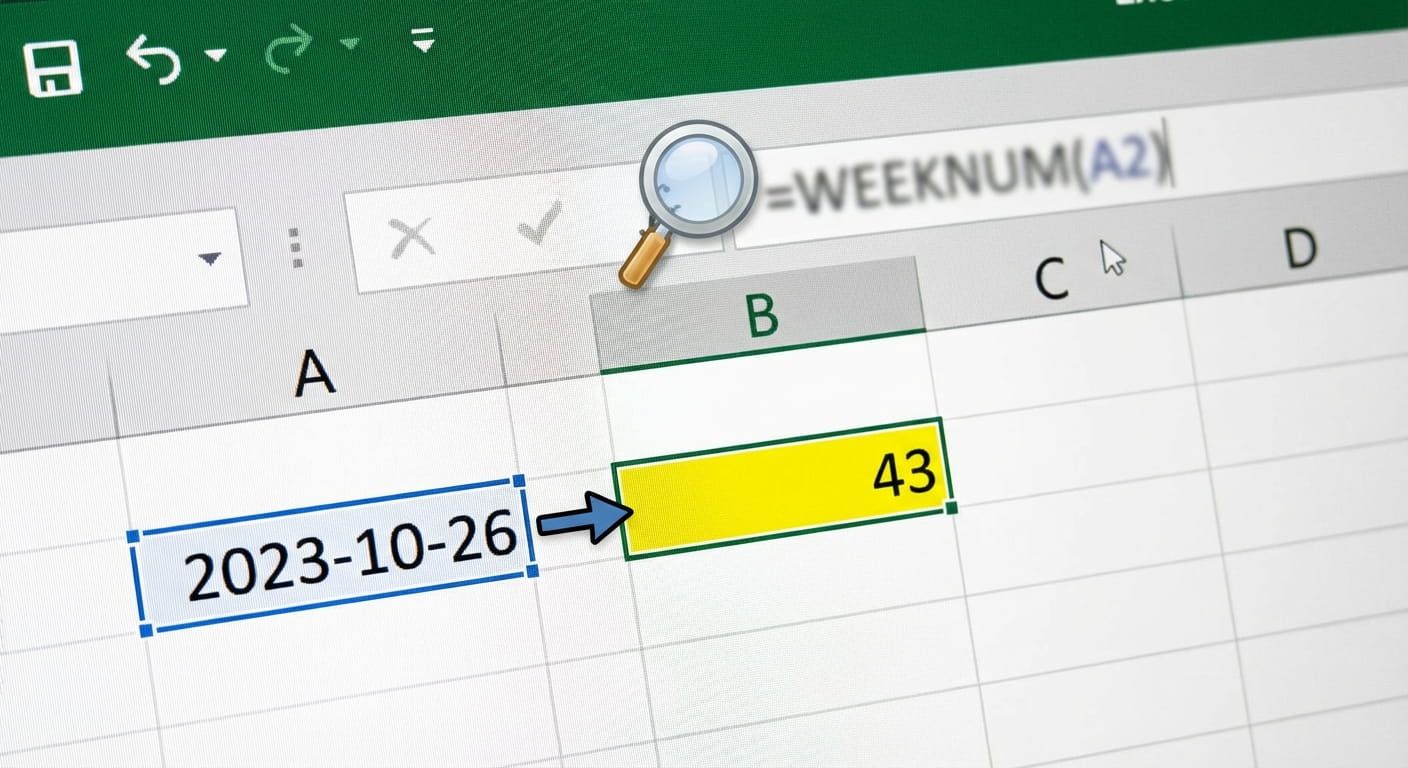
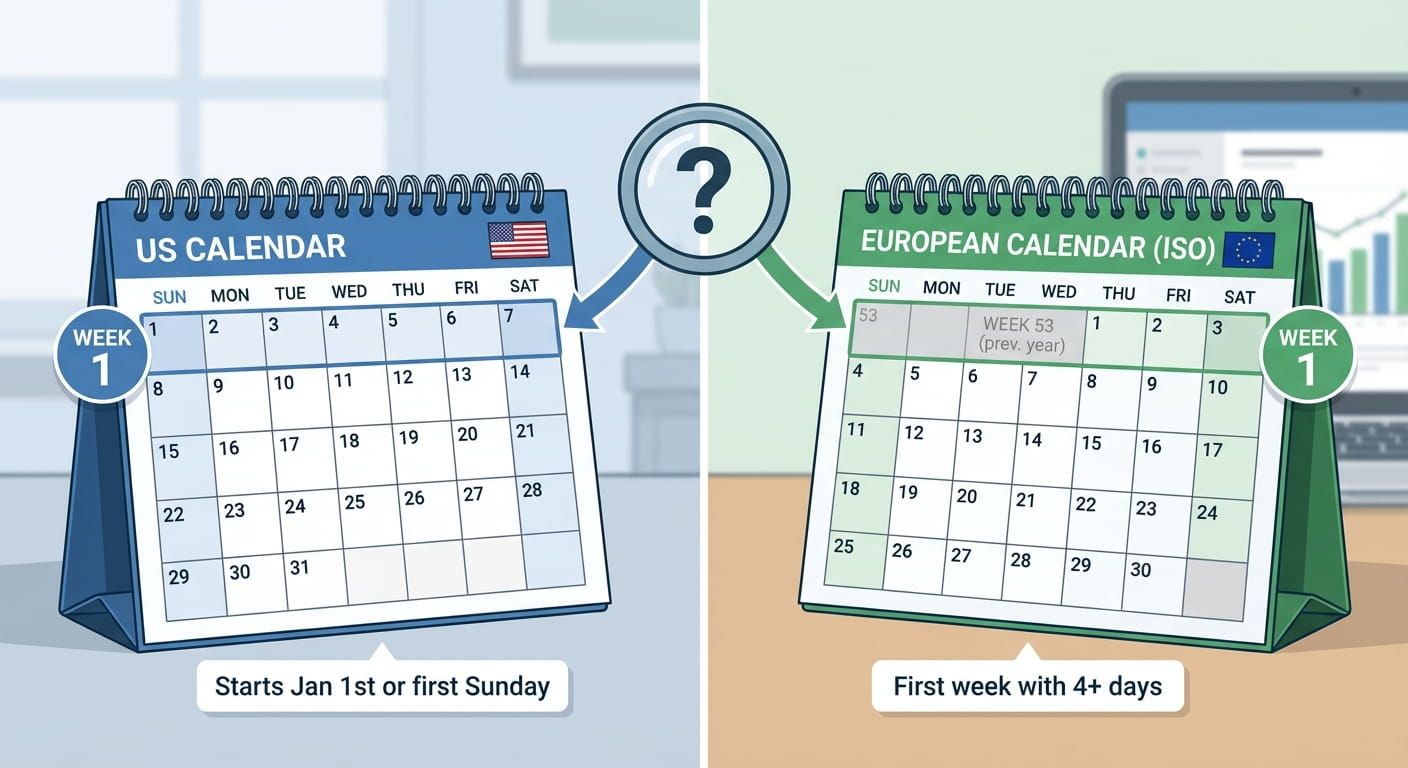
Week numbers seem simple until you compare apps. Some calendars start weeks on Sunday. Others call the first partial week of January “week 1” even if it only has one day. ISO 8601 fixes that by requiring Monday starts and a clear definition of Week 01.
This consistency matters if you share schedules between teams in different countries. It also matters for reports and school terms, where “Week 12” should mean the same thing in Singapore, Germany, and the United Kingdom.
A practical way to read an ISO week date
Imagine you see a week date written as 2026 W 09 3 (shown with spaces here). Read it like this:
- 2026 is the week based year
- 09 is the ninth ISO week
- 3 means Wednesday
If you want to cross check a week number for a specific day, the week number calculator can confirm it without you counting squares on a wall calendar.
Week based years can start in December
Here is the weird part that becomes normal once you expect it. If January 1 falls on Friday, Saturday, or Sunday, that tiny first chunk of January belongs to the last ISO week of the previous week based year. The new Week 01 starts on the next Monday, and that Monday may still be in December of the prior calendar year.
Find the first Thursday of the year. The Monday of that week is the start of Week 01. If that Monday is in December, the week based year still counts it as Week 01 of the new week year.
When a year gets Week 53
Most week based years have 52 weeks. Some have 53. This happens because 52 ISO weeks cover 364 days. A calendar year has 365 days, and leap years have 366. Those extra one or two days have to land somewhere, and sometimes they create a full extra week at the end.
A week based year has 53 weeks when:
- January 1 is a Thursday, in a common year
- January 1 is a Wednesday, in a leap year
That rule may feel random, but it is a direct consequence of “Week 01 contains the first Thursday.” Once you anchor on Thursday, the rest follows.
ISO week basics
| Concept | ISO rule | What it helps with | Common pitfall |
|---|---|---|---|
| Week start | Monday is day 1 | Consistent planning across regions | Assuming Sunday is day 1 |
| Week 01 | Week with the first Thursday, also contains January 4 | Stops “partial week” confusion | Calling the first few January days “week 1” |
| Week based year | Year label for the week system, can differ near New Year | Accurate reports spanning year boundaries | Mixing it with calendar year |
| Week count | 52 weeks, sometimes 53 | Reliable week numbering for year plans | Assuming every year has 52 |
| Weekday number | 1 to 7, Monday to Sunday | Sorting and scheduling | Using 0 for Sunday in ISO contexts |
Where ISO week dates show up in real life
ISO week numbers are not just a trivia item. You see them in places where consistency beats local custom.
Common uses include:
- Manufacturing and logistics schedules, where shipments run by week number
- School terms and training plans, where “Week 7” needs a shared meaning
- Business reporting, especially in Europe, Australia, and multinational teams
- Software sprints and releases, where teams plan in weeks instead of months
If you are coordinating across time zones, it helps to pair week numbers with accurate local time. Time.you’s atomic clock synced service makes that easy, and the calendar view can keep week planning grounded in real dates.
ISO 8601 and date math for days between
Date math sounds simple until you cross boundaries: month ends, leap years, and daylight saving changes in places that observe it. ISO week dates help with one part of the puzzle: week alignment. They do not replace calendar dates, but they give a stable week grid you can count against.
For “days between” calculations, use calendar dates under ISO 8601 full date rules (year, month, day). Then convert to week dates if you need to group or label the results by week. This is common in analytics dashboards where daily data is rolled up into weekly totals.
Store the actual calendar date for each record, then compute the ISO week label for grouping. That way you can always drill back to the day without losing the week context.
How leap years interact with week numbers
Leap years add February 29, which affects day counts and sometimes affects whether a week based year gets Week 53. The key is that ISO week years are tied to weekday alignment, not to months. A leap day shifts the weekday position for the rest of the year, which can push the end of the year into an extra ISO week in certain patterns.
This is one reason why planning quarters purely by “every 13 weeks” can drift against the calendar. It can still be a good planning tool, but it should be checked against real dates and local holidays in places like Japan, India, and the United Kingdom.
Country calendars and week number expectations
Week number culture differs. In much of Europe, ISO week numbers are the default, and Monday starts are normal. In some other places, Sunday start calendars are common, even if the team still talks in ISO weeks for work. That mix can create quiet confusion, especially around Week 01.
It helps to compare views across countries when you work with international teams. If you are coordinating travel, school breaks, or launch windows, a country calendar page can clarify local expectations. For example, planning with partners in Australia often benefits from checking the Australia calendar view, while North American teams might reference the United States calendar for holiday timing.
A step by step way to find the ISO week for any date
If you want to do it by hand once, just to understand the logic, try this method:
- Find the weekday for your date. Monday is 1 and Sunday is 7.
- Find January 4 of that calendar year.
- Find the Monday of the week that contains January 4. That Monday starts Week 01.
- Count how many Mondays have passed from that Week 01 start to reach your date’s week.
- If your date is before Week 01 start, it belongs to the last ISO week of the previous week based year.
Most people do not want to hand count, and you should not have to. A converter can do it instantly and correctly. The ISO 8601 converter is useful when you have a date and need the ISO week label for reporting or logs.
Months, quarters, and why weeks can feel misaligned
Months do not have a consistent length, and quarters vary in day count too. Weeks are steady blocks of seven days, so weeks will always cut across month edges sometimes. That is not a flaw, it is just geometry of the calendar.
For quarterly planning, teams often use a “thirteen week quarter” structure. It lines up well most of the time, but the presence of a Week 53 year and the shifting of weekdays can create edge cases. If you are mapping quarterly goals to week numbers, keep a reference calendar handy for the specific year. Checking a compact yearly view can help, and the 2026 compact calendar is a good example of how weeks flow across months in a single screen.
Using week numbers with exact time zones
Week numbers answer “which week is this day in,” but time zones answer “which day is it right now.” If you have a team split between Singapore, France, Germany, and Brazil, a late night meeting can land on different dates in different places. That changes the week label if the local date crosses midnight.
That is why a good workflow pairs accurate current time with ISO week logic. Time.you is built around atomic clock synchronized time, so the “now” part stays precise across major cities, countries, and time zones. Then you can apply ISO week rules on top without worrying that your base time is drifting.
A final check before you publish or report by week
Before you send a report that says “Week 01” or “Week 52,” take a breath and check two things: does your tool use Monday as the start of the week, and does it define Week 01 using the first Thursday rule. If yes, you are speaking ISO 8601. If not, you might be speaking a local week scheme without realizing it.
Once you get used to ISO week dates, they become a calm, steady reference. Weeks start on Monday. Week 01 is anchored by the first Thursday. And the week based year does its own thing near New Year, in a way that is consistent and predictable.
If you want a simple place to check a week label as you plan, the week number page keeps the week context front and center, which is exactly what this standard was designed to support.