Public holidays look simple on a calendar, until you work across countries, plan travel, manage school terms, or try to book a meeting with teammates spread from Tokyo to Toronto. One country pauses for a national day, another is celebrating a religious festival that moves each year, and a third is observing the holiday on Monday because the date lands on a weekend. This guide pulls the big patterns together and gives you a solid starting point for checking any country and any year.
Key takeaway
Major public holidays fall into a few global families: fixed date civic days, moving religious festivals, and seasonal breaks that shift by local rules. The same name can mean different dates in different places, and observed dates often move when a holiday lands on Saturday or Sunday. Use this page to recognize the most common holidays, understand how dates are set, and jump into country pages to confirm the exact day for your year and location.
Holiday check in
Pick one answer for each question, then tap the button to see how you did.
What counts as a public holiday
A public holiday is a date officially recognized by a government or authority. Many workplaces close, schools may pause, and public services often run on reduced hours. The details vary. Some places define a national set of days off, others combine national and regional days, and some industries follow their own rules. If you are sorting out time off expectations at work, the employee rights overview at employee rights on public holidays is a helpful companion.
Tiny detail, big impact
A holiday name alone is not enough. The same label can land on different dates, and the day off can shift. Always check the country and the year.
Major global public holidays and why they show up everywhere
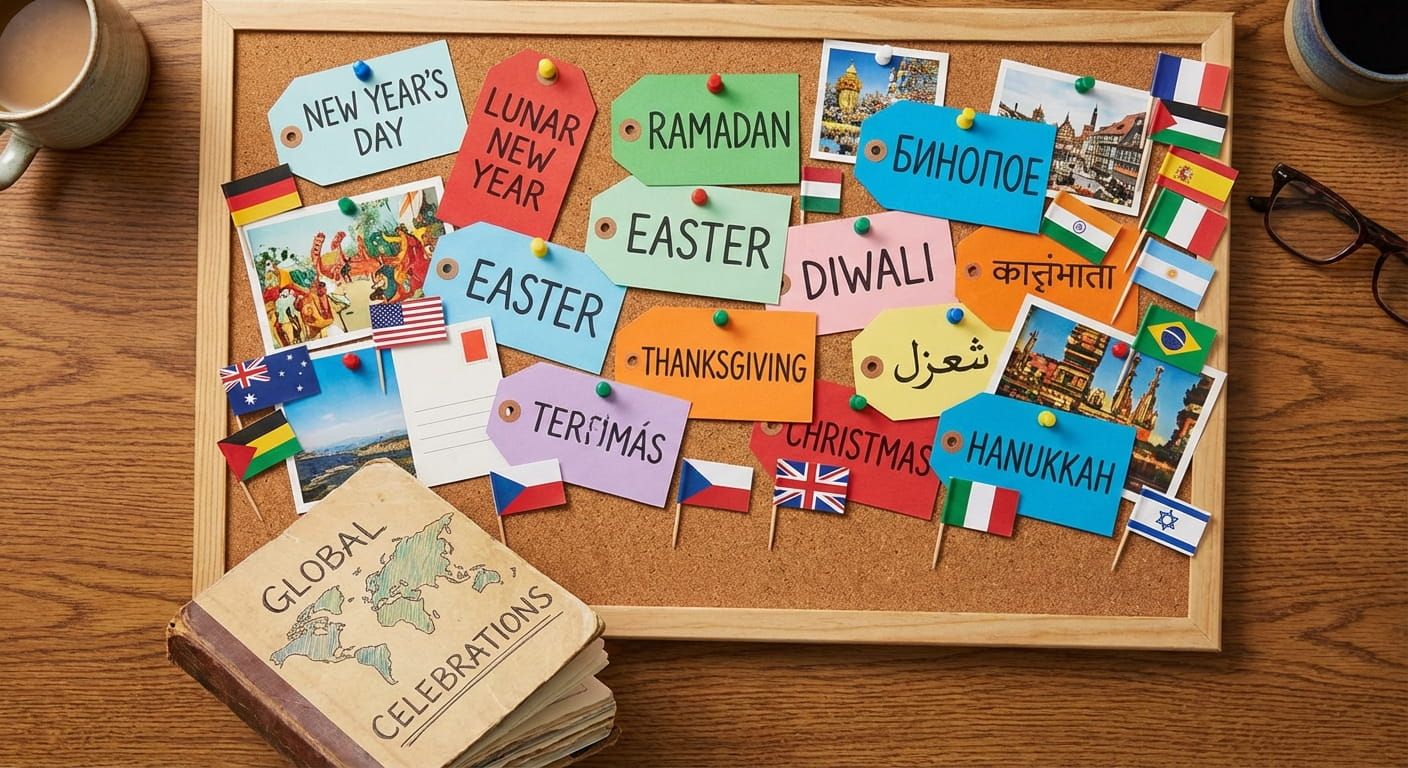
No single list fits every country, yet certain holidays appear again and again because of shared history, religion, or global business rhythm. These are the big ones you will see most often in international schedules:
- New Year’s Day, celebrated widely on January 1, often with a public holiday.
- Labour Day or May Day, tied to workers’ rights in many places, commonly in early May.
- Christmas Day, a public holiday in many countries, typically December 25.
- Easter related days, including Good Friday and Easter Monday in parts of Europe, Africa, and the Americas.
- National day or independence day, unique to each country but similar in purpose.
- Lunar New Year, central in East Asia and observed in many communities worldwide.
- Eid holidays, important across many Muslim majority countries and also observed in diverse societies.
- Diwali, especially significant in India and places with large Indian communities.
Fixed date, floating date, observed date
Most public holiday confusion comes from these three ideas.
Fixed date holidays
These stay on the same date each year. New Year’s Day is the easy example. National days often work this way too, although some countries use a particular weekday instead.
Floating date holidays
These move because they follow a lunar calendar, a religious calculation, or a rule like “the first Monday of a month.” Eid al Fitr and Eid al Adha are based on the Islamic calendar. Lunar New Year follows a lunisolar calendar. Easter is calculated using a church calendar method, so it shifts between late March and late April.
Observed dates
When a holiday lands on Saturday or Sunday, some countries move the day off to Friday or Monday. Others create a substitute day, and some do nothing at all. If you want the patterns and examples, the explanation at public holiday observed dates gives a clear set of scenarios.
A snapshot table you can scan fast
This table is not a legal calendar. It is a practical overview of widely seen holidays, the kind you will hear in international planning meetings. After this, jump into country pages to confirm exact dates for your year.
How to use this guide with Time.you
Time.you is built for the real world problem of time zones. It shows exact current time across major cities, countries, and timezones, with an atomic clock synchronized backbone. That same precision mindset fits holidays too, because a holiday is only helpful when it is tied to the right local date. If you are planning around specific countries, open their holiday pages and check the year you care about:
Start with Singapore holidays if you want a clean example of a compact national list, then compare it with India holidays, where national and regional patterns add more variety.
Regional patterns that shape public holiday calendars
Americas
In North America, many holidays use weekday rules, which helps create long weekends. In the United States, federal holidays often land on Mondays, and observance rules are common. Check United States holidays when you need the exact day off used in practice. In Latin America, independence days and religious holidays both matter, and some countries add “bridge” practices through local custom. For a South American reference point, Brazil holidays is a good example of a calendar that mixes civic history with widely recognized religious days.
Europe
Europe has a strong mix of Christian holidays and national civic days. Many countries recognize Good Friday, Easter Monday, and Christmas, plus local patron or national days. The United Kingdom has bank holiday traditions that can feel different from public holidays elsewhere, and the wording can trip people up. The explainer at difference between bank and public holidays helps you match the label to what actually closes. For a compact reference, France holidays shows a set that many international teams run into.
Middle East and North Africa
Many countries in this region recognize Eid holidays, and the date can depend on lunar calculations or official announcements. You will also see national days that reflect modern state history. If you work across the Gulf, always verify whether the public sector and private sector share the same days off. For an example calendar, open United Arab Emirates holidays.
Africa
African holiday calendars often blend national independence dates with major religious days. In some countries, regional observances add more local days. If you need an example that combines national history, faith traditions, and modern civic days, South Africa holidays is worth a look.
Asia Pacific
Asia Pacific is where you see the widest range of holiday timing rules. Lunar New Year affects China and nearby regions, while India’s calendar includes festivals that can vary by state. Japan has a distinct set of public holidays and rules around substitute holidays, visible at Japan holidays. Australia blends fixed dates with Monday rules and regional differences, which you can confirm at Australia holidays. This is also the region where time zone planning is most obvious, because a date difference can appear while the workday is still in motion on the other side of the world.
The planning moves that prevent calendar mistakes
If you only remember a few habits, make them these. They reduce surprises for families, travelers, and global teams.
- Check the country and the year. A holiday list from last year can be wrong this year, especially for lunar based festivals.
- Look for observed rules. A holiday may be “on” a Saturday but “off” on Monday, depending on the place.
- Confirm regional differences. Provinces, states, and territories can add their own days.
- Separate name from date. “National Day” tells you meaning, not timing. The date is always country specific.
- Plan meetings with time zones and holidays together. A meeting time that looks fine in one city can land on a closed day in another.
Public holiday names you will see often, with plain language explanations
New Year’s Day
A global reset. Many countries treat January 1 as a public holiday. Some also recognize the next day, especially when celebrations run late. In places where January 1 lands on a weekend, the day off may shift to the next weekday.
Lunar New Year
Celebrated across East Asia and many diaspora communities. It can bring multiple days off, and the travel rush can be massive. Even where it is not an official public holiday, it can still affect business rhythm.
Easter period
Good Friday and Easter Monday are common public holidays in many countries with Christian traditions, though the specific day off varies. Because Easter moves each year, these holidays move too.
Labour Day
Often tied to worker movements and labor rights. Many countries observe it on May 1, while others choose a different date. It is one of the most common public holidays worldwide, and it can create surprise closures for cross border work.
Eid al Fitr and Eid al Adha
Major Islamic holidays. In several countries, the exact date is announced close to the time based on lunar observation or official calculation. Expect dates to shift by a day between countries, and sometimes within a country depending on the authority.
National days and independence days
Every country has its own story here. These are fixed in purpose but not in timing. They often come with ceremonies, fireworks, parades, and government closures. For travel, they can mean big crowds and limited services. For work, they can mean a full stop for offices and banks.
Where “next holiday” questions get tricky
People often ask, “What is the next holiday?” The honest answer depends on location, current date, and whether you mean a public holiday, a bank holiday, or an observance that is not an official day off. It also depends on what counts as “next” across time zones. If it is late evening in Los Angeles, it may already be tomorrow in Auckland. This is where Time.you’s exact time view pairs naturally with holidays. You can avoid the classic mistake of assuming the date is the same everywhere at the same moment.
Common misunderstandings, cleared up
- Same holiday name means same date, often false. Dates and rules differ.
- Weekend holiday means no day off, not always. Many places shift the day off.
- Public holiday equals full shutdown, not guaranteed. Essential services may run, and retail can vary.
- All regions follow the national list, not true in many countries with federal structures.
If you are curious which countries tend to have more days off each year, the overview at most public holidays adds context that helps when comparing calendars.
A simple way to keep holiday planning human
Public holidays are not just empty squares on a calendar. They are family gatherings, remembrance days, religious celebrations, and national moments. If you are scheduling across borders, a small check can prevent an awkward meeting invite on someone’s biggest day of the year. If you are traveling, knowing the holiday can explain why trains are packed, why shops are closed, or why a city feels extra alive. Keep the habit: verify by country and year, respect observed rules, and use local time when you confirm a date. Your plans will feel calmer, and people will notice.