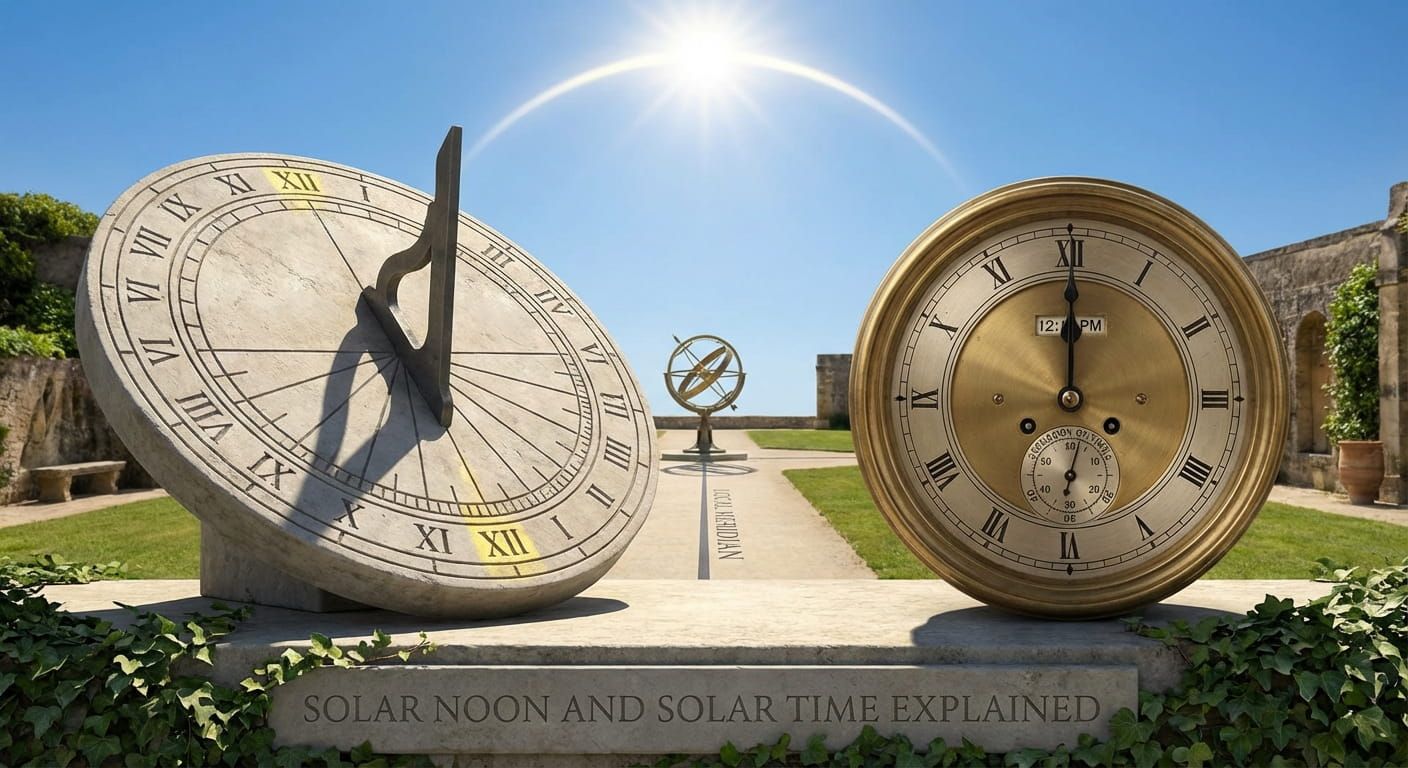
Stand outside on a clear day and watch your shadow. It slides across the ground, changes shape, and reaches its shortest point once each day. That moment is solar noon, the Sun’s highest point in your local sky. It sounds simple, yet it explains why two towns in the same time zone can feel slightly out of sync, why sunrise times drift day to day, and why your clock is a helpful compromise rather than the sky’s rulebook.
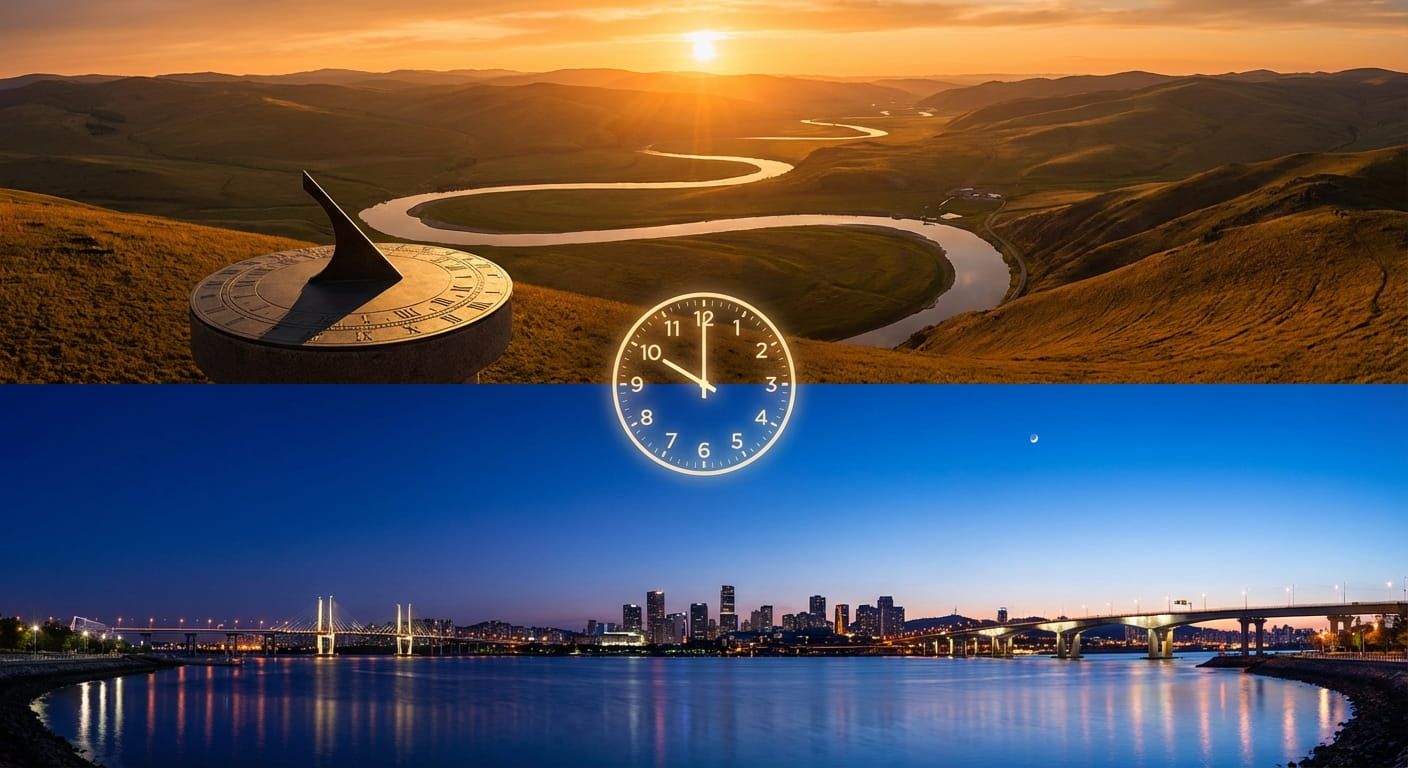
Solar noon is the daily moment the Sun is highest for your location, when shadows are shortest. Solar time is time measured by the Sun’s position, with solar noon marking 12:00 in that system. Clock time uses time zones and standard minutes, then adds local choices, to keep schedules consistent. The gap between solar time and clock time comes from longitude, time zones, Earth’s tilt, and Earth’s changing orbital speed.
A friendly quiz to test your Sun sense
Answer these five questions, then tap Check answers. This quiz runs in your browser, no sign in needed.
Solar noon, the shadow moment that sets the day
Solar noon is not a clock setting. It is a sky event. It happens when the Sun crosses your local meridian, the imaginary line that runs from north to south and passes through the highest point in your sky. At that moment:
- Your shadow is at its shortest length for the day, assuming fairly level ground.
- The Sun is at its highest altitude for that day.
- The Sun is due south in many places north of the equator, and due north in many places south of the equator.
People often mix up solar noon with the idea of the Sun being straight overhead. Only locations within the tropics can get the Sun directly overhead, and only on certain days. That is why solar noon in Nairobi can feel intense, while solar noon in Stockholm can still feel low and gentle, especially in winter.
Plant a stick upright in the ground and mark the tip of its shadow every ten minutes. The shortest mark points to solar noon. This also gives you a reality check on how your clock time lines up with the Sun where you live.
Solar time, the day measured by the Sun
Solar time answers a simple question: where is the Sun in the sky right now? In solar time, local solar noon is 12:00 by definition. Solar sunrise and solar sunset sit roughly around 06:00 and 18:00, yet only roughly, because day length changes with seasons and latitude.
- Solar time matches the Sun’s daily rhythm, mornings feel like mornings because the Sun is still climbing.
- It gives a location specific meaning to noon, based on the sky rather than a time zone map.
- It explains why two places share a time zone but do not share the same Sun position at a given clock time.
Solar time is also why old town clocks and church bells once varied from city to city. Before standardized time zones, each place followed its own Sun. That worked for local life. It fell apart for railways, telegraphs, and modern scheduling.
Clock time, the compromise that makes schedules work
Clock time is built for coordination. It uses fixed minutes and seconds, then groups longitudes into time zones. That way, Paris and Berlin can run the same meeting time without arguing about where the Sun is at that instant.
Time.you sits right in the middle of this. You can check exact time in major cities and time zones, synced to atomic clock standards, then relate that precision back to the sky. This matters for travel, flights, international calls, livestreams, and that sunrise shoot you planned in another country.
- Time zones are wide, solar noon shifts as you go east or west inside the same zone.
- Some countries pick offsets that fit commerce more than geography.
- Daylight saving time, where used, shifts clocks by one hour compared with the Sun.
The equation of time, why the Sun runs fast and slow
Even if you stayed in one place and ignored time zones, solar noon would still wander a bit across the year. The reason is the equation of time, a compact name for two combined effects.
- Earth’s axis is tilted relative to its orbit, changing how the Sun’s apparent motion projects onto the sky.
- Earth’s orbit is slightly elliptical, meaning Earth’s orbital speed changes through the year.
Put those together and the Sun appears to run ahead or behind an idealized average Sun. The result is that apparent solar time can differ from mean solar time by up to around a quarter of an hour. This is one reason solar noon is not always at 12:00 on your clock, even if you lived close to the center line of your time zone.
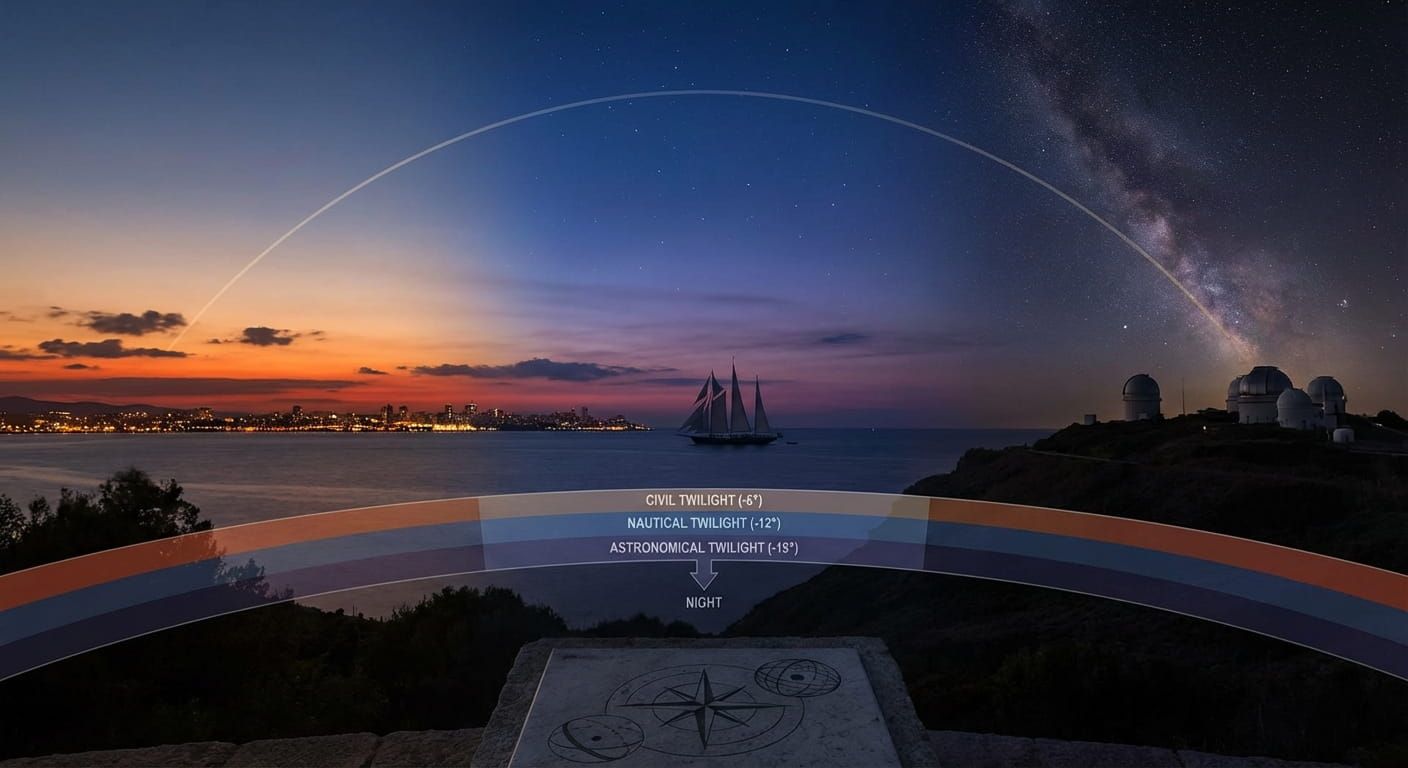
If you enjoy twilight details, the Sun’s path also shapes the definitions of civil, nautical, and astronomical twilight, which is covered in the civil nautical astronomical twilight guide.
Longitude, the quiet reason your noon differs from another city
Longitude is the big lever. Earth rotates 360 degrees in about 24 hours, around 15 degrees per hour. Move east, you reach solar noon earlier. Move west, you reach it later. This stays true whether you are in one country or crossing continents.
Within the United States, solar noon in New York City arrives earlier by clock time than in Chicago, and earlier than in Los Angeles, even when clocks are aligned by time zones. In Europe, solar noon in Berlin and Brussels is not identical, and Madrid can feel shifted because Spain’s clock setting does not sit neatly on its longitude.
A solar noon table you can actually use
The table below maps sky concepts to planning choices. The palette is muted and professional, without leaning on blue.
How to estimate solar noon without special tools
You can get close to solar noon in a few calm steps. This is handy when you are hiking near Reykjavik, camping in Namibia, or planning a family photo in New Zealand where shadows matter.
- Look up your local sunrise and sunset times for the date.
- Add the two times together, then divide by two, that midpoint is a good estimate of solar noon.
- Adjust for daylight saving time if your region uses it.
- Expect a small seasonal offset because the equation of time nudges the Sun ahead or behind the average.
To keep the first step smooth, pick the place that matches your plan. If you are planning around the early light in South Asia, sunrise in India gives a country level view that helps you choose a city and date. If you are thinking about a European trip, sunrise in France makes it easy to see how morning timing changes between regions.
For evening plans, local sunset timing is often the anchor. In East Asia, sunset in Japan can help you line up dinner, street photos, and that last warm light. In North America, sunset in the United States is useful for comparing how far the same date stretches across a wide country.
Solar noon through the seasons, latitude changes everything
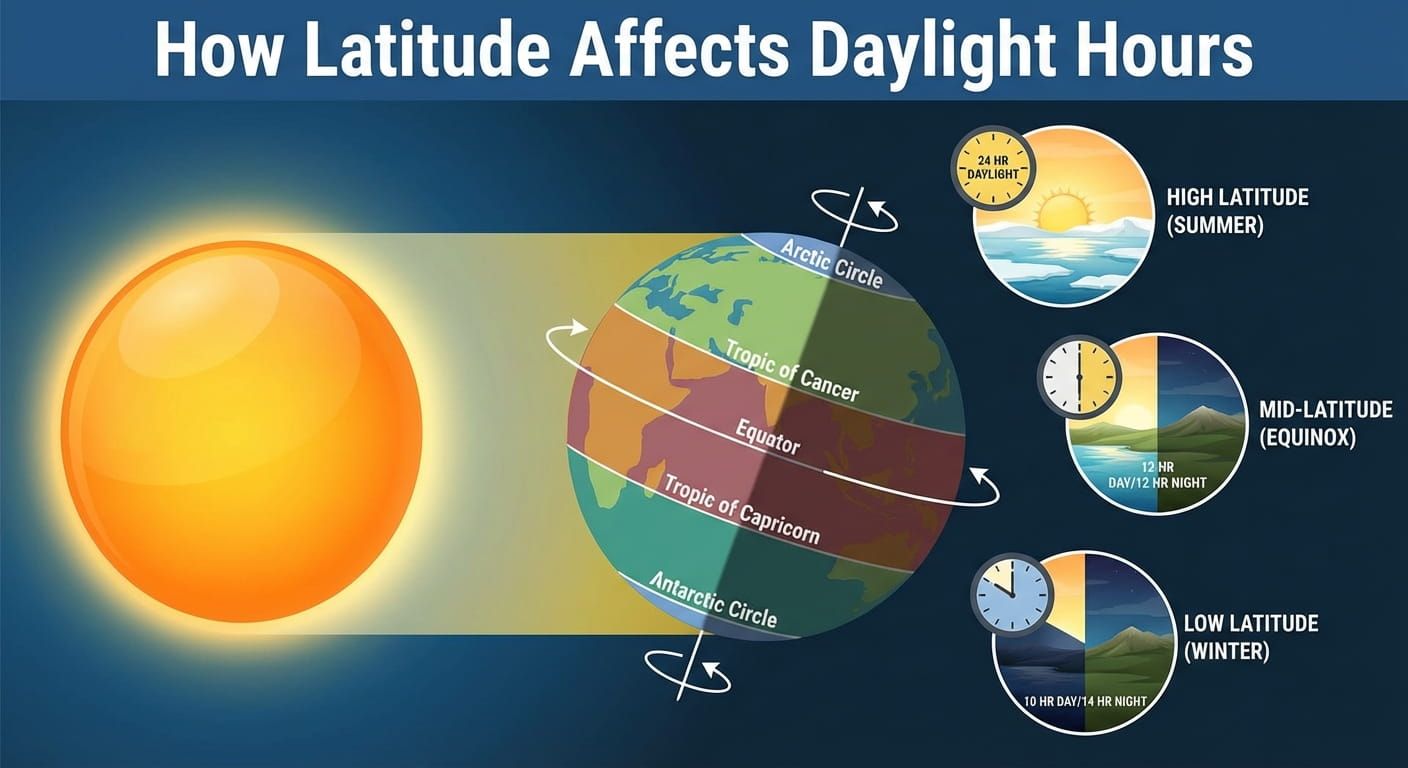
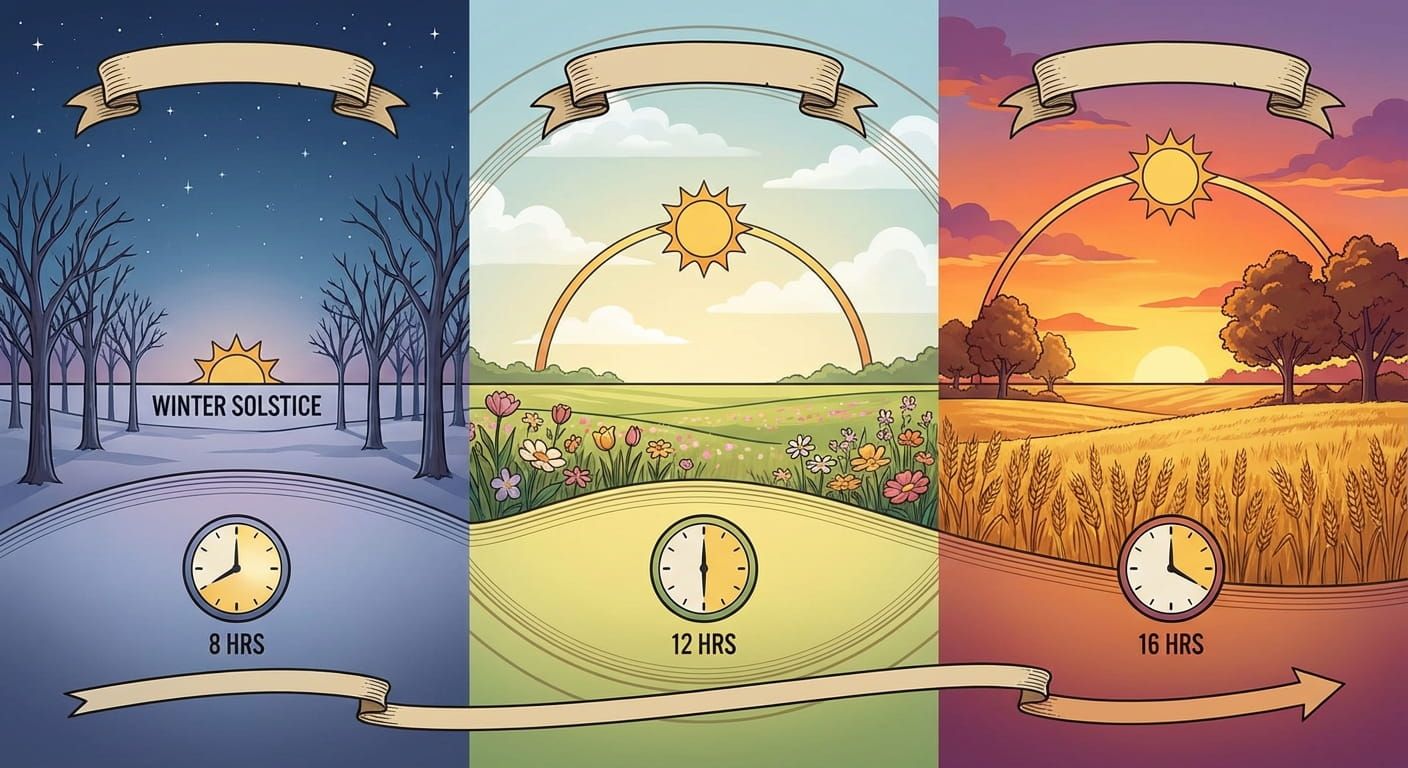
Latitude decides how high the Sun climbs and how long the day lasts. This is where sunrise and sunset become a story, not just numbers.
- Near the equator, places such as Singapore, Kampala, and Nairobi often see day length that stays fairly steady through the year.
- Mid latitudes, places such as Rome, Paris, Vienna, and Toronto see noticeable seasonal swings in daylight.
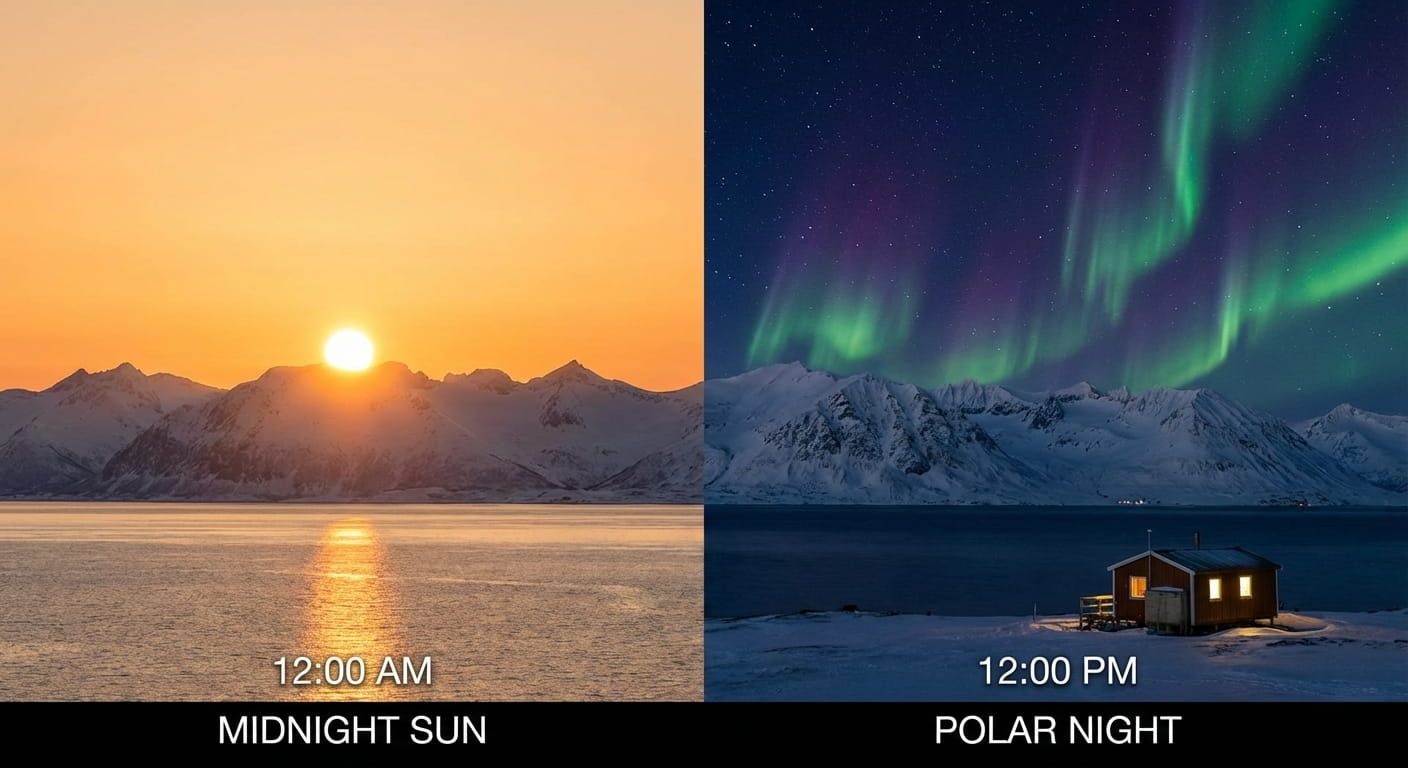
- High latitudes, places such as Stockholm, parts of Greenland, and Norway can see extreme daylight patterns.
Those swings change the feel of your day. In Sydney, late summer evenings can stay bright longer than visitors expect. In Moscow, winter daylight can feel tight, with a low Sun even at solar noon. This is also why the timing of golden hour and blue hour shifts a lot from season to season.
A list of solar time moments people actually plan around
Here is a compact set of planning moments, written for everyday life rather than a classroom.
- Morning ramp, the hour after sunrise, useful for softer light and cooler air.
- Solar noon window, a short span around the Sun’s highest point, when shadows are sharp.
- Afternoon slide, the period after solar noon when shadows stretch again.
- Pre sunset stretch, when angles soften and light warms in many climates.
- Twilight layers, the staged fade after sunset, where the sky keeps changing.
Solar noon around the world, examples that make it click
Solar noon is personal to a spot on Earth. These mini scenarios show why it feels different across cities.
All three cities run by modern time zones, yet their solar noon times do not line up. In New York City, solar noon tends to arrive earlier by clock time than in Chicago. In Los Angeles it tends to arrive later still. The Sun follows longitude, not the time zone border.
London’s clock setting sits closer to its Sun position than Madrid’s does. Madrid can feel shifted, because the clock choice pulls noon away from the sky’s midpoint more than many visitors expect. This is why daylight can feel later in the day than your instincts predict.
In hot climates, solar noon connects to heat planning. Outdoor schedules in Dubai and Riyadh often lean early or late to avoid the most intense overhead Sun. Cairo adds its own rhythm, blending latitude, local routines, and the Sun’s climb.
This region shows how longitude stacks across a wide area. Tokyo and Seoul sit farther east than Shanghai and Hong Kong, and the Sun reflects that. Manila sits in between many of these longitudes, while its seasonal daylight changes add another layer to what noon feels like.
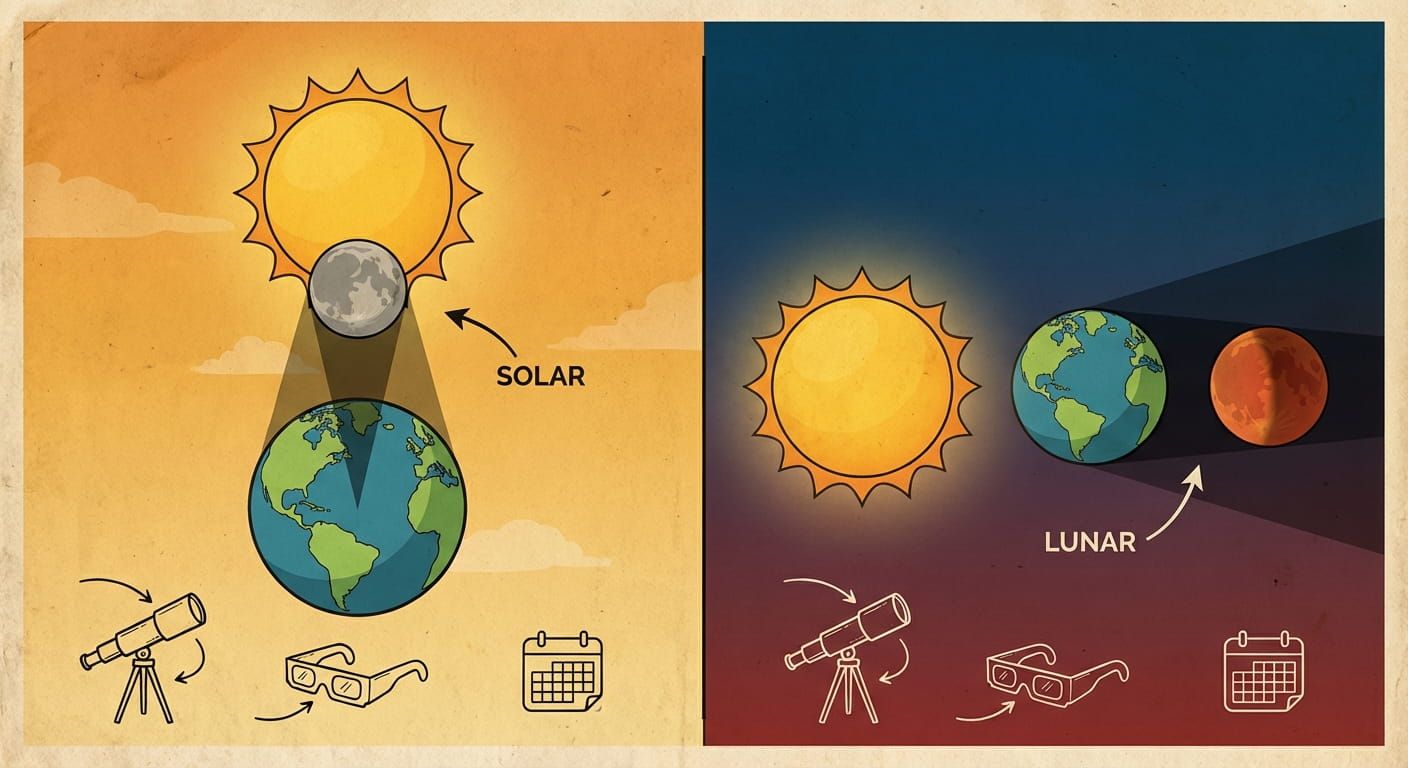
Sky events beyond daily Sun timing can also add context. If you are curious about rare alignments over Europe, eclipses in London is a neat way to see how the Sun and Moon line up across the calendar.
Common questions people ask after learning solar noon
Is solar noon always the hottest part of the day?
Usually not. The warmest time often comes later because the ground and air keep absorbing heat after solar noon. This lag can be noticeable in places such as Bangkok, Delhi, and Mexico City.
Does solar noon mean the Sun is due south everywhere?
No. It depends on your hemisphere. Many locations north of the equator see the Sun due south at solar noon, many locations south of the equator see it due north. Near the equator, the direction can flip through the year.
Why does solar noon change from day to day?
The equation of time shifts the Sun’s apparent schedule across the year. Your longitude within the time zone adds another offset.
Can I convert clock time to solar time?
Yes in a practical sense. Start with your clock time, then adjust for your longitude relative to the central meridian of your time zone, and account for the equation of time for the date. Many people only need a rough estimate, especially for photography, gardening, or outdoor workouts.
A final look at noon, with the sky as your clock face
Solar time gives the day a physical anchor. The Sun rises, climbs, peaks, and falls, and your location makes that pattern unique. Clock time gives everyone a shared plan, synced and steady, a tool for modern life. Put them together and you get a richer sense of time, precise enough for meetings in Zurich and Amsterdam, and still connected to the shadow on the ground outside your door.