Week numbers feel simple until a flight, a project plan, and a school schedule collide. You check a calendar in the United States, then you open a calendar in Germany, and the same date lands in a different week number. Nothing is broken, two different counting rules are at work. This guide explains the common US approach, the ISO approach used across much of Europe, and how to switch between them without missing a deadline.
Summary
US week numbers often treat Sunday as the first day of the week and count week 1 as the week that contains January 1. Many European calendars follow ISO 8601, Monday starts the week, and week 1 is the week with the year’s first Thursday. That shift changes week numbers near New Year and can create week 53 in some years. Use a reliable converter, confirm the rule set in invites, and label dates with both week number and full date.
Quiz: Week numbers edition
Pick the best answer, then check your result.
Why week numbers can feel inconsistent
Week numbers are a shortcut. Instead of saying “the Monday after next,” teams say “week 14.” Factories plan production by week. Sports leagues publish fixtures by week. Schools share term schedules by week. It works nicely until two people use different rules.
Most of the year, the difference stays hidden because the week number lines up anyway. The friction shows up near the edges of the year, late December and early January. A date that is still in the last week of the old year under one rule can be labeled as week 1 of the new year under another. That is why international teams in France, Italy, Spain, the United Kingdom, Canada, and the United States sometimes talk past each other even while looking at the same day.
How the United States commonly counts week numbers
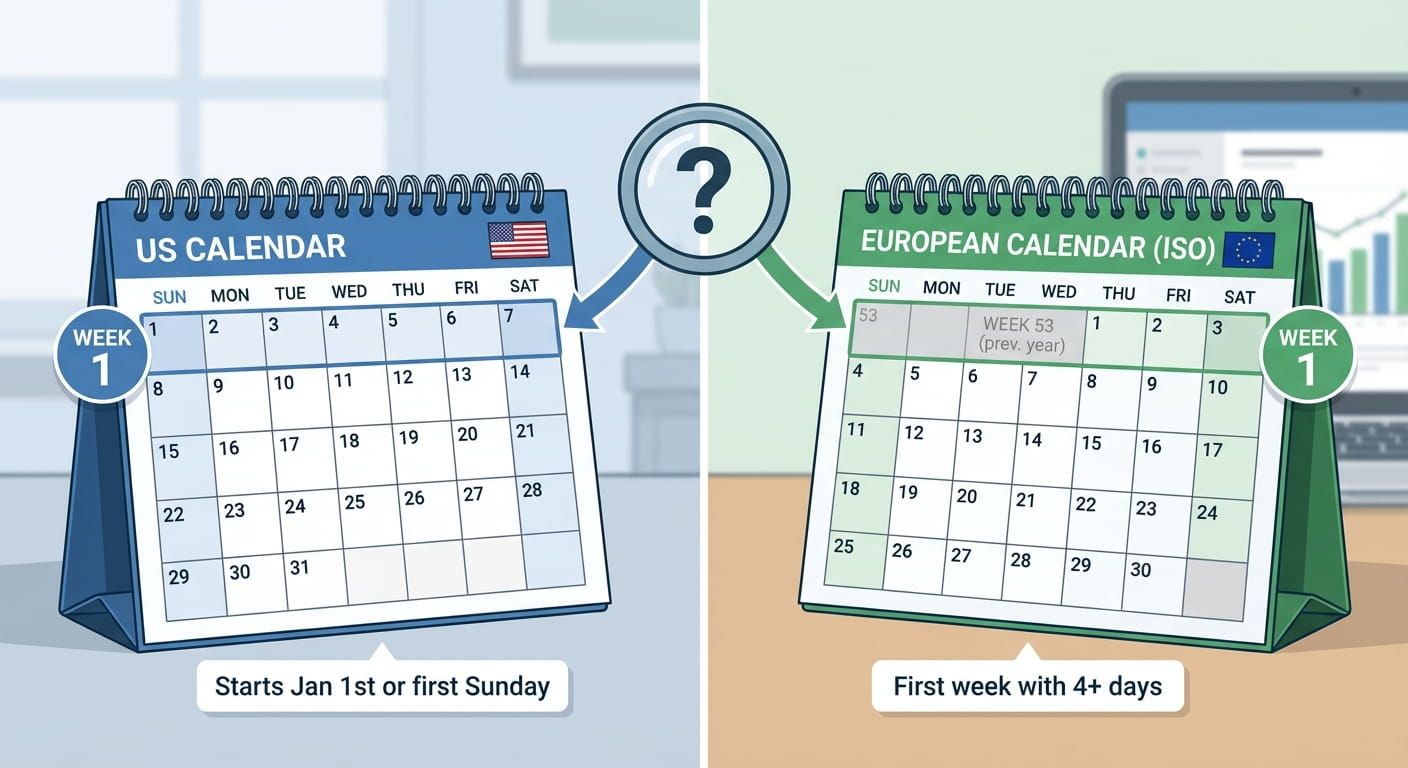
In the United States, week numbering is often informal. Many calendars and planners treat Sunday as the first day of the week. A typical rule of thumb sets week 1 as the week that contains January 1. Under this approach, the first partial week of January still counts as week 1 even if it has only a couple of days in the new year.
That sounds straightforward, and it is, but it has tradeoffs. Because the first week can be short, the last week can also be short. If you are building schedules by full weeks, those partial weeks can make comparisons across years feel uneven.
If you want to see how this looks in a full year view, United States scheduling is easy to scan inside United States calendar. The important part is not the design, it is the assumption that the week often starts on Sunday in US contexts.
How Europe and many global teams use ISO week dates
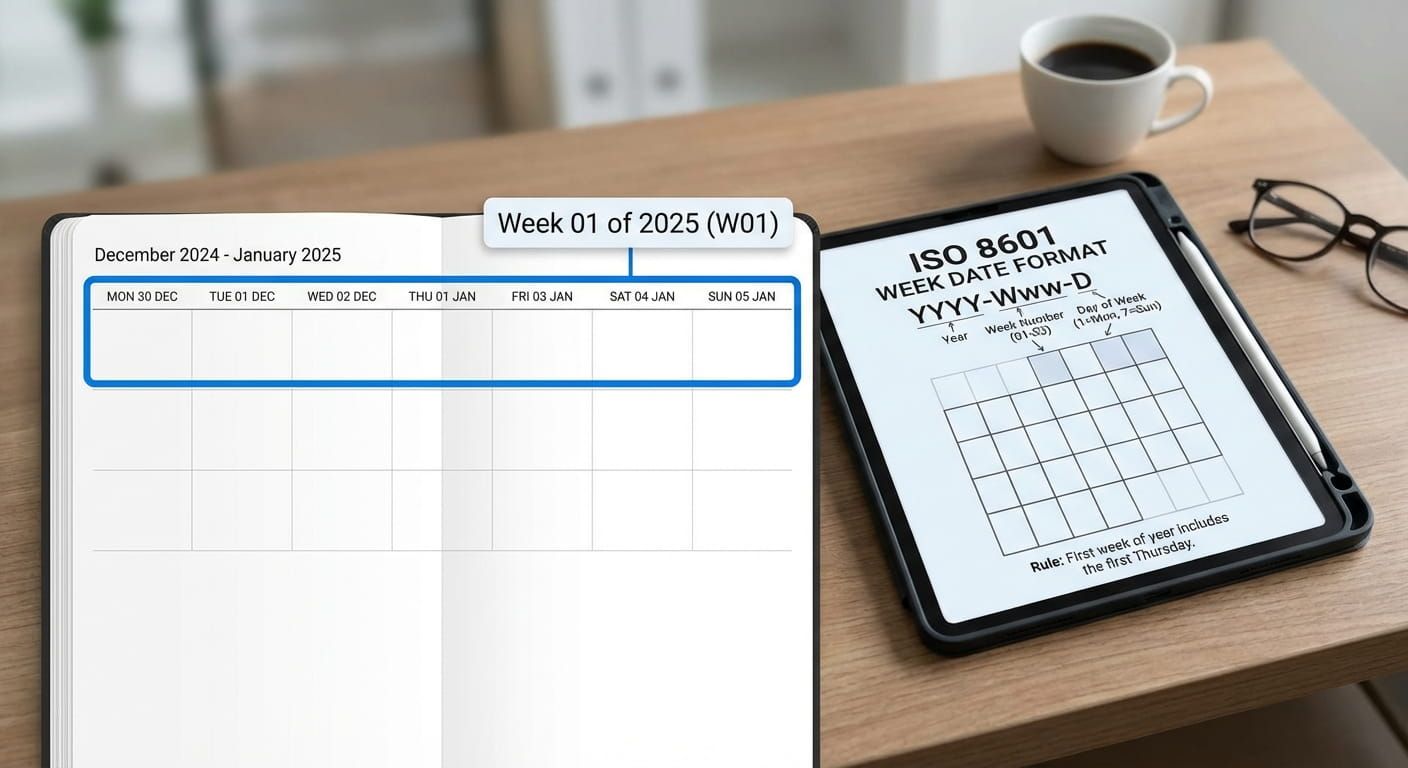
Across much of Europe, week numbers usually follow ISO 8601 week date rules. In that system, Monday starts the week. Week 1 is not defined by January 1. It is defined by the first week that contains the year’s first Thursday. Another way to say the same thing, week 1 is the week that contains January 4.
This rule keeps weeks consistent. ISO weeks are always full weeks, Monday through Sunday. That helps planning in places where week based logistics and staffing are common, including Germany, France, Spain, Italy, and also many international companies with teams spread across regions.
If you want the formal standard in plain language, the ISO approach is explained clearly in iso 8601 week date standard. Even if you never read standards, it helps to know the two anchor points: Monday start, first Thursday defines week 1.
Quick reality check: A date can belong to week 1 of a year in ISO while still being in the last week of the previous year in a US style calendar. This is normal near New Year.
A side by side view of the rules
| Topic | Common US approach | ISO approach used across much of Europe |
|---|---|---|
| Week start day | Often Sunday | Monday |
| What makes week 1 | Week that contains January 1 | Week that contains the first Thursday, also the week with January 4 |
| Partial weeks | Can appear at start or end of year | Avoided, weeks stay full |
| Year boundary surprises | Less common inside the year, still happens near New Year | More noticeable near New Year because week 1 may begin in late December |
| Best use case | Personal planning inside the US, many local calendars | International operations, logistics, cross border teams |
Where week 53 comes from and why leap years matter
Most years have 52 weeks plus one extra day. A normal year has 365 days. Divide 365 by 7 and you get 52 weeks with 1 day left. A leap year has 366 days, that is 52 weeks with 2 days left.
Those leftover days are the reason week numbers can shift from year to year. In an ISO system, the calendar tries to keep weeks full and aligned to Monday through Sunday. That structure means some years need a week 53. It does not happen randomly. It depends on which day of the week the year starts and ends, plus whether there is a leap day.
If you want a deeper explanation with examples, why some years have 53 weeks breaks down the patterns. The useful takeaway is simple: week 53 exists in ISO calendars for specific year layouts, and it often appears right where people are most likely to be on vacation or closing books for the year.
Examples across countries, the same date viewed two ways
Picture a company with a sales team in Canada, a support team in the United States, and an engineering team in France. A meeting invite says “week 1 planning session.” If the invite does not include an actual date, the teams may pick different Mondays.
ISO weeks are widely used in Europe. A manager in Germany might open Germany calendar and see the ISO week number right next to each row. A colleague in Japan might check Japan calendar and still run into ISO week labels because many global tools default to ISO. Meanwhile, a US based planner might rely on a Sunday start layout.
Spain is a classic example for ISO week usage in everyday planning. If you are coordinating travel or work there, Spain’s week layout in Spain's calendar makes it clear how Monday centered weeks drive the count.
Australia, Brazil, India, Italy, South Korea, and the United Kingdom may show week numbers differently depending on the calendar product, but ISO is common for international work. If you are mixing public holidays, school terms, and project sprints, the safest move is to confirm which system your calendar app is showing.
One set of habits that prevents most mistakes
Week numbers are great labels, but they should not stand alone. These habits reduce mixups in teams that span the United States and Europe.
- Write the date next to the week number. “Week 14, Monday 6 April” is far clearer than “Week 14.”
- State the week start day when it matters. “Week starts Monday” removes doubt for a US reader.
- Use ISO for shared schedules. Many global companies standardize on ISO to keep Monday through Sunday consistent.
- Confirm year boundaries. Late December and early January deserve a second look.
- Pick one converter tool for the whole team. Shared tools reduce argument, and they reduce copy paste errors.
Places you will see week numbers in real life
Week numbers show up in more places than most people expect. Here are common spots where the US and ISO difference can quietly cause a mismatch:
- Work sprint planning and release calendars
- School schedules and term timetables
- Manufacturing, shipping, and warehouse staffing
- Airline crew planning and travel itineraries
- Sports fixtures and event planning
- Payroll cycles and timesheets
Tools that make conversions painless
If your calendar app does not clearly label which week standard it uses, use a dedicated week number tool. The easiest starting point is week number, where you can check a date and see the associated week number without guessing.
For planning across systems, week number calculator helps you test dates around New Year, where the tricky cases live. If your work uses ISO week date formats in data files, ISO 8601 converter is handy for translating between ISO week dates and regular calendar dates.
Week starts vary by region and by tool settings. If you want a clear explanation of why Sunday vs Monday is such a big deal, week start sunday or monday lays out the logic without requiring any calendar theory.
Week numbers in spreadsheets and reports
Many teams first notice the issue inside spreadsheets. One person uses a US style week number function, another uses an ISO function, and a weekly report splits the same dates into different buckets. That can make charts, staffing counts, and sales totals look wrong even though every row is correct.
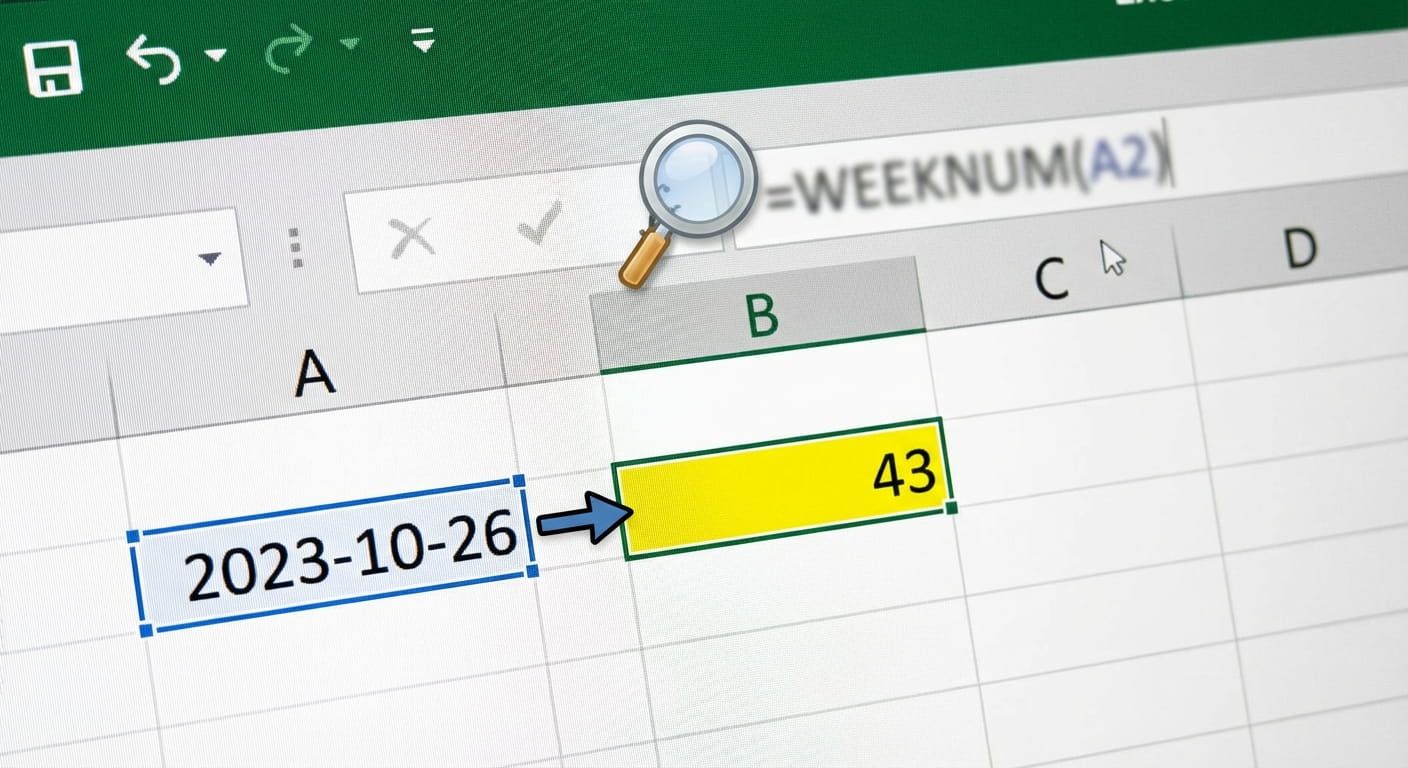
If you use Excel, the safest approach is to pick the week numbering method explicitly rather than relying on defaults. The guide at find week numbers excel walks through common formulas and the typical points where ISO and non ISO results differ.
For reporting that crosses borders, a practical approach is to store the actual date in your data, then compute both week numbers in separate columns. That way a teammate in the United States can filter by the week label they expect, and a teammate in France can do the same, with no silent mismatch.
Date math, days between, and why week numbers are not enough
Week numbers are labels, not measurements. If you need to calculate how long something lasts, use date math. Counting days between two dates is straightforward, and it stays correct even if a week boundary shifts by rule set.
Here is a simple mental model:
Use week numbers to label a plan. Use actual dates to measure time. A sprint might be called “week 22,” but its true duration is defined by its start date and end date.
This matters for leap years too. A leap day can shift day of week alignment for everything that follows. ISO rules handle the alignment in a consistent way, which is part of why ISO is popular for operations. US style week numbering can still work, but it is best paired with explicit dates.
Months, quarters, and week numbers living together
Months and quarters are common business buckets. Week numbers cut across them. Week 1 can start in late December in ISO. Week 13 might straddle the end of March and the start of April. That is not a problem, but it does mean you should decide which bucket has priority in your reporting.
In finance and planning, quarters usually win. A quarter is tied to months, not weeks. In supply chain planning and staffing, weeks often win because headcount and shifts follow weekly cycles. If you want a clean reference layout for a whole year, the compact year view in 2026 calendar can be useful for scanning month boundaries while keeping an eye on the weekly rhythm.
A neat practice is to label a report with both systems when teams span continents. For example, a weekly update can include an ISO week label plus the Monday date. That stays readable for someone in the United Kingdom and for someone in the United States.
A note about Time.you and staying consistent across time zones
Week numbers are only one piece of the scheduling puzzle. Time zones add another. Time.you helps by providing exact time for any time zone across the world, showing current time for major cities, countries, and timezones. It is synchronized to atomic clock time sources, giving precise time readings that are useful for travel, remote work, and coordination.
If your meeting crosses time zones and week standards, include the full date, the local start time for key regions, and the week number standard you are using. Clarity beats assumptions every time.
Keeping schedules aligned across the Atlantic
Week numbers are a shared language, but only when everyone agrees on the dictionary. The United States often leans toward Sunday start weeks and a January 1 anchor. Europe commonly follows ISO, Monday start weeks and a first Thursday anchor. Once you know that, the odd looking week labels near New Year stop being mysterious.
If you take one habit from this guide, make it this: pair week numbers with full dates. Add a trusted converter for edge cases, and set one standard for team wide planning. That single change prevents most of the confusion that shows up between the United States, Canada, the United Kingdom, France, Germany, Spain, Italy, Japan, India, Brazil, Australia, and South Korea.