Some calendars feel tidy until the end of December shows up and the weeks refuse to line up. One year ends on a Wednesday, another ends on a Friday, and suddenly you hear someone say, “This year has week 53.” It sounds strange because most of us grew up thinking a year is 52 weeks. The twist is that 52 full weeks only cover 364 days, and the calendar has to place the leftover days somewhere. Week 53 is one of the cleanest ways to do that, when you follow ISO week numbers.
Key takeaway
A year can show 53 weeks when the week numbering system counts full weeks that cross the year boundary. ISO week dates count weeks from Monday to Sunday, and week 01 is the week that contains January 4. Most years land at 52 numbered weeks, but some layouts create an extra numbered week. This happens when January 1 lands late in the week, or when a leap year shifts the weekday pattern in a way that adds one more full ISO week.
Mini quiz to test your week number instincts
What week 53 really means
Week 53 does not mean the year suddenly became longer than it should be. It means your week numbering system found 53 distinct week labels while mapping real days onto tidy Monday to Sunday blocks. In everyday speech, people mix two ideas:
- A year measured in days, 365 or 366.
- A year measured in labeled weeks, using a rule for where week 01 begins.
Those ideas usually line up, but not always. A seven day week is fixed, but the point where you switch the label from one year to the next depends on the rule you pick. ISO week dates pick a rule that stays stable across years, and that stability is exactly what makes week 53 show up sometimes.
A helpful mental model: week numbering is a labeling system laid over real dates. When the label boundary shifts, the labels can count to 53 even though the days are normal.
How ISO week numbers decide where a year starts
ISO week numbering is part of the ISO 8601 date standard. It is common in scheduling, payroll, logistics, software releases, and cross border work. It answers a simple question: if you only look at a week label, can everyone agree which dates it covers?
The three core ISO rules
- Weeks start on Monday.
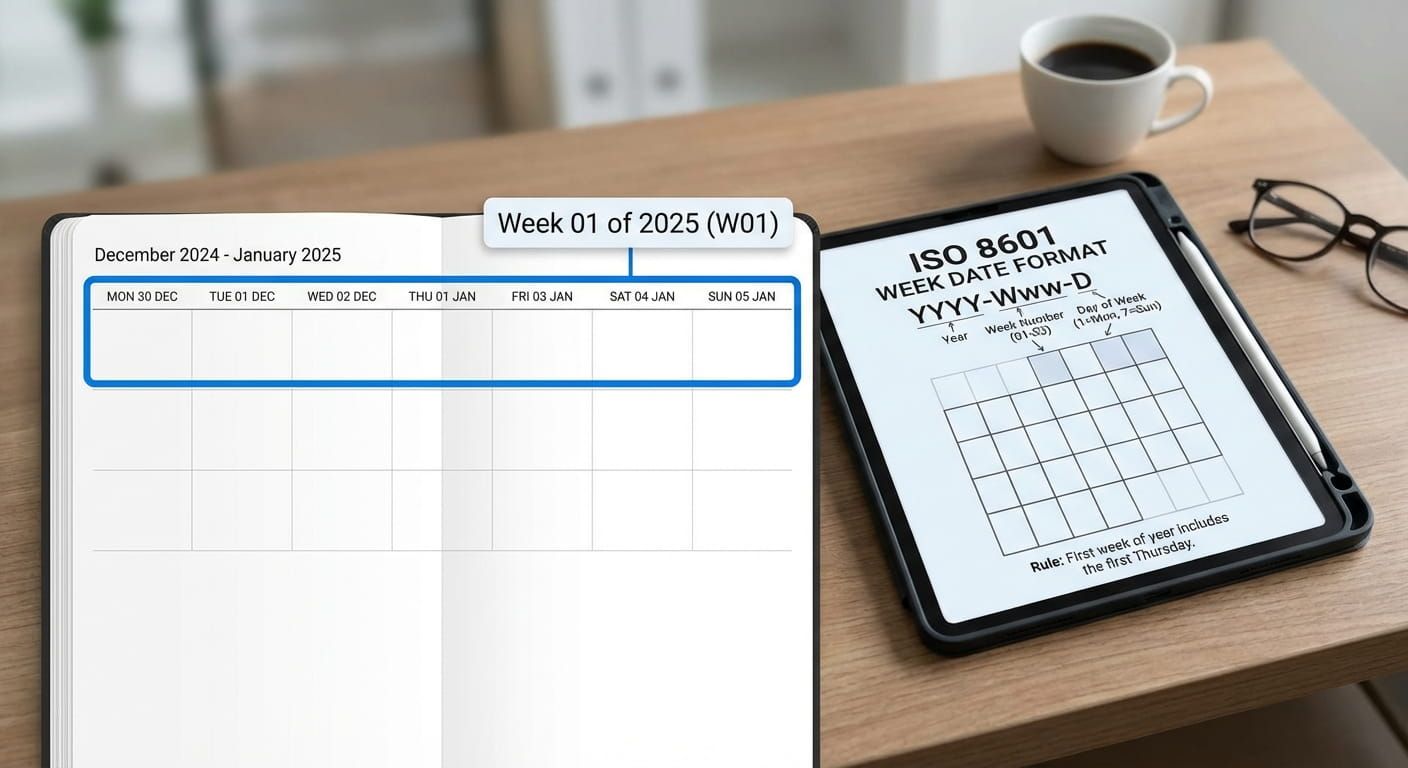
- Week 01 is the week that contains January 4.
- Each week belongs to the year that contains the Thursday of that week.
That Thursday rule sounds odd at first, but it has a neat effect. It avoids tiny partial weeks at the start of the year. If January 1 is on a Friday, Saturday, or Sunday, then those days fall into the last ISO week of the previous year, because the Thursday of that week is still in December. The next Monday begins a clean week 01.
If you want a visual check while planning projects, the week number page on time.you is built for that kind of sanity check. It helps you confirm which dates sit inside each labeled week without doing mental gymnastics.
Why 52 weeks is not enough, in plain numbers
Start with the math everyone can trust.
- 52 weeks equals 52 times 7 days equals 364 days.
- A common year is 365 days, which is 364 plus 1.
- A leap year is 366 days, which is 364 plus 2.
Those extra one or two days have to land somewhere. In a system that labels weeks, the leftovers push the weekday pattern forward each year. That push changes which dates land inside which Monday to Sunday blocks. Over several years, the boundary can drift enough that an extra labeled week appears, week 53.
The exact patterns that create week 53
In ISO week numbering, week 53 happens only in specific calendar layouts. You do not get it randomly. A year has 53 ISO weeks if one of these is true:
- The year starts on a Thursday in the Gregorian calendar.
- The year is a leap year and starts on a Wednesday.
That is it. Those two patterns create enough room for 53 Monday to Sunday blocks that belong mostly to that ISO week year. Another way to say it is that the year contains 53 Thursdays, which matters because of the Thursday ownership rule.
A practical check you can do on paper
Look at January 1 on a calendar. If it lands on Thursday, the ISO week year is very likely to include week 53 at the end. If it lands on Wednesday and the year is a leap year, the extra day adds the space needed for week 53.
Seeing the week 53 triggers at a glance
This table focuses on the ISO week year, not just the calendar year. The goal is to show the two layouts that can produce 53 ISO weeks, plus the common layouts that stop at 52.
| January 1 weekday | Leap year? | ISO weeks in the year | Reason in one sentence |
|---|---|---|---|
| Thursday | No or yes | 53 | Week ownership by Thursday creates one more full ISO week before the boundary flips. |
| Wednesday | Yes | 53 | The extra leap day shifts the weekday pattern just enough to fit week 53. |
| Monday, Tuesday, Wednesday | No | 52 | The year begins early in the week, so week labels switch years without needing an extra label. |
| Friday, Saturday, Sunday | No or yes | 52 | Early January dates can belong to the last ISO week year, keeping the count at 52. |
Why your week 01 might start in December
ISO week dates can feel weird the first time you see them because week 01 can start in late December of the prior calendar year. This is not a mistake. It is a direct result of the January 4 rule and the Thursday ownership rule.
Here is a simple example with words, not formulas. If January 1 is on a Friday, then the week that contains that Friday also contains the Thursday right before it. That Thursday is in December. The ISO system assigns the whole week to the year that holds the Thursday, which is the prior year. That means the Friday, Saturday, and Sunday at the start of January are still part of the last ISO week year.
People notice this most in workplaces that run by week number. Project plans, sprint boards, and factory schedules often speak in week labels, not month dates. A year boundary becomes a week boundary, and those do not always match.
Week numbers versus months and quarters
Months and quarters are great for financial reporting. Week numbers are great for operations. The tension comes from the fact that months do not contain a whole number of weeks. A quarter can include 12, 13, or 14 weeks depending on where the calendar lands.
How teams use week numbers in real life
- Manufacturing uses week labels to tag batches and track lead times.
- Retail uses week labels for promotions that must start on a predictable weekday.
- Tech teams use week labels for release cycles and sprint planning.
- Schools use week labels for term schedules that repeat weekly patterns.
If you want to compare a week plan with a month view, it helps to keep a calendar view open. The calendar area on time.you is built for fast cross checks when you are switching between weeks, months, and the dates your friends actually talk about.
Date math that makes week 53 feel less mysterious
Week numbering becomes much easier once you treat it as date math. The calendar is a grid, and the weekday position matters as much as the number on the date.
Three small pieces of math that show up again and again
- Every non leap year shifts the weekday of the next January 1 forward by 1 day.
- Every leap year shifts it forward by 2 days.
- Week labels shift when a boundary week has more days on one side of the year than the other.
That is why week 53 appears in some years but not most. The weekday drift does not always land on the layouts that create space for 53 ISO weeks.
Different countries, different week habits
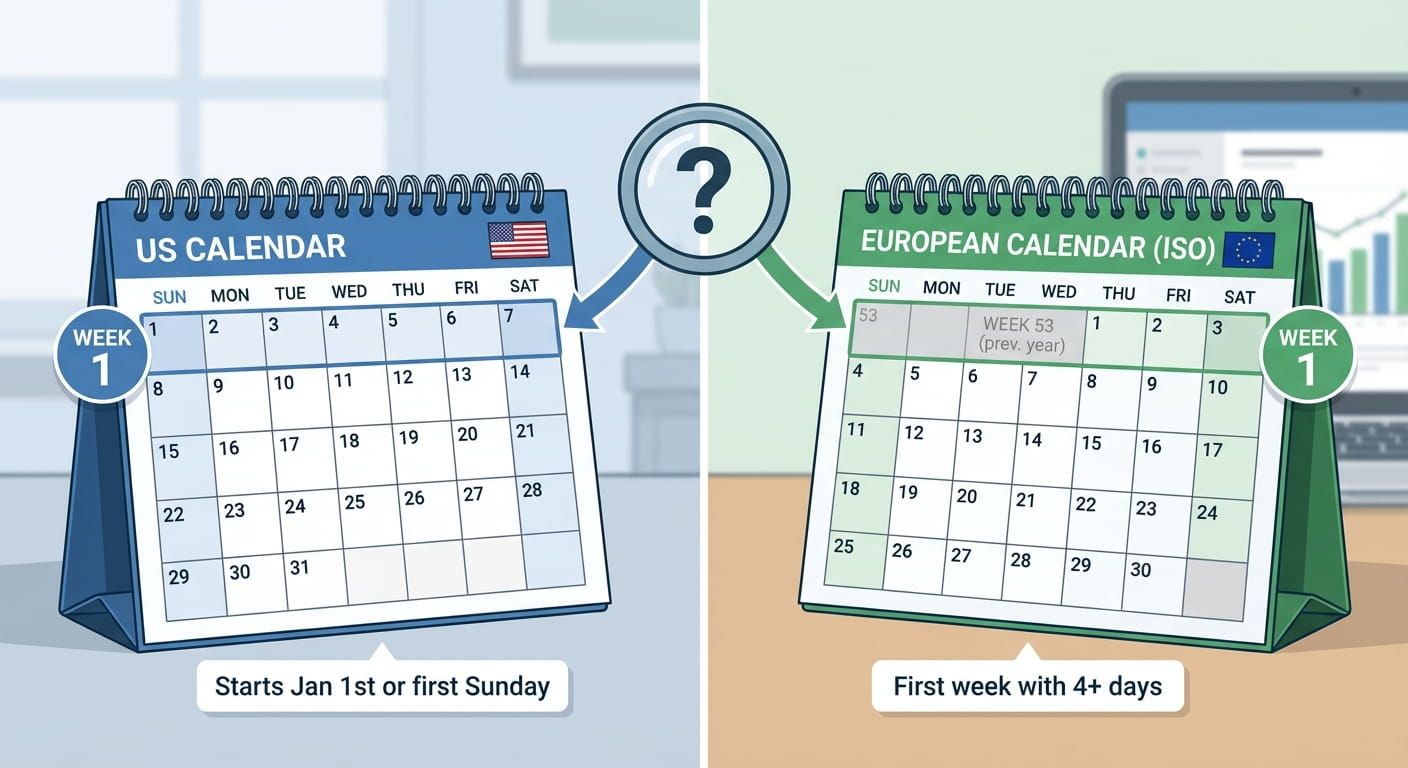
ISO week numbering is popular globally, but not every place treats weeks the same way in everyday life. Many European countries think of Monday as the start of the week. In the United States, lots of calendars show Sunday first. That difference affects how people interpret a “week” when they are not using ISO labels.
If you are planning across regions, it helps to check the local calendar view for the country you are working with. A few examples from time.you are handy for that: planning public holiday coverage in France's calendar, scheduling a product shipment timeline in Germany's calendar, or mapping school terms in Japan's calendar.
Time zones matter too. Time.you is built around precise, atomic clock synchronized time, so when a team in Singapore coordinates with teams in Europe or the Americas, you can keep the time aligned while also keeping the calendar labels aligned. That combination is where week numbers earn their keep.
Examples you can picture with real places
Week 53 shows up on planning boards in ways that feel practical, not theoretical. Imagine a logistics team moving inventory from Italy to Spain. If their contracts specify delivery windows by ISO week, then “week 01” and “week 52” are not just labels. They decide staffing, warehouse hours, and carrier bookings.
Or think about a support team that rotates on weekly shifts across India, Canada, and Australia. A year with week 53 adds one more scheduled rotation. That means payroll and staffing must account for it. It is not an extra week of days, it is an extra labeled week in the schedule.
Country calendar pages can help when you are checking how dates land in a familiar layout: India's calendar, Canada's calendar, Australia's calendar, Italy's calendar, Spain's calendar, and Brazil's calendar.
Misunderstandings that trip people up
Worth clearing up
- Week 53 is not a bonus week of new days. The days are the same, the labels are different.
- A date near January 1 can belong to the previous ISO week year.
- Different calendars can show different week starts, but ISO week dates stay consistent with Monday starts.
- A leap year alone does not guarantee week 53. The weekday layout matters.
How to talk about week numbers without confusion
If you are writing schedules, emails, or specs, clarity is everything. A small habit helps: always pair the week label with one anchor date in that week. For example, “week 12, Monday March 17” is clearer than “week 12” alone. In global teams, it avoids the Monday versus Sunday interpretation gap.
A simple, repeatable format teams like
- State the ISO week year and week number.
- Add the Monday date for that week.
- Add the local time zone abbreviation when time matters.
The year is still the same length, the labels are just smarter
Week 53 is a reminder that calendars are tools, not laws of nature. The days keep moving in their steady rhythm. A week numbering system is a human choice designed to help people plan, ship, pay, build, and meet deadlines without confusion. ISO week dates choose consistency over perfect alignment with January 1, and that choice creates a clean, predictable structure. Some years need one more label to keep that structure honest. That is why week 53 exists, and why it is a feature, not a glitch.