Calendar Systems Explained: From Week Numbers to Leap Year Patterns

Calendars feel simple until a deadline lands on “week 10,” a flight crosses midnight, and February decides to have an extra day. Then you notice something, dates are a system, not just squares on a grid. Once you understand week numbers and leap year patterns, planning gets calmer, meetings line up, and your tools stop disagreeing.
Week numbers and leap years solve the same problem, keeping time consistent as months and years drift against the solar day. ISO week rules create stable “week 1” boundaries that many workplaces rely on, while leap year rules keep seasons from sliding through the calendar. Learn the handful of rules behind both, and you can convert dates cleanly, plan across time zones, and understand why some years have week 53.
What a calendar system actually solves
A calendar is a promise. It promises that when you say “March,” everyone imagines the same window of days. It promises that “next Tuesday” shows up on the same wall grid in your office and in your friend’s phone. It also promises that seasons stay in the right neighborhood, spring does not slowly drift into winter on the page.
Those promises are harder than they look because nature does not hand us neat units. A day is close to the Earth spinning once. A year is close to one orbit. A month is close to a lunar cycle. Close, not exact. Even worse, those cycles do not fit each other cleanly.
Some calendars keep months tied to the Moon. Some keep seasons tied to the Sun. Some keep weeks stable for work planning. The system you use reflects what your culture, business, or tools value most.
Modern daily life mostly runs on the Gregorian calendar, plus a week system that has become a planning language in its own right. That is why this article keeps circling back to two themes, week numbers, and leap year patterns. One handles weeks with clean boundaries. The other keeps the year aligned to the seasons.
If you want a practical starting point, browsing any year view on calendar pages makes the structure obvious, months, weekdays, and how the grid shifts year to year. That shifting is the core story.
Week numbers are a planning language
In many workplaces, “week 10” is more useful than “mid March.” Week numbers are compact, and they fit into recurring schedules. Teams that run sprints, shipping cycles, payroll, rotas, or maintenance windows often speak in weeks because weeks behave consistently. Months do not. Months vary in length. Weeks do not.
Week numbers also reduce ambiguity across borders. A date like 03 04 2026 can mean different things depending on local format. “Week 10 of 2026” is harder to misread once everyone agrees on the same week rule.
That last part matters. Week numbering only works if the rules are shared. There are multiple week numbering conventions. The most common global standard is ISO 8601 week dating, often shortened to ISO week numbers.
- Project planning and sprint boards
- Manufacturing schedules and maintenance shutdowns
- School term calendars and exam periods
- Travel planning with recurring routes
- Finance, reporting, and payroll cycles
If you want the rules laid out in a focused format, the guide on how week numbers work is a handy companion. Here we will go broader and connect week numbers to the rest of calendar logic.
ISO week date in plain language
ISO week numbering uses three ideas that make it stable.
Idea one, weeks start on Monday. This is common in many regions and in international standards. It also matches a typical work week rhythm.
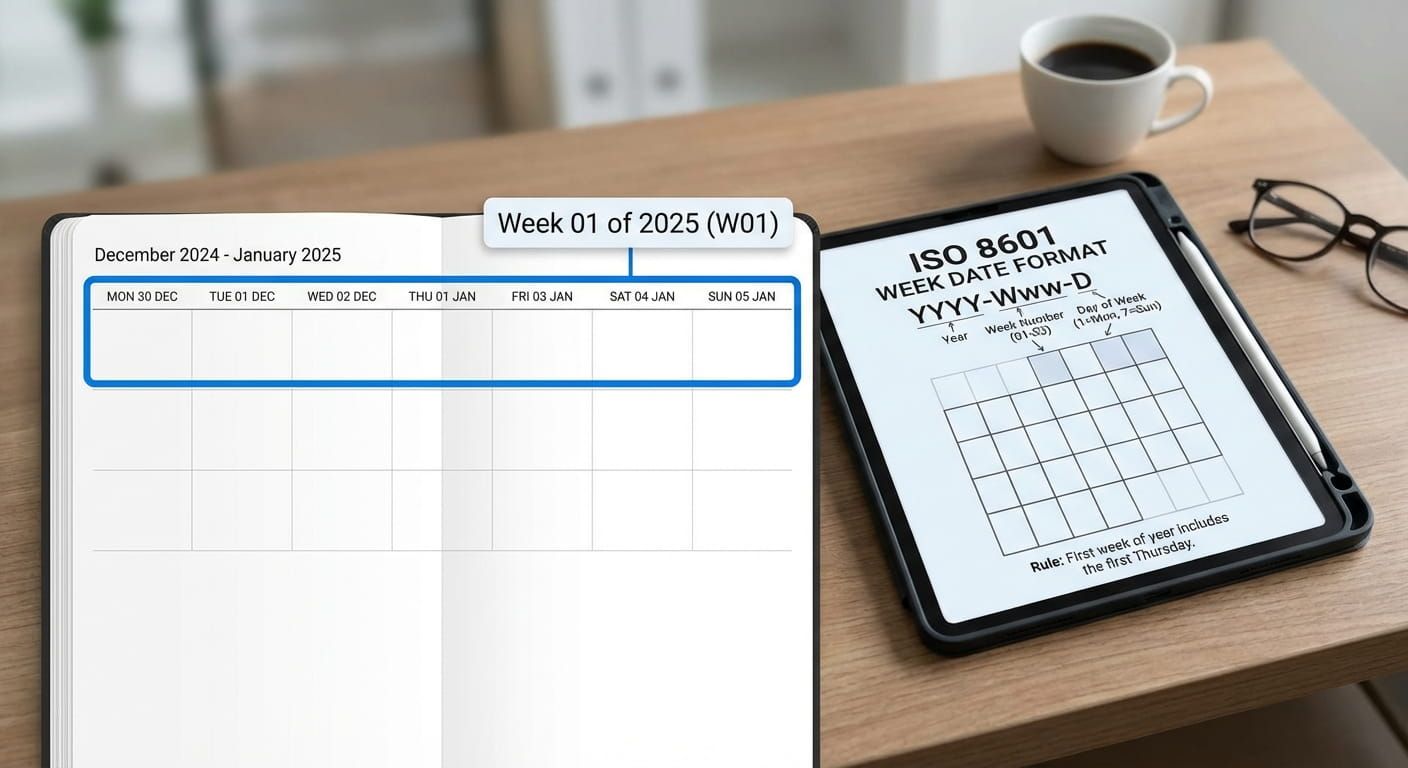
Idea two, week 1 is the week with the first Thursday of the year. That sounds odd until you see what it achieves. It guarantees week 1 has at least four days in January. This prevents tiny “week 1” fragments that would otherwise happen when January 1 lands late in the week.
Idea three, the week belongs to the year that contains most of its days. This follows from the Thursday rule. A week that has four or more days in January is counted as week 1 of the new year. A week with four or more days in December is counted as the last week of the old year.
If January 1 is a Friday, Saturday, or Sunday, that week has fewer than four days in the new year. ISO treats it as the last week of the previous year. The new year’s week 1 begins on the next Monday.
ISO week dating is often written as a year, a week number, and a weekday number. In ISO, Monday is day 1 and Sunday is day 7. The date format can look like 2026 W10 2, meaning Tuesday of week 10 in 2026.
That format is part of ISO 8601, the same standard family that influences many date and time formats used by computers and APIs. If you need to convert between date styles cleanly, the ISO 8601 converter can save a lot of back and forth.
How to calculate an ISO week number by hand
You rarely need to do this manually, but understanding the steps explains why edge cases happen at the start and end of a year.
- Find the weekday of January 1 for the year you care about.
- Locate the first Thursday of the year. The week containing that Thursday is ISO week 1.
- Count weeks forward from that Monday start, each week is Monday through Sunday.
- If your date lands before week 1 begins, it belongs to the last ISO week of the previous year.
- If your date lands after the last ISO week ends, it belongs to week 1 of the next year.
Those last two points are where confusion creeps in. People expect January 1 to always be in week 1. ISO does not make that promise. It makes a different promise, week numbering stays consistent and weeks do not become tiny fragments.
Week numbering around the world
ISO is common, but not universal. Differences usually come from two choices, what day starts the week, and how week 1 is defined.
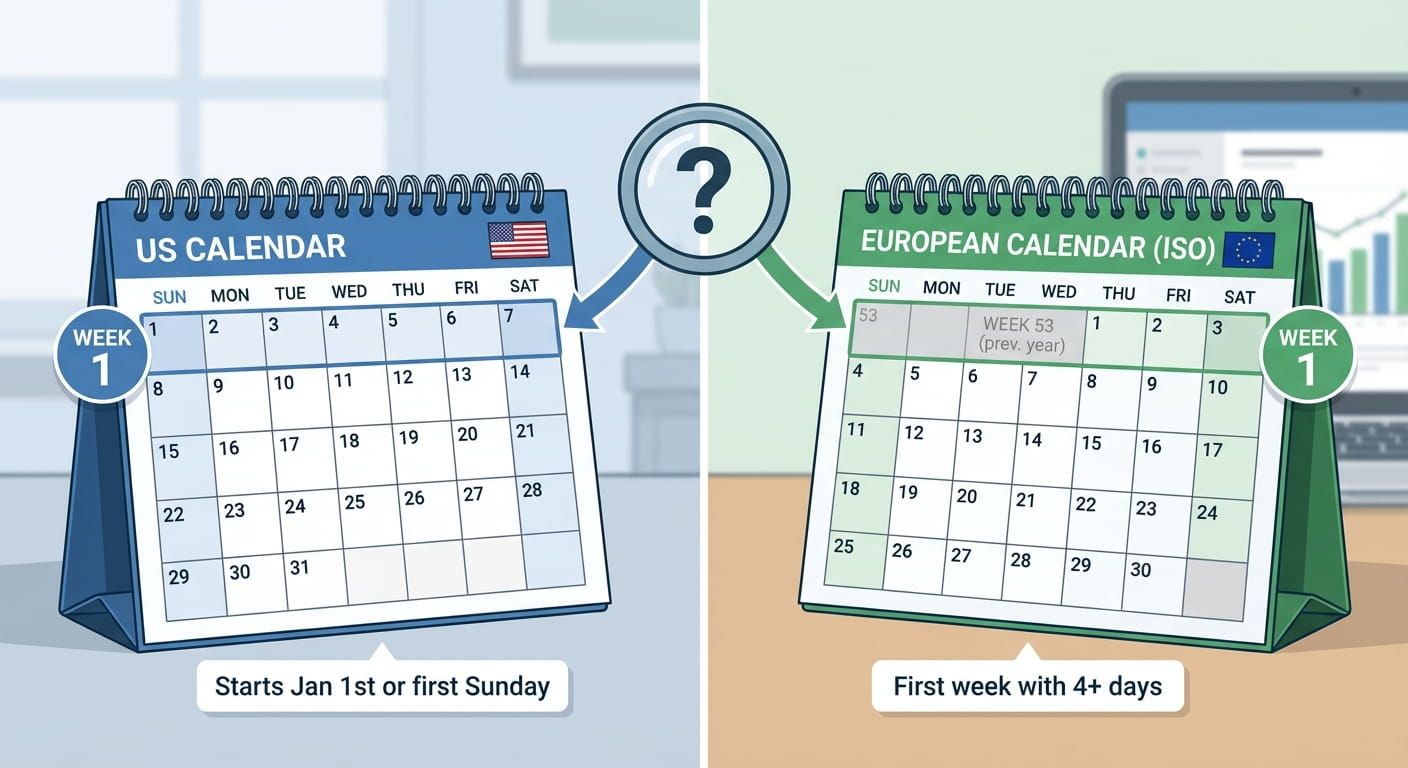
Many calendars and tools in the United States treat Sunday as the first day of the week. Some define week 1 as the week containing January 1. Some define week 1 as the first full week of the year. Those are three different rules, and they can disagree for the same date.
This is why software settings matter. One person can be looking at “week 10” while another tool labels the same days as “week 11.” Neither is broken. They are following different definitions.
When you share a week number in a message, pair it with a date range once. After that, your group usually syncs on the same interpretation.
Country specific calendars can also affect how people think about weeks, working days, and holidays. For example, using the Japan calendar view while planning cross border work helps you spot local observances that reshape a typical Monday to Friday plan.
Leap years keep the seasons in place
Week numbers organize the year from the inside out. Leap years organize the year from the outside in, aligning the calendar year to the solar year.
The Earth does not orbit the Sun in exactly 365 days. The extra fraction adds up. If we never added an extra day, the calendar would drift. After enough decades, “summer” on the calendar would slide toward what we currently call spring.
Leap days are the correction. They are a scheduled adjustment so that March stays near the same point in the seasonal cycle over long periods.
The rule looks fiddly because it needs to be accurate across centuries. It is a slow correction, applied at predictable intervals.
The Gregorian leap year rule, written for humans
The Gregorian calendar uses a layered rule that sounds complicated until you see the logic. It tries to approximate the real solar year closely, without requiring constant adjustments.
- If a year is divisible by 4, it is a leap year.
- Except if the year is divisible by 100, then it is not a leap year.
- Except if the year is divisible by 400, then it is a leap year after all.
This means 2024 is a leap year, divisible by 4. The year 1900 was not a leap year, divisible by 100 but not by 400. The year 2000 was a leap year, divisible by 400.
That pattern makes the average calendar year very close to the length of the solar year, which keeps dates anchored to seasons over long spans.
Tying week rules and leap rules together
When weeks and leap years collide
Weeks and leap years are separate systems, but they interact because both affect how days line up on weekdays.
A leap year adds one extra day. That shifts the weekday alignment for the next year by two days instead of one. That shift changes which dates fall into which weeks, especially at the edges of the year.
This is one reason week 53 exists. A year can fit 53 ISO weeks depending on where the year starts and ends in the weekday cycle. Leap years increase the chances of that alignment, but they do not create week 53 automatically. It is all about weekday placement.
Treat it as a normal week that happens to be labeled 53. Plan it the same way you plan week 52. If your tool uses ISO, keep using ISO. If your tool uses a different system, label your date range once and move on.
Month grids, why they slide every year
Open a month view for one year, then compare it to the same month next year. The weekday positions shift. March 1 might be a Tuesday one year, then a Wednesday the next. In a leap year, it jumps a bit differently.
That sliding is not a bug. It is the result of 365 not being a multiple of 7. Each year has one extra day beyond 52 weeks, and leap years have two extra days beyond 52 weeks. Those extra days push the starting weekday forward.
That is why the calendar feels like it “moves” each year, even though the month names stay the same.
If you want a concrete example, looking at the 2026 calendar view is a simple way to see how weekday alignment and month layout work together across an entire year.
Week numbers vs months, choosing the right lens
Months are good for human memory. People remember “late July” more easily than “week 30.” Months also match many billing cycles and social routines.
Weeks are good for operations. They are even blocks. They behave consistently. They avoid the weirdness of a 31 day month next to a 28 day month.
A lot of planning goes wrong because people mix lenses. A plan is set in weeks, but status updates talk in months. Or a budget is monthly, but staffing is weekly. When the lens is mixed, someone feels “behind” even when the plan is fine.
Use one primary unit for a plan, weeks for delivery work, months for billing or seasonal work. Then translate carefully at the boundaries.
When week numbers save time
Week numbers shine when you need a shared shorthand. Here are common moments where they reduce back and forth.
- Setting sprint start and end dates without arguing about month length
- Coordinating release trains across multiple teams
- Planning on call rotations and staffing coverage
- Scheduling recurring maintenance with stable weekly windows
- Tracking production output week by week in a consistent way
- Organizing course schedules and assignment cadence
- Comparing year over year performance on the same week basis
- Aligning marketing campaigns to reporting weeks
- Coordinating sports training blocks and recovery weeks
- Planning travel with repeated weekly patterns
- Running warehouse operations with weekly cutoffs
- Sharing plans across regions where date formats differ
Fiscal calendars and the 4 4 5 approach
Some businesses do not want months at all for internal reporting. They want quarters made of weeks, because weeks are consistent. That is where retail style fiscal calendars come in.
A common structure is 4 4 5. Each quarter is split into two four week months and one five week month. That keeps each quarter at 13 weeks, which is stable and easy to compare.
This system is not about the Moon or the Sun. It is about repeatable reporting. It still interacts with leap years and ISO weeks, because the underlying days still shift, and sometimes an extra week is added in a fiscal year to keep alignment.
Ask which rule set your finance team uses, ISO weeks, a Sunday based system, or a 4 4 5 calendar. Then match your reporting to that rule set. Half the “data mismatch” stories come from a hidden definition mismatch.
Historical calendar systems and why they still matter
Even if you live fully inside the Gregorian calendar, other calendar systems still show up in modern life. They matter in travel, cultural events, and history. They also matter because they explain why the Gregorian system looks the way it does.
Broadly, calendar systems fall into a few types.
- Solar calendars, designed to track the seasons. Gregorian is the best known example.
- Lunar calendars, designed to track moon phases, months often follow the lunar cycle closely.
- Lunisolar calendars, months follow the Moon but extra adjustments keep seasons roughly aligned.
- Operational calendars, built for business cadence, often week based.
These systems answer different questions. A lunar system keeps months meaningful to moon phases. A solar system keeps months meaningful to seasons. A business calendar keeps reporting periods comparable. Once you see that, the differences feel less mysterious and more intentional.
Time zones and why a date can change while you travel
Weeks and leap years are about the calendar grid. Time zones are about the clock on top of that grid. When you combine them, strange things can happen.
If you travel east, you can skip over a date boundary faster. If you travel west, you can live through the same calendar date longer. Cross the International Date Line and the calendar date can jump forward or backward.
Even without travel, remote teams feel this. A meeting at 09:00 in one region can be the previous day for someone else. That changes which week number the meeting belongs to if it sits near a week boundary, especially late Sunday or early Monday depending on your week settings.
Always include the time zone in meeting invites and notes, and confirm which week rule your tool is using. A small setting difference can shift a boundary by a day.
Since time.you focuses on precise, atomic clock synchronized time across cities and time zones, it pairs naturally with calendar work. Accurate time keeps the boundaries honest, and honest boundaries keep your date logic consistent.
Holidays, work weeks, and why “business days” vary
Week numbering tells you where you are in the year, but it does not tell you how workable that week is. A week with two public holidays behaves very differently than a normal week.
That is why holiday context matters when you plan with week numbers. A sprint that ends in a holiday heavy week will feel shorter. A shipping window can shrink without anyone noticing until it is too late.
Checking local days off helps, and doing it early prevents awkward surprises. Browsing the holidays section while planning can make a week plan feel realistic instead of optimistic.
Common calendar mistakes and how to avoid them
Most calendar confusion is not about math. It is about assumptions. People assume everyone’s tools use the same week start day. People assume week 1 always contains January 1. People assume time zones are implied. Then the plan breaks quietly.
- Mixing ISO week numbers with a Sunday based week system in the same report
- Using a week number without stating the year during year end planning
- Scheduling a deadline for “end of week” without agreeing on the boundary
- Forgetting that some early January dates can belong to the previous ISO week year
- Assuming a time without a time zone will be interpreted the same way by everyone
One small practice fixes a lot of this, write the date range once, then use week numbers. For example, “week 10, Mar 2 to Mar 8.” After that, “week 10” is clear for your group.
Leap year patterns are easy to spot
How to talk about dates so tools agree
Most conflicts happen when the same moment is described in different formats. One tool stores UTC timestamps. Another stores local dates. A third stores “all day” events without a time zone. Then the same meeting appears on different days.
Two habits help more than any other.
- Write dates in an unambiguous format when accuracy matters, year, month, day. Pair it with a time zone.
- When you use a week number, state the week rule once for your group, ISO or not.
In practical terms, that can look like “2026 03 03 at 15:00 UTC,” or “2026 W10 2 at 15:00 UTC.” Once your team uses a consistent pattern, calendar friction drops fast.
Glossary you can copy into a note
Key terms
- ISO week, a week numbering system where weeks start Monday and week 1 contains the first Thursday.
- Week year, the year label attached to an ISO week, which can differ from the calendar year near New Year.
- Leap year, a year with an extra day added to keep the calendar aligned to the solar year.
- Leap day, February 29 in the Gregorian calendar.
- UTC, a global time standard used as a reference for time zone conversion.
- All day event, a calendar event without a time component, sometimes tricky across time zones.
The calm payoff of understanding the pattern
Once you see the rules, calendars stop feeling random. Week numbers become a clean shared shorthand, because you know which definition your team is using. Leap years stop feeling like a surprise, because you know the correction schedule and why it exists. Month grids stop feeling like they “shift,” because you know the weekday alignment must move.
Most of all, you gain a simple confidence, you can look at any date, any week label, any year boundary, and understand what the system is doing. That confidence is what keeps plans steady, even when the calendar looks messy on the surface.
More Calendars, Dates & Week Numbers Related Articles:
What is the ISO 8601 Week Date Standard
Week 01 can start in late December. That surprises people every year, and it is exactly why the ISO 8601 week date standard exists...

Does the Week Start on Sunday or Monday
The week feels simple until you try to pin down its very first day. Some calendars begin on Sunday. Others begin on Monday. Both choices can be cor...

Why Some Years Have 53 Weeks
Some calendars feel tidy until the end of December shows up and the weeks refuse to line up. One year ends on a Wednesday, another ends on a Friday...
How to Find Week Numbers in Excel
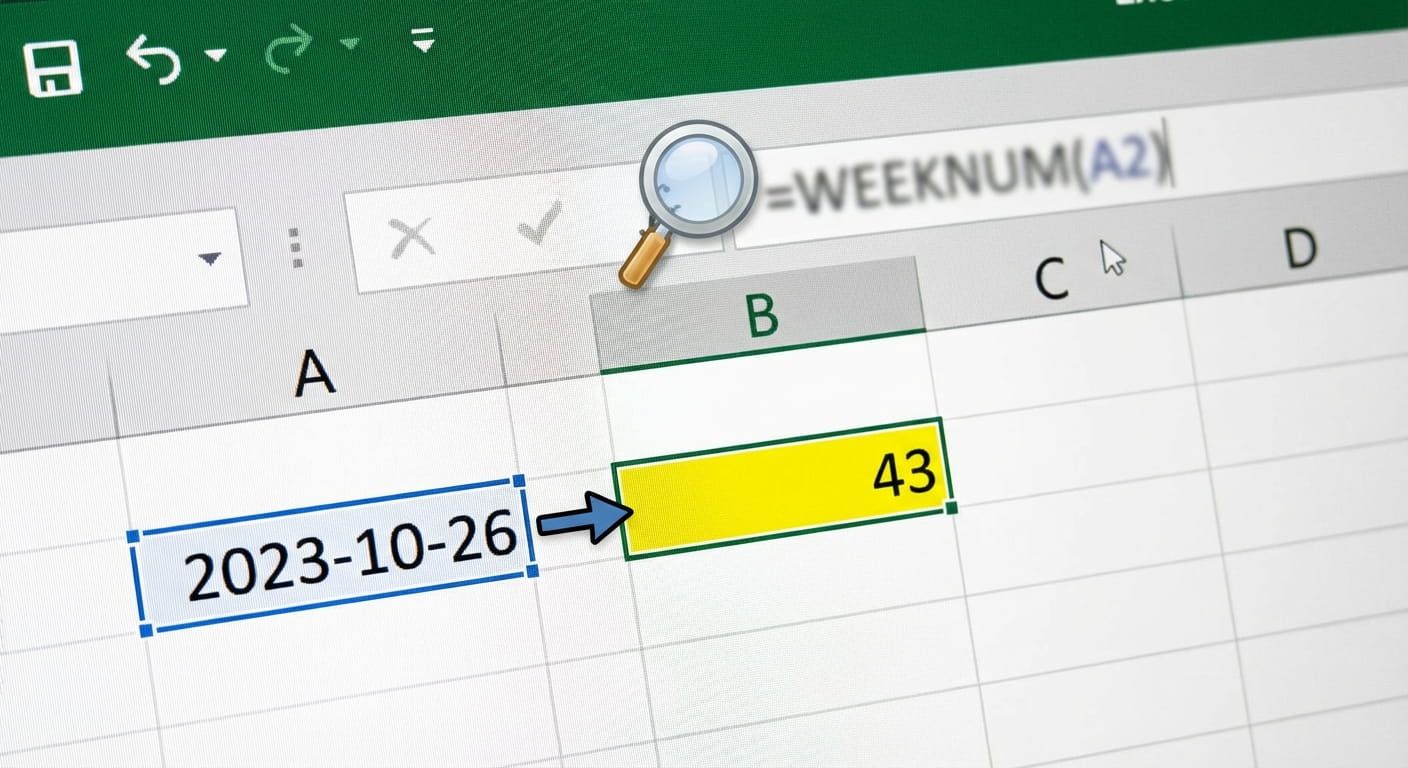
Week numbers sound simple until a report says Week 1 and two people mean two different weeks. Excel can show week numbers fast, but you need to pic...
Difference Between US and European Week Numbers
Week numbers feel simple until a flight, a project plan, and a school schedule collide. You check a calendar in the United States, then you open a ...

Complete Guide to International Calendar Standards
Calendar confusion shows up at the worst moments, project deadlines, flight bookings, payroll cutoffs, school terms, and global launches. One team ...