The Science Behind Daylight Length and Solar Timing
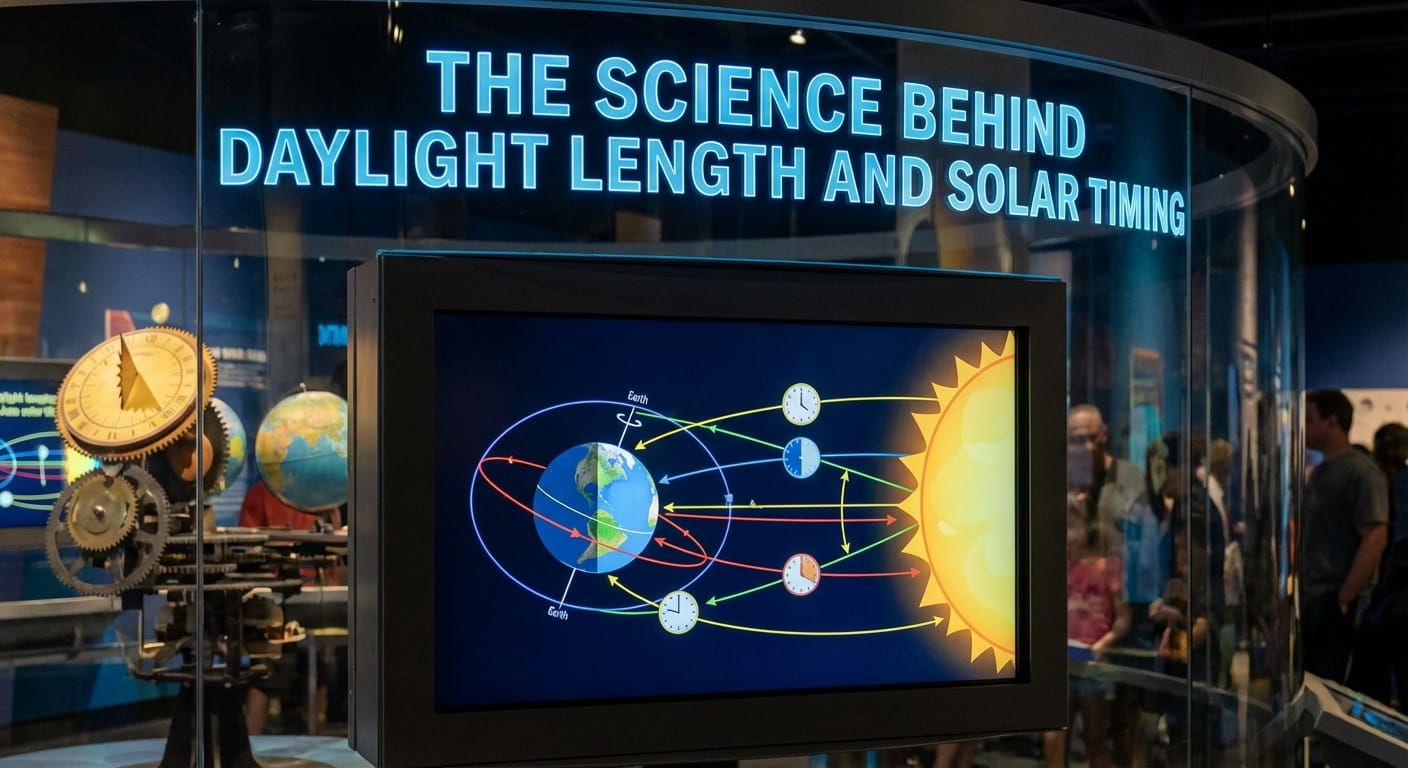
Daylight is a daily habit, yet the numbers behind it can feel slippery. A sunrise that was early last month can look late today. A sunset that felt steady can drift by minutes for weeks. None of this is random. It is the combined effect of Earth’s tilt, your latitude, the shape of Earth’s orbit, the atmosphere at the horizon, and the way humans label time.
Key takeaway
Day length changes because Earth is tilted. As Earth moves around the Sun, the Sun’s daily path climbs or sinks in your sky, changing how long it stays above the horizon. The clock adds another layer. Time zones, daylight saving time, and the Sun’s seasonal timing offset shift where those events land on your watch. Geometry sets the daylight, physics shapes the edges, and standards translate it into local time.
For a fast real world feel, compare sunrise times in India with sunset times in India.
Tip
Civil time can hide solar time. If you want to feel that difference in a familiar place, check sunrise times in the United Kingdom and note how solar timing shifts through the year. If sky events are your thing, eclipses visible in London connect the same precision mindset to rarer moments.
A quiz that checks your daylight intuition
Choose an answer for each question, then score it. The explanations are short, and they point to sections below.
The science behind day length starts with one angle
Earth’s axis is tilted relative to its path around the Sun. That tilt is about 23.44 degrees. It sounds like a small number, yet it shapes the entire daylight calendar. The tilt sets how high the Sun climbs at midday, and how long the Sun stays above your horizon.
Picture the Sun’s daily path as a smooth arc across the sky. On some dates the arc is high and wide, and the Sun spends more time above the horizon. On other dates the arc is low and short, and daylight shrinks. This is why the longest days cluster near a solstice, and the most balanced days cluster near an equinox.
The tilt is also why north and south live opposite daylight seasons. When the Northern Hemisphere leans toward the Sun, it gets longer days. When it leans away, it gets shorter days. The Southern Hemisphere flips that schedule.
A small detail that changes sunrise by minutes
Published sunrise and sunset times usually include atmospheric refraction and the Sun’s visible disk. That means the Sun can appear above the horizon while its geometric center is still a bit below it.
Solar declination is the moving address of the Sun
Solar declination is the angle of the Sun north or south of Earth’s equatorial plane. It changes a little every day. Near an equinox, declination is near zero, and the Sun sits near the celestial equator. Near a solstice, declination is near its extreme, either north or south.
If you want a clean way to connect declination to day length, focus on the Sun’s altitude at solar noon. When solar noon altitude increases, daylight often grows. When it decreases, daylight often shrinks. This is not a perfect one line rule everywhere, because refraction and solar timing offsets add texture, yet it is an excellent first mental model.
Declination also explains why equal dates do not feel equal in every region. A mid latitude city responds strongly to declination changes. A city near the equator responds less in day length, though the Sun’s height and shadow length can still vary.
Latitude decides how dramatic the year feels
Latitude is your personal amplifier. It controls the angle at which the Sun’s path meets your horizon. When that angle is steep, sunrise and sunset happen fast. When that angle is shallow, sunrise and sunset stretch, twilight lasts longer, and small shifts in solar position can move the clock times by noticeable amounts.
Near the equator, day length hovers near twelve hours through the year. At mid latitudes, you feel a clear swing between longer summer days and shorter winter days. Near polar circles, the swing can be extreme, including stretches where the Sun does not set or does not rise.
- Low latitude, steadier day length, quicker twilight transitions.
- Mid latitude, noticeable seasonal swing, familiar long summer evenings.
- High latitude, strong swing, long twilight, special cases near polar circles.
Earth’s orbit adds a seasonal timing offset
Even if Earth had no tilt, the Sun would still not behave like a perfect clock, because Earth’s orbit is not a perfect circle. Earth moves faster in its orbit at some times of year and slower at others. Tilt adds another layer because the Sun’s apparent motion is projected onto Earth’s equator in a way that changes through the year.
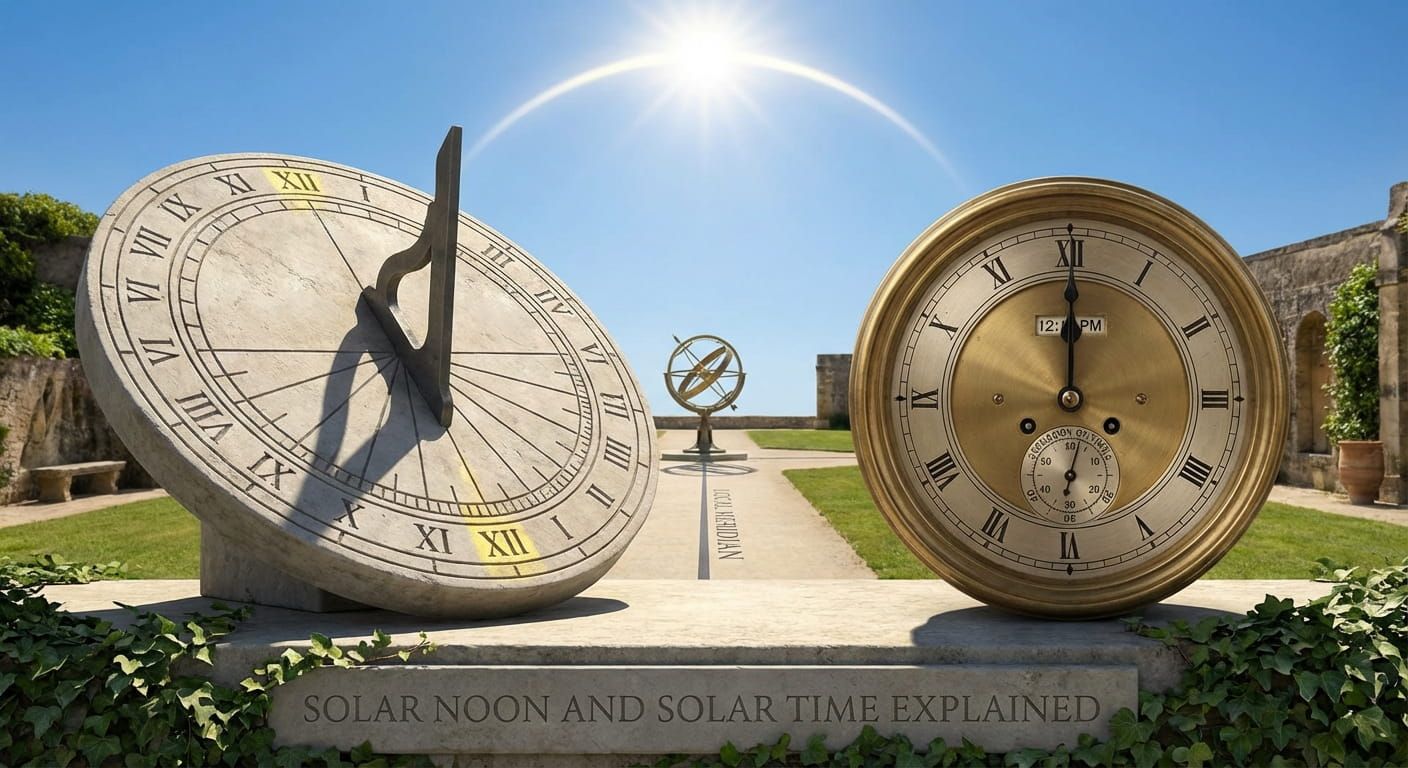
The outcome is the equation of time, a seasonal difference between apparent solar time and mean solar time. Apparent solar time is what a sundial shows. Mean solar time is a smoothed version that gives every day the same length, which is friendlier for clocks.
This is a quiet reason sunrise and sunset times sometimes drift in ways that surprise people. Day length might be changing steadily, yet the whole schedule can slide by minutes, because the Sun runs a bit early or late compared with an averaged clock.
Solar noon, time zones, and why 12:00 is a social label
Solar noon is the moment the Sun reaches its daily highest point in your sky. It is also the moment the Sun crosses your local meridian, an imaginary line that runs north to south through the sky. Solar noon is an astronomical event, tied to your exact longitude.
Clock noon is part of civil time. Civil time is set by time zones and laws. Time zones are wide, and they often follow borders, coastlines, and practical needs. That means many places share a legal clock while having different solar timing.
A simple rule helps. Every degree of longitude corresponds to about four minutes of solar time. If your location sits east of your time zone’s reference line, solar noon tends to happen earlier by the clock. If you sit west, solar noon tends to happen later. Then the equation of time adds a seasonal shift on top.
A short definition you can reuse
Solar time follows longitude. Civil time follows the rules of a time zone. Sunrise and sunset tables translate solar geometry into civil time for your location.
Daylight saving time changes the label, not the sunlight
Daylight saving time shifts the clock, often by one hour, for part of the year in some regions. It does not change the Sun’s path, the length of the day, or the physics of twilight. It changes how we name those moments.
If you compare sunrise times across months, you may notice a sudden one hour jump in the listed time when daylight saving begins or ends. That jump can look dramatic even though the sky changed smoothly. It is a calendar choice layered over an astronomical schedule.
This also shifts solar noon by the clock. During daylight saving, solar noon can land closer to 13:00 in places that adopt the shift. That can be surprising until you separate solar time from civil time.
What sunrise and sunset mean in published tables
In casual speech, sunrise can mean first visible light. In astronomy tables, sunrise is usually defined more precisely. Most published values aim to match what people observe: the first moment the upper edge of the Sun appears above a flat horizon, with atmospheric refraction included.
Refraction bends light as it passes through air layers of different density. Near the horizon, refraction is strongest, so the Sun can look slightly higher than its geometric position. Add the Sun’s visible radius, and the published sunrise time lands a bit earlier than a pure geometry definition would.
This is why two sources can disagree by a minute or two, even if both are careful. They may use slightly different conventions. A service that is consistent about its conventions becomes trustworthy because you learn how its numbers match what you see.
Twilight tells you when the sky is usable, not only when the Sun is up
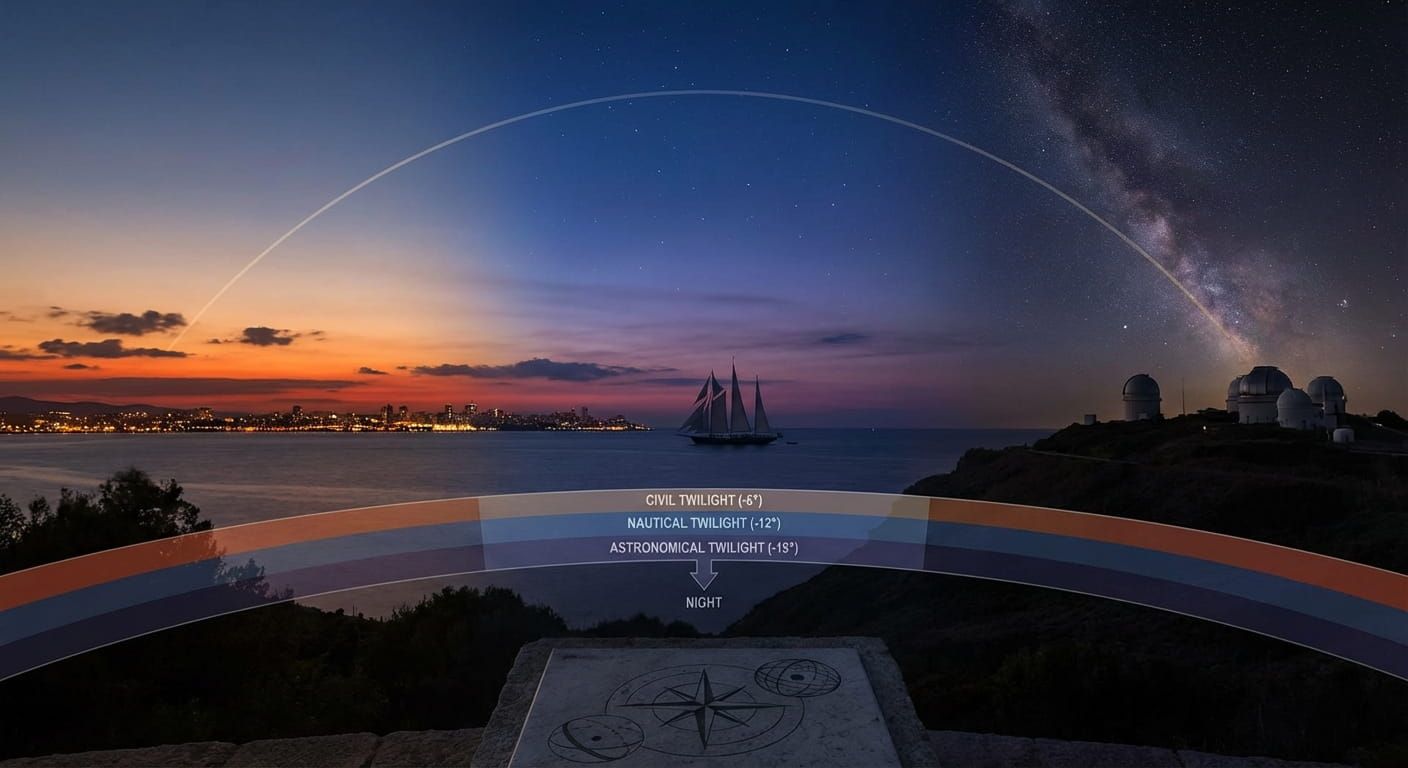
The world does not go from night to day in one instant. Twilight is the in between. It is defined by the Sun’s angle below the horizon, and it explains why you can see the landscape before sunrise and after sunset.
- Civil twilight is when outdoor activities can often continue without artificial lighting.
- Nautical twilight is darker, with the horizon still faintly visible under clear conditions.
- Astronomical twilight ends when the sky is dark enough for many observing needs.
Twilight length depends strongly on latitude and season. Near the equator, the Sun drops steeply, so twilight is often shorter. At higher latitudes, the Sun slides shallowly, so twilight can stretch and sometimes dominate the entire night.
A professional table that ties the layers together
This table shows how the main pieces shape both day length and the clock times you read on a page. Colors are muted and warm for readability.
Reading country sunrise and sunset patterns without getting lost
Country pages are where the science becomes personal. You see how the same sky rules play out under different latitudes, different time zones, and different seasonal rhythms. A country near the equator shows steady day length. A country at higher latitude shows a wide swing. A large country can show both behaviors across its span.
A clean comparison that teaches latitude fast
Compare sunrise times in Brazil with sunset times in Sweden. The difference is not just taste, it is latitude and season in action.
A helpful habit is to look at a small set of places across the globe. Pick one near the tropics, one mid latitude, and one farther north or south. You will feel the pattern within minutes of browsing.
If you want a steady reference close to the equator, sunrise times in Singapore show how day length stays close to even. If you want a contrast in a desert latitude band, sunset times in Egypt can help you see a different seasonal rhythm.
For a southern hemisphere feel, sunrise times in Australia pair well with sunset times in South Africa. You see the opposite seasonal leaning compared with many northern locations.
A numbered method to make solar timing feel predictable
This step by step method builds intuition without drowning you in equations. It mirrors what careful software does, just in human language.
- Locate your latitude. The farther from the equator, the more dramatic the day length swing tends to be.
- Choose a date and place it between solstice and equinox landmarks. Closer to a solstice, the Sun’s daily arc is closer to an extreme. Closer to an equinox, it is closer to balanced.
- Ask where solar noon lands on the clock. This is a mix of your longitude inside the time zone plus the seasonal timing offset.
- Split the day around solar noon. Day length changes control how far sunrise and sunset sit from solar noon. The split is not always perfectly symmetrical because of the timing offset, yet it is a strong guide.
- Add the horizon realities. Refraction, terrain, and local skyline can shift what you personally observe.
Why sunrise and sunset can drift in unexpected directions
Many people expect a simple story: after the winter solstice, sunrise gets earlier every day. Sometimes it does, yet there can be stretches where sunrise still gets later even as the day gets longer. That is not a mistake. It is the combined motion of two effects.
One effect is changing day length from solar declination. The other is the seasonal timing offset, which can slide solar noon earlier or later on the clock by minutes. If solar noon slides later while day length grows, the extra daylight can land mostly in the evening for a while, while sunrise still lags.
You can see this clearly in places with strong seasonal swings. sunrise times in Canada make this pattern easy to spot if you compare dates around the solstices.
Local horizons, elevation, and why your street view can differ
Sunrise and sunset tables assume a clean horizon. Real life has hills, mountains, buildings, trees, and coastlines. If your eastern horizon is blocked, your personal sunrise can come later than the published value. If your western horizon is blocked, your personal sunset can come earlier.
Elevation matters too. From a higher viewpoint you see farther over Earth’s curve. That tends to make sunrise appear earlier and sunset appear later compared with a nearby lower location, even if both share the same latitude and longitude.
Atmospheric conditions can shift the edge as well. Refraction depends on temperature and pressure profiles near the surface. On most days the change is subtle. On unusual days, the horizon can behave in surprising ways.
How precise timekeeping supports precise solar schedules
A sunrise time is only useful if the clock behind it is reliable. Time.you is built around exact time for any time zone, using atomic clock synchronized time as the foundation. That means the displayed time is stable and consistent, and the astronomical calculations have a clean time base to land on.
In practice, solar schedule work has two major parts. One part is astronomy, finding the Sun’s position and solving for when it hits a chosen altitude threshold. The other part is time, translating that instant into your local civil time accurately. A strong time core keeps the translation honest.
A reader friendly checklist
Day length comes from tilt plus latitude. Sunrise and sunset times add refraction, horizon assumptions, and civil time rules. If a number surprises you, check which layer is speaking.
Practical ways people use sunrise, sunset, and solar time
These are common real world uses. They are also a good way to remember why each science detail matters.
- Sleep rhythm support, aligning morning light and evening dimness.
- Outdoor training, choosing safer light windows in winter months.
- Photography planning, using twilight and low Sun angles for mood.
- Travel scheduling, understanding jet lag and local daylight feel.
- Worksite coordination, timing tasks that depend on visibility.
- Stargazing preparation, knowing when twilight ends for darker skies.
Eclipses connect naturally to solar timing and location
Eclipses are not daily events, yet they use the same building blocks as sunrise and sunset schedules: precise location, precise time, and precise sky geometry. If you already trust solar timing tables, eclipse visibility schedules feel familiar.
Eclipse pages often add contact times, peak timing, and visibility notes for a given city. The concept is the same as sunrise and sunset, just applied to a different celestial alignment.
If you want to see how location changes what you can witness, eclipses visible in New York City offer a clean example of city based scheduling.
Regional examples that bring the science to life
Reading one place teaches a pattern. Reading a few places teaches the whole system. Here are several region stories you can use as mental anchors.
Asia, Europe, and the feel of civil time
If you compare sunset times in Japan with sunrise times in France, you can notice how latitude and civil time choices shape the local daily rhythm.
The Americas show how size changes the story. Large countries span longitudes and sometimes multiple time zones. That spreads solar timing even when the legal clock is shared within a region.
Africa shows how latitude bands can shift daylight in a steady way. sunrise times in Kenya can feel steadier than places far north, while still showing seasonal nuance.
The Middle East offers another clear daylight rhythm, and sunset times in the United Arab Emirates can help you notice how the Sun’s daily schedule sits inside a warm latitude band.
A gentle FAQ that answers the common stumbling points
Why do two sites show slightly different sunrise times?
Small differences often come from definitions. One source may use a standard altitude threshold that includes refraction and the Sun’s disk in a specific way, while another uses a slightly different convention. Both can be valid, as long as they are consistent. Local horizon assumptions can also matter if one source tries to model elevation while another does not.
Why does the earliest sunset happen before the winter solstice in many places?
The solstice marks the point where day length stops shrinking and starts growing. The timing of sunset on the clock is also influenced by the seasonal timing offset and by how solar noon moves. Those layers can shift the earliest sunset earlier in the calendar than the solstice, while the shortest day still lands at the solstice.
Why does twilight last longer in some seasons?
Twilight length depends on how steeply the Sun’s path crosses the horizon. At higher latitudes, and in certain seasons, the Sun slides at a shallow angle, which stretches twilight.
Lower fold links that keep the reading grounded in places
If you reached this far, you have the full framework. The fastest way to make it stick is to apply it to a few more locations and watch the pattern hold.
For a classic Mediterranean rhythm, sunrise times in Spain pair well with a northern contrast like sunset times in Norway.
If you want an island feel with a stable seasonal arc, sunrise times in Iceland show how high latitude changes the pace of the year.
For a major global city eclipse view that complements solar timing, eclipses visible in Tokyo make the same location driven thinking feel natural.
If you enjoy the southern sky, eclipses visible in Sydney sit neatly beside long summer evenings and shorter winter days in that hemisphere.
A calm way to use this pillar page
Use the science sections to understand the layers, then use the location pages to feel the pattern in real places. When you can predict what a country table will look like before you open it, you have solar timing intuition.
When the moving Sun becomes an everyday reference
The science behind daylight length and solar timing is not a pile of trivia. It is a readable system. Tilt sets the season. Latitude sets the intensity. Orbit adds a small timing offset. Refraction softens the edge at the horizon. Time zones translate the sky into a shared clock. Once those layers are clear, sunrise and sunset stop being surprising numbers and start feeling like a daily report on where you stand on a turning planet.
More Sunrise/Sunset & Solar Time Related Articles:
Civil Nautical and Astronomical Twilight Guide
The Sun does not need to be above the horizon to shape the whole mood of the sky. Those minutes before sunrise and after sunset can feel soft, dram...
Solar Noon and Solar Time Explained
Stand outside on a clear day and watch your shadow. It slides across the ground, changes shape, and reaches its shortest point once each day. That ...
Golden Hour and Blue Hour Timing
The best photos and the calmest walks often happen in the light that feels almost unreal. That warm glow near sunset, the soft cool tones before su...
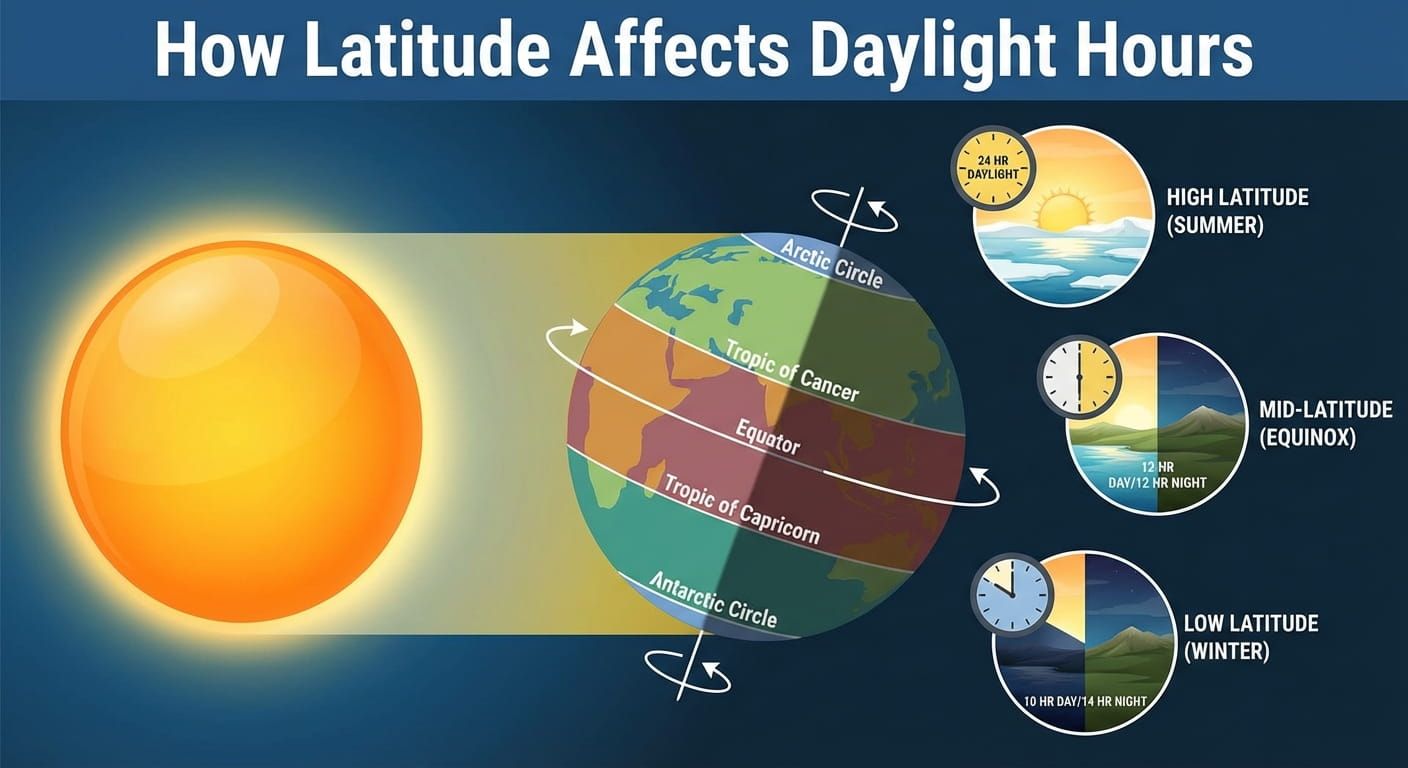
How Latitude Affects Daylight Hours
Step off a plane in Stockholm in June and your watch keeps ticking long after your brain expects night. Fly to Nairobi and the day feels steadier, ...
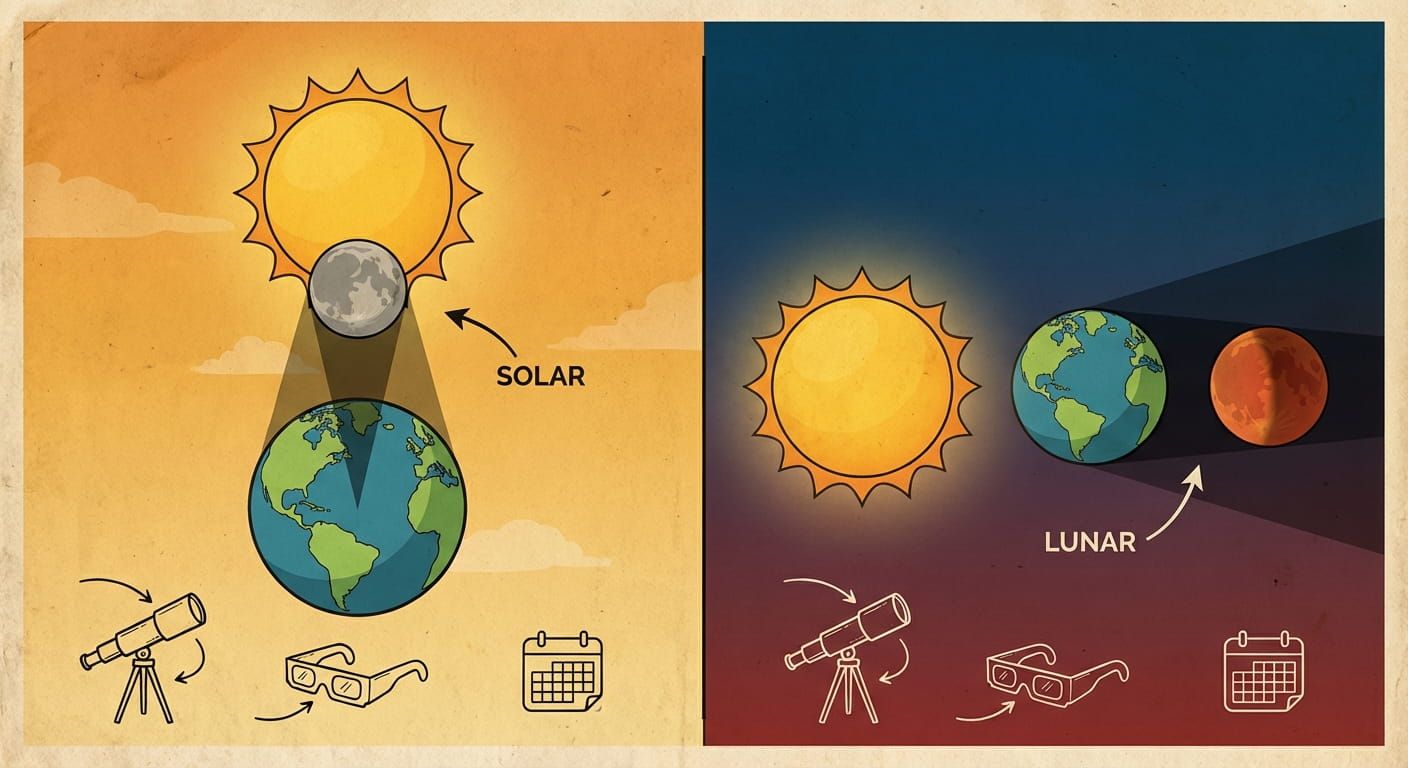
Solar and Lunar Eclipse Guide
Some days, the sky puts on a show that changes how you feel about time. The light shifts. Shadows look sharper. Birds behave oddly. For a few minut...
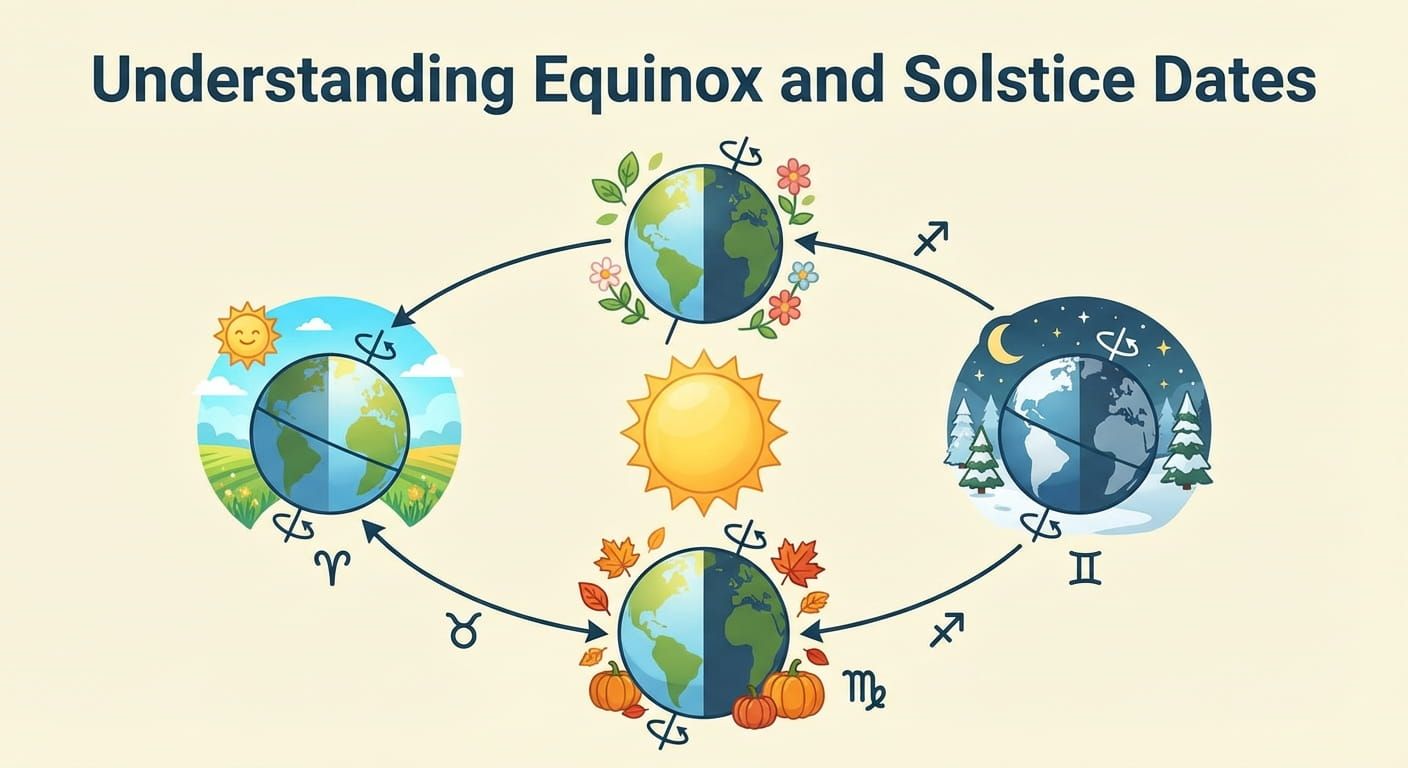
Understanding Equinox and Solstice Dates
The Sun keeps a steadier schedule than we do, yet the calendar dates for equinoxes and solstices still shift from year to year. One year the June s...
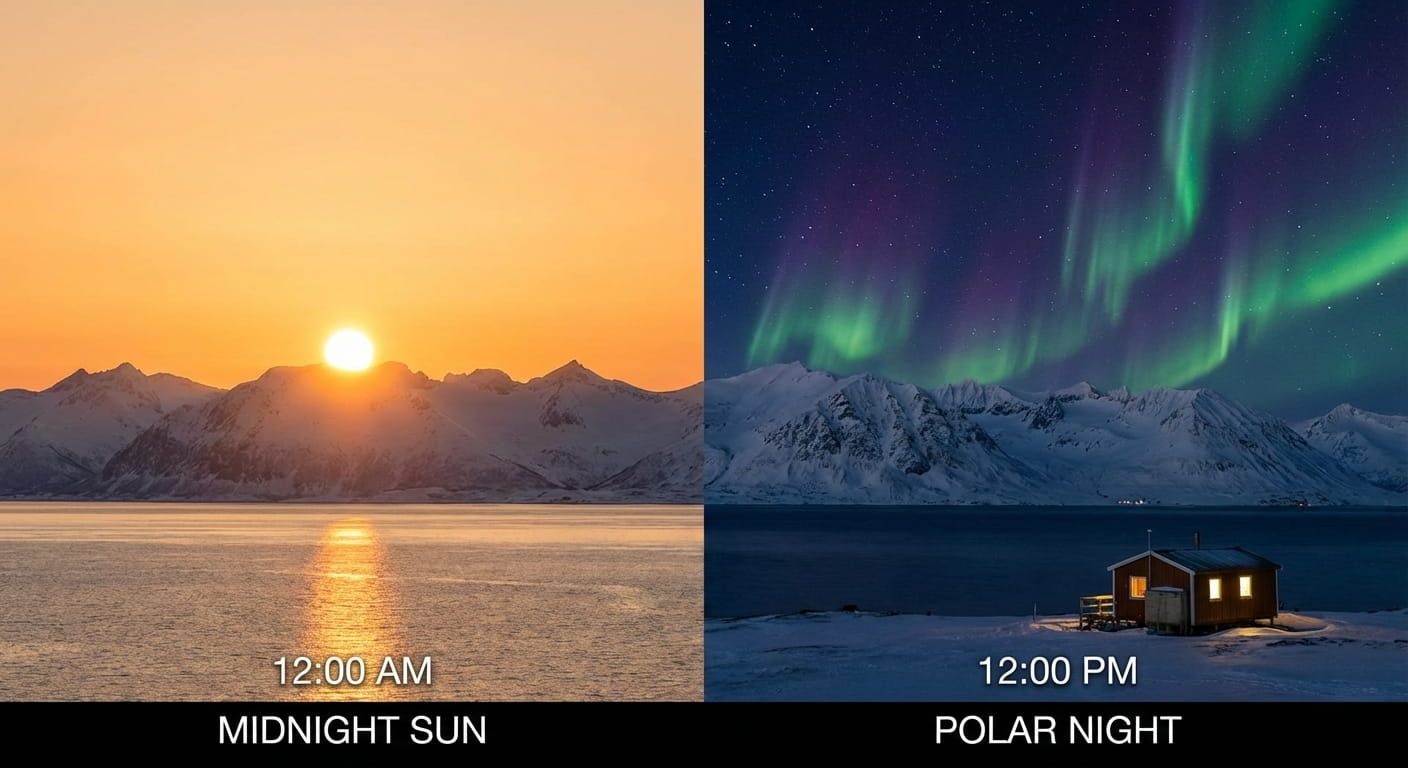
Midnight Sun and Polar Night Phenomenon
The first time you meet a night that never gets dark, your brain keeps checking the sky as if it missed something. Then you realise nothing is miss...
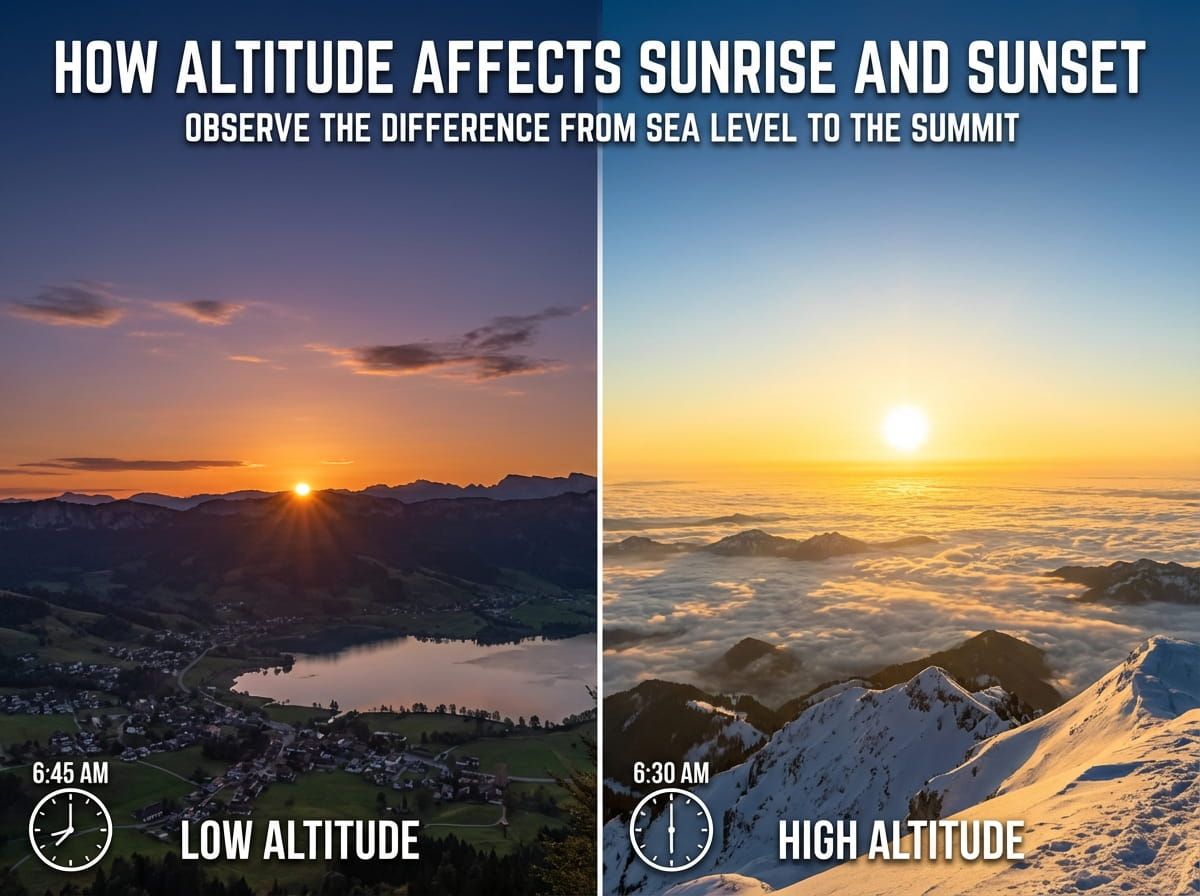
How Altitude Affects Sunrise and Sunset
Stand on a beach at sea level and watch the Sun lift itself over the horizon. Then try the same thing from a mountain ridge. The moment feels diffe...
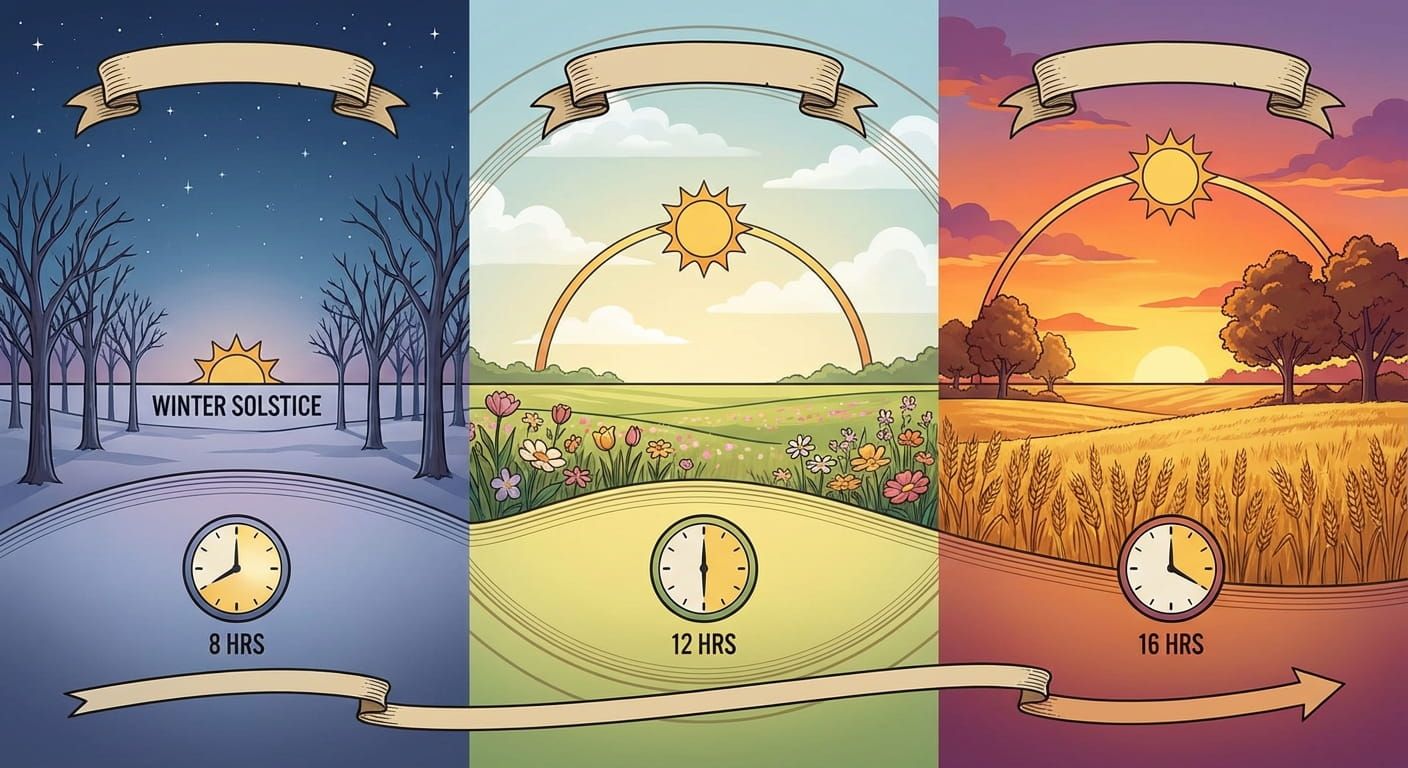
Seasonal Changes in Day Length
Some days feel endless, others vanish before dinner, and it is not your imagination. Day length changes through the year, and the pattern is one of...
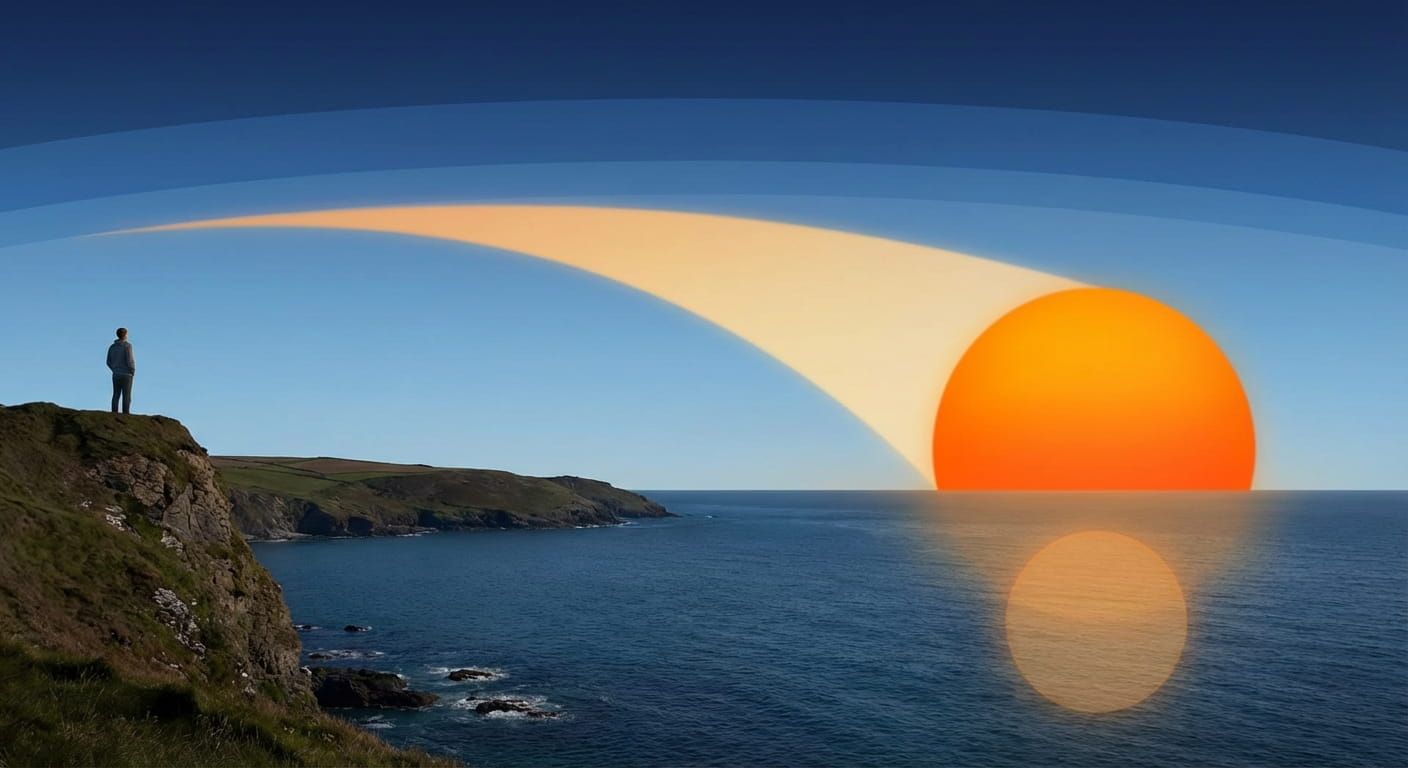
Atmospheric Refraction and Sunset Times
You line up the perfect sunset shot, the clock hits the listed time, and the Sun is still hanging on the horizon. Or it slips away a little ea...